The owner of a high-rise multifamily residential building in Battery Park, Manhattan, faced a pressing infrastructure decision: replace an aging, gas-fired domestic hot water (DHW) system that could no longer deliver reliable, efficient service to residents. The upgrade needed to prioritize energy savings and meaningfully reduce the carbon footprint — a requirement driven by New York City’s Local Law 97, part of the 2019 Climate Mobilization Act. Buildings over 25,000 square feet that fail to significantly reduce greenhouse gas emissions face a per-ton carbon penalty.
Retrofitting a Manhattan high-rise with commercial heat pump water heating technology is no simple feat. Space constraints within the building and rooftop mechanical room along with the difficulty of rigging large equipment into an existing building presented serious obstacles. Hiring a crane for this project was cost prohibitive.
An innovative installation approach
Using the building’s general exhaust air for the heat pump’s air supply was the result of some creative thinking from John Stevens, CEO of Alternative Sustainability, and manufacturers’ representative Wallace Eannace, Inc. That air supply was ducted into the unused space in the penthouse mechanical room. Once the approach was established, finding the right piece of equipment was key.
Ultimately, Lochinvar’s Veritus air source heat pump water heater was selected for a few key reasons:
• Its compact size enabled it to fit in the freight elevator and be rigged up the narrow stairs leading to the penthouse mechanical room.
• The selected Veritus model matched the base load of the zone, and its source airflow closely matched the available building exhaust airflow.
• The Veritus uses R-513A refrigerant, which is non-toxic and non-flammable, making it safe for indoor installation.
• The Veritus has a double wall heat exchanger that allows for direct heating of the potable water; eliminating the need for glycol.
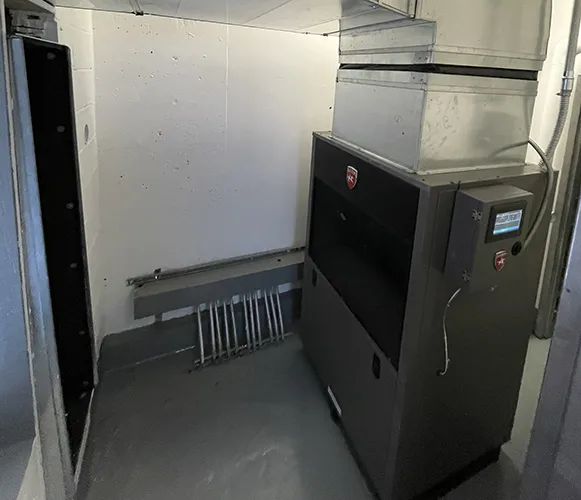
The Veritus was placed in a previously unused section of the mechanical room, which was converted into a dedicated plenum room. A wall, ductwork and louvers were installed, and three nearby exhaust fans were ducted into this plenum room, positively pressurizing the space.
When the Veritus unit operates, building exhaust air provides 100% of the air supply. Any excess air exits freely through an outside air louver, which always remains open. The unit’s discharge air is ducted to the exterior to prevent recirculation.
By reclaiming heat from the building’s exhaust air, the Veritus unit operates with maximum efficiency. Stevens worked with building management to confirm existing fan airflow, determine electrical modifications and provide the necessary ductwork.
System performance
The building had existing domestic water storage tanks that the Veritus heat pump feeds to supply DHW. Three new Lochinvar electric water heaters were added as backup capacity for periods of peak demand.
The water flows from the storage tanks into the electric water heaters. When the heat pump is meeting the demand, the electric water heaters remain off or in stand-by mode and act as additional storage. If the temperature in the system drops below set point, the stand-by electric water heaters energize to satisfy the requirement.
Addressing NYC’s unique challenges
Electricity costs in New York City run approximately 50% above the U.S. average — one of the highest rates in the nation. In this environment, a heat pump’s coefficient of performance (COP) is a critical economic metric.
The Veritus HPWH’s COP of up to 4.61 means it delivers up to 4.61 units of heat energy for every unit of electrical energy consumed — making decarbonization financially viable even at NYC electricity rates.
Despite the particularly harsh winter conditions New York City experiences, the unit performs exceptionally well. During the last week of January 2026, with exterior temperatures reaching as low as 9 F (-12.7 C), the temperature inside the heat pump room remained at 65 F (18 C) — a testament to the effectiveness of the building energy recovery / plenum room design.
“The Veritus meets the base load of the DHW. In typical day-to-day operations, the backup electric water heaters rarely turn on — that’s how well the Veritus unit has been performing,” according to Stevens. “We have yet to find another unit that operates as efficiently while simultaneously offering incredible installation benefits.”
Rhea-Anne Pendley is the senior product manager for commercial water heating at Lochinvar LLC, responsible for both gas and electric, including heat pump water heaters for commercial application. She has been with the company since 2023.
Bob Barrett is the director of the building systems group for Wallace Eannace with 25 years of experience in the HVAC and plumbing industry. He uses his engineering and equipment application understanding to ensure the right equipment is utilized, in the right way, to eliminate problems by design.