
Speaking recently at the graduation ceremony at Carnegie Mellon University in Pittsburgh, Nvidia CEO Jensen Huang told graduates that their talents would be in high demand as American technology companies continue the rapid buildout of data centers, semiconductor manufacturing and other projects related to the explosive growth of artificial intelligence.
Perhaps more surprising to those in attendance at that pre-eminent science and engineering university, Huang said the biggest workforce need would be electricians, plumbers and HVAC techs — all fields where huge shortages exist as employers struggle to find enough skilled trades workers to fill the most in-demand construction and manufacturing roles.
Likewise, OpenAI, another tech giant behind ChatGPT, has said it could use 20% of the country’s electricians, plumbers and HVAC technicians just to complete the company’s infrastructure projects over the next five years.
Familiar refrain
This has become a familiar refrain, as Americans are finally beginning to realize that the “college for all” mentality that dominated the nation’s collective mindset for decades has led to the current paradox in higher education, where record numbers of college graduates are unable to find jobs in their chosen fields of study while record numbers of employers are unable to find qualified workers to fill open positions.
The statistics are dire. According to workforce development research firm Lightcast, there are 2.9 million vacancies advertised each year across all skilled trades. To put that in perspective, the cumulative total of all education and training for those skills across America each year produces about 1.25 million workers, leaving an annual gap of approximately 1.7 million workers.
The gap is only going to continue to widen, as the International Energy Agency predicts demand for American energy will grow over the next five years at double the rate that occurred over the past decade. To compound the problem of the workforce shortage, our nation’s population is aging rapidly, as the number of Americans over age 65 increases by 3% each year while the percentage of those under 18 decreases by 0.2%.
Sources for next generation
So, with so much demand and so little supply, where are all the workers going to come from?
We need all hands on deck to solve this problem. Apprenticeships and other on-the-job training opportunities are a growing piece of the workforce pipeline, as increased federal resources have been directed to those initiatives. High schools across the country are beginning to revive vocational education programs — not in the mold of the old shop classes that many of us remember from our youth, but as newly built, state-of-the-art training centers.
In White Plains, New York, school district officials approved a plan to clear 75 acres and build a new training facility to accommodate students interested in the skilled trades. In Massachusetts, the statewide waiting list for high school vocational education programs runs in the thousands, while at Father Judge High School in Philadelphia, all 25 students in the school’s welding program had job offers at graduation paying at least $50,000 per year.
Community colleges have similarly upped their game, as increased attention to workforce issues has expanded the flow of funding to public institutions, allowing them to grow their skilled trades programs and better align coursework to labor market demand.
Rising to the challenge
At Career Education Colleges and Universities, we are also rising to the challenge. As the national association representing private postsecondary trade schools and career colleges, CECU serves students at more than 900 campuses across America. Our schools often serve nontraditional students who need greater flexibility in their classes due to family, work or other logistical constraints.
For many of our students, education and training in the trades follows other experiences along life’s winding path, offering them a second chance to pursue a career in a high-demand profession paying reliable, family-sustaining wages. These programs include fast-growing skilled trades such as high-wire electrical lineman, underwater construction divers and everything in between.
As America rebuilds crumbling infrastructure, restores domestic manufacturing, modernizes the electrical grid, builds thousands of new data centers and expands its nuclear and shipbuilding capacities, CECU’s member trade schools are an integral part of the workforce ecosystem.
Our schools often form innovative partnerships with employers in high-demand fields to ensure curricula and coursework align with industry needs and put students on a pathway to success. Private trade schools and career colleges are an integral part of the workforce development pipeline, and we are proud to support students from across the country who have a dream of entering the skilled trades.
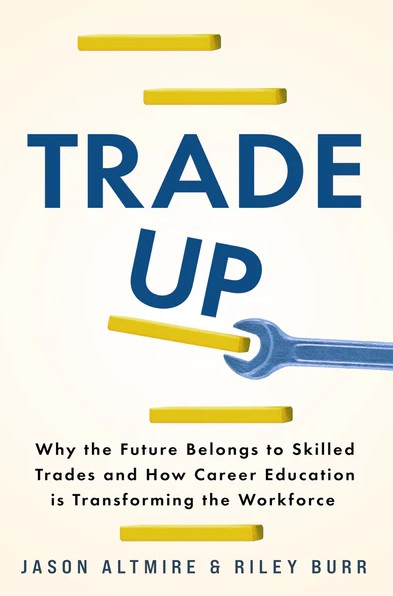
In our new book, “Trade Up: Why the Future Belongs to Skilled Trades and How Career Education Is Transforming the Workforce,” we explore the causes and consequences of the skills gap and offer innovative solutions to the workforce shortages plaguing employers. Please take a look and let us know what you think. Let’s keep the conversation going as we work together to solve one of the most important issues facing America today.
Jason Altmire is president and CEO of Career Education Colleges and Universities and a former three-term U.S. congressman. His new book, co-authored with Riley Burr, is available on Amazon, Barnes & Noble, Walmart or wherever books are sold. You can order directly at: https://tradeupbook.com