Within the first minute, I knew something was wrong. It wasn’t anything I could smell, hear or see; it was something I felt. After nearly 40 years working in boiler rooms, I’ve come to trust what I call my “Spidey Sense.” Small droplets of water covered the piping, boiler and electrical panels. The room felt unusually hot and humid. Then, without warning, the boiler’s pop safety valve lifted. In seconds, the room filled with dense steam. I couldn’t see my hand in front of my face. I felt my way to the exit door like a blind ninja, steam pouring out behind me and tripping the hallway smoke detector.
That moment drove home a critical lesson: pop safety valves on steam boilers behave very differently from hydronic relief valves. They don’t open gradually; they snap open fully and fast. It was not the start to the day I had envisioned.
The first five minutes in a boiler room are the most important. Using your senses, you can quickly assess whether the space is safe or if you should turn around and leave immediately.
The first thing I do is to make a mental image of the escape route to the exit doors in case something goes wrong. As I said previously, a room filled with steam has no visibility. Worse, steam displaces air, reducing your ability to think clearly. What’s in your path to safety? I’ll bet there are piping, boxes or ducts between the boiler and the exit door.
Using a personal carbon monoxide detector or your combustion analyzer, calibrated outside, could detect and alert you to elevated carbon monoxide levels in the room.
Most serious boiler issues give warning signs long before catastrophe strikes. Your senses are your first and best safety system. If you pay attention in those initial moments, you can prevent accidents or costly mechanical failures.
What do you see?
Start with the big picture: Is the lighting adequate for safe work? How’s the housekeeping? Is the floor clean and dry, or covered in water and debris? Chaos in a boiler room usually signals neglected maintenance. Improper maintenance is the No. 1 cause of boiler accidents.
In the case mentioned, both boiler pressure controls were mounted on a single pigtail that was plugged. The boiler ran wild until the pop safety valve opened. In my opinion, each pressure control should be on its own pigtail or siphon.
Excess rust under the draft diverter could mean a leak, back-drafting or flue gases condensing due to under-firing.
Sagging steam pipe allows condensate to pool. This causes the steam to condense rapidly, creating condensate-induced water hammer. It can generate more than 1,500 pounds of pressure, blowing apart fittings.
Water on the floor could indicate a boiler/pipe leak or a relief valve opening. Makeup water introduces oxygen and hardness, lowering the life of the boiler.
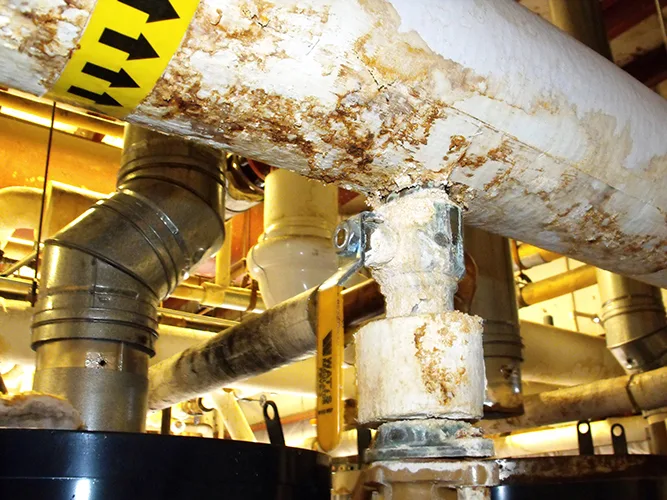
Wet pipe insulation could suggest a leak under it. Find the cause of the leaks and fix it as soon as possible. Sixty percent of all pipe leaks happen under insulation, and they always seem to fail on Friday afternoons around 3 p.m.
The boiler pressure gauge should be checked to verify whether it’s not too high on a steam boiler or too low on a hydronic boiler. Most comfort-heating steam boilers should operate at around 2 psi. The hydronic boiler pressure should be about 12 psi for a two-story building, higher for a taller building.
On a steam boiler, verify that water is present by looking at the gauge glass. A pencil held behind the gauge glass can tell you if it’s flooded or empty. A flooded gauge glass makes the pencil appear broken. An empty gauge glass shows the pencil is intact.
Also, pay attention to what’s stored in the boiler room.
Gasoline, propane or solvents should never be in a boiler room. Their vapors are heavier than air and can be drawn into the burner, turning the room into a fireball.
While not flammable, chlorine is an oxidizer that will make the fire burn hotter, faster and more violently. It accelerates corrosion on metal surfaces inside the boiler.
Check combustion air openings. Are they blocked? Closed off? Covered with debris? The burner will try to get its needed air and could pull it through the domestic water heater flue pipe.
Flue gas pipe with rust or water marks could indicate dangerous flue gases escaping
Is the relief valve piping restricted or plugged? The relief valve should have no shutoff valve on the inlet or outlet. The discharge pipe should be the same size as the relief valve outlet.
Wires hanging out of an electrical box scare me. Did the careless person who left the cover off jumper any safety controls?
Black streaks on the jacket? That’s soot, which is flammable. It also signals improper combustion and elevated carbon monoxide levels.
Boiler jacket discoloration? That could indicate flue gases aren’t flowing correctly through the boiler flue passages. When flue gases change direction or spill, carbon monoxide production surges.
What do you hear?
When the burner starts, listen carefully. It should start with a smooth woosh. If it starts with a bang or boom, these are red flags meaning delayed ignition.
A ticking sound might indicate scale forming on the water side. Scale can reduce the efficiency or lifespan of a boiler.
Banging pipe? That’s water hammer and not normal. It’s the first warning sign that something needs attention.
Hissing could indicate steam leaks or a gas leak.
Other sounds to pay attention to:
A gravel-like noise from pumps (cavitation);
Squealing belts;
Rapid clicking relays;
Gas train chattering;
A burner that short cycles.
What do you smell?
Your nose might be your most powerful diagnostic tool.
A strong gas odor is obvious. Mercaptan is added to gas to ensure leaks are noticed, but many hazards are subtle.
Burning electrical components have a sharp, distinct smell.
Improperly adjusted flue gases will burn your nose and could cause your eyes to water.
Flue gas condensation produces an acidic odor, often a sign of corrosion inside the system.
Musty air can indicate poor combustion air supply.
And then there are smells that don’t originate in the boiler room but end up there anyway: paint thinners, cleaning chemicals and industrial adhesives.
Sometimes the most dangerous situations don’t announce themselves loudly; they whisper. You just have to listen.