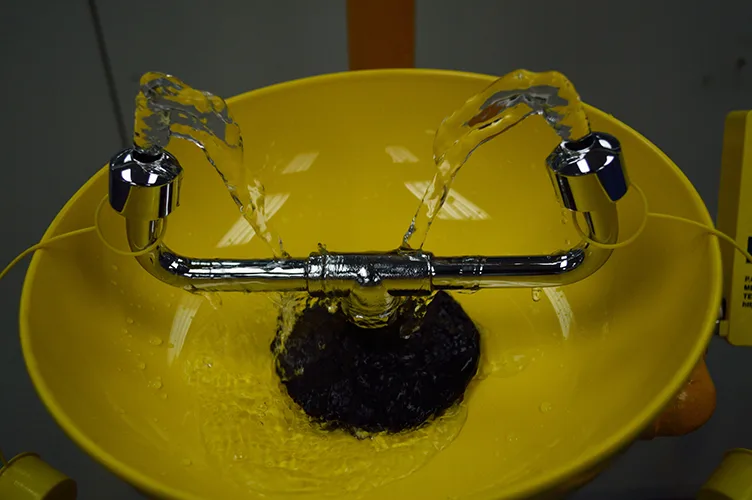
In hospitals and outpatient facilities, the Facility Guidelines Institute (FGI) is the standard basis for patient care and staff safety requirements for engineering and architectural firms to follow. Designing these complex facilities requires compliance with overlapping regulatory standards. Among these, the FGI provides the foundational framework for healthcare.
When architects define utility areas where hazardous chemicals, bodily fluids or cleaning agents are handled, a common risk-compliance challenge is the proper placement of emergency eyewash stations. Integrating an emergency eyewash station at a handwashing or utility sink is a popular strategy to save space, which many of us have done over the years.
Now, it requires a precise understanding of the 2021/2022 FGI Guidelines (FGI updates on a four-year cycle, with the 2026 edition now serving as a code) alongside the strict mandates of ANSI/ISEA Z358.1 (2020), Emergency Eyewash & Shower Standard. The 2026 code has yet to be adopted by local or state governing bodies.
Understanding the FGI guidelines framework
The FGI publishes the Guidelines for Design and Construction of Hospitals, Outpatient Facilities, and Residential Care Facilities. FGI codes do not dictate the exact mechanical engineering specifications of an eyewash nozzle; instead, FGI focuses heavily on infection control, clinical workflows, clearances and the prevention of cross-contamination.
FGI guidelines mandate that any facility handling corrosive or injurious materials must provide immediate access to emergency drenching equipment. Because FGI serves as an administrative design standard, it formally adopts, by reference, the criteria of OSHA (29 CFR 1910.151(c), Medical Services and First Aid) and ANSI/ISEA Z358.1.
Consequently, an eyewash station installed at a healthcare sink must meet both FGI’s strict plumbing sanitation rules and ANSI’s rigorous mechanical performance requirements.
The sink-mounted strategy
• Footprint optimization. This uses the plumbing infrastructure and drainage, thereby eliminating the need for dedicated floor space or standalone wall-mounted units. Drench hoses have also been considered alongside a sink location.
• Proximity to hazards. Sinks typically are placed near chemical use zones, clean-up counters and laboratory benches.
However, mixing emergency infrastructure with daily-use handwashing or utility sinks introduces significant design risks regarding infection control and accessibility. Distance of travel also comes into play if you bring in The Joint Commission (EC.02.02.01, Hazardous Materials and Waste Risk Management) or Centers for Medicare & Medicaid Services requirements.
1. Hands-free, instant operation
When following ANSI Z358.1, an eyewash unit must activate within one second or less with a single, intuitive motion (such as pushing a paddle or pulling a lever). Once turned on, the valve must remain open permanently without the user needing to hold it.
Standard screw-on faucet diverters that require the user to first turn on the hot and cold faucets and then pull a small pin do not comply. In an emergency, an injured worker cannot calibrate faucet knobs. A code-compliant, sink-mounted unit must feature an independent actuator that bypasses the manual faucet valves to deliver immediate water.
2. The tepid water mandate and anti-scald protection
Both OSHA and ANSI mandate that the flushing fluid must be tepid, explicitly defined as a temperature between 60 F and 100 F.
A potential risk: If an eyewash is hooked directly to a standard sink faucet line, a staff member washing medical instruments with hot water could leave the line piping hot. If an eye injury occurs seconds later, the eyewash could discharge scalding water into the victim’s eyes.
The solution: To meet code, the eyewash mechanism must be supplied via a dedicated thermostatic mixing valve or an integrated mechanical anti-scald bypass valve. This ensures that even if the sink faucet is running hot water, the emergency eyewash line instantly delivers safe, tempered water. You may not be required to provide a mixing valve if the cold water is within the tepid range.
3. FGI infection control and cross-contamination restrictions
FGI codes are highly protective of the handwashing environment to prevent healthcare-associated infections. FGI strictly prohibits emergency eyewash components from interfering with the sanitary parameters of a clinical handwash sink.
• Aerators. FGI guidelines generally prohibit the use of traditional faucet aerators in high-risk areas because they trap stagnant water and promote the growth of Legionella or Pseudomonas biofilms. Eyewash nozzles must feature smooth-bore designs or self-draining configurations.
• The splash zone. Eyewash outlets must be protected from dirty splash water originating from the sink basin. Code-compliant sink eyewashes feature spring-loaded dust caps over the spray heads. These caps shield the nozzles from daily sink contaminants but pop off automatically under the pressure of the incoming water flow when activated.
This aspect of caps popping off or flipping open is still not considered enough to make the eyewash compliant when mounted on or in a sink.
Critical dimensions and spatial placement rules
When placing an eyewash station at a sink, architects must ensure the physical layout accommodates a disabled or injured worker while maintaining appropriate structural clearances.
1. Nozzle elevation. The fluid spray heads must be positioned between 33 and 53 inches above the finished floor surface.
2. Wall clearance. The center of the eyewash spray pattern must sit at least 6 inches away from the nearest wall, backsplash or adjacent equipment obstruction to prevent the user from striking their head while bending over the stream.
3. Americans with Disabilities Act synergy. If the sink serves as an accessible handwashing station, the sink rim cannot exceed 34 inches above the floor. The under-sink plumbing must be shielded to prevent a wheelchair user from being burned, and the eyewash actuator must remain within an accessible forward-reach zone.
The system must deliver a simultaneous, symmetric flow of potable water to both eyes at a minimum flow rate of 0.4 gallons/minute (gpm) for a continuous duration of 15 minutes. The velocity must be low enough to guarantee it will not cause damage to a fragile ocular surface.
The 10-second physical travel rule
No matter how perfectly engineered a sink-mounted eyewash is, its installation is entirely invalid if it fails the proximity test. FGI and ANSI stipulate that the eyewash must be located within 10 seconds of walking travel distance from the hazard.
1. In a standard layout, 10 seconds translates to roughly 55 feet of unobstructed walking distance.
2. The path of travel must be completely level and free of physical barriers (no steps, stairs or clutter).
3. An injured person cannot pass through more than one door, and that door must swing in the direction of emergency travel without requiring keys, fobs or security access turnstiles.
Inspection and maintenance requirements
1. Sink-mounted eyewash stations must be activated weekly for a brief period (three to five minutes) to clear out sediment, flush away bacterial biofilms and verify operational pressure.
2. An annual comprehensive, documented inspection must occur to ensure the mixing valve maintains the proper tepid temperature and the flow rate remains at or above 0.4 gpm over a prolonged test cycle, if and when a mixing valve is used.
Questions to resolve early in design
Integrating an emergency eyewash station at a sink within the boundaries of the 2021/2022 FGI Guidelines requires careful alignment with ANSI Z358.1 performance parameters. By selecting units with independent single-motion actuators, dedicated thermostatic mixing valves and protective self-draining dust caps, facility managers can protect their clinical space while upholding rigorous health, safety and infection control standards.
Some facility risk management personnel are informing engineers and architects that placing an eyewash on a sink or even a swing-down or away eyewash does not comply. As previously noted, the cross-contamination function has become something new to be aware of. Infection control personnel are saying that placing an eyewash in a sink or on it violates this restriction.
Be prepared to ask questions about this issue early on to avoid late changes to a project.
The risk: Emergency eyewash stations represent “dead legs” in building plumbing networks where stagnant water rests. These systems are highly susceptible to the growth of Legionella, Pseudomonas and other waterborne biofilms. When an eyewash is activated or tested, it generates aerosols that can spread these deadly pathogens through the air to high-risk patients.
Integrating emergency eyewash stations into healthcare sinks to save space poses challenges under FGI guidelines due to potential cross-contamination and the risk of infection from stagnant water (dead legs) in the plumbing.
While technically allowed under ANSI Z358.1 if equipped with proper tepid water thermostatic mixing valves, independent actuators and sanitary covers, infection control specialists are increasingly rejecting sink-mounted units due to Legionella/Pseudomonas risks.