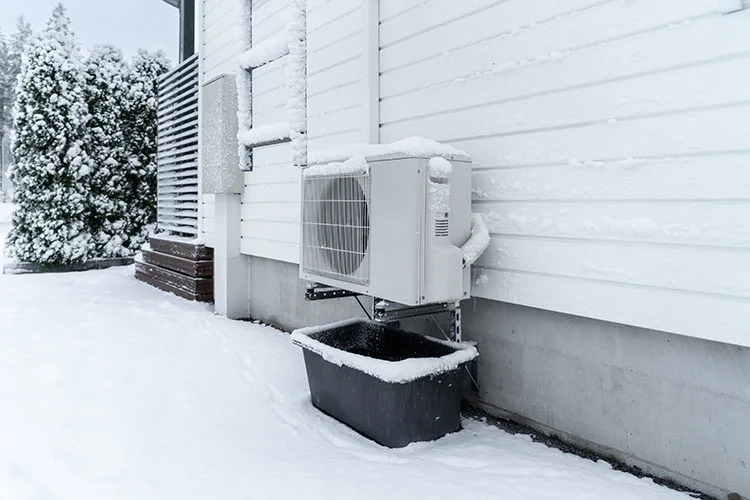
Heat pumps, for all their recent attention-grabbing headlines, are old news. Rudimentary heat pumps can traced back to the 1850s when Lord Kelvin described a concept he called a “heat multiplier” because of its ability to move heat from one place to another more efficiently than simply generating it from scratch.
Leap to the late-1940s, and General Electric and other manufacturers began producing and marketing heat pumps commercially, as they started appearing more widely in American homes, particularly in the Southeast, where the milder temperatures made them cost-effective.
But a combination of rising energy prices, tightening government efficiency standards, consumer demand for carbon-cutting products and dramatic advances in cold-climate performance have all put this old-timer back in the spotlight again.
What was once a niche alternative is now at the center of the heating and cooling industry’s future thanks to variable-speed compressors, inverter technology and cold-climate performance breakthroughs.
At the 2026 AHR Expo held last February in Las Vegas industry leaders from four manufacturers gathered to debate heat pump technology, economics and training challenges shaping the next phase of that adoption — and one concept kept rising to the top: dual fuel.
Those were among the central themes from a panel discussion entitled, “Heat Pumps: Scaling for Commercial and Residential Markets.” Moderated by Greg Walker, CEO of the Association of Smarter Homes and Buildings, the panel was comprised of Josh Coaten, vice president and general manager for the York channel at Bosch; Chris Day, vice president of product strategy, marketing and training at Rheem Manufacturing Co.; Heidi Gehring, managing director of light commercial solutions at Carrier; and Zack Chapin, senior director of R&D for residential air conditioning at Midea America’s Research Center.
Single-stage to inverter
Coaten opened the discussion by tracing heat pump technology from the 1970s — single-stage systems with rudimentary controls — through the two-speed compressors of the 1980s and 1990s, and finally to today’s sophisticated inverter-driven platforms.
“Technology has kind of caught up,” he said, “and there’s a lot more to come.”
No concept generated more agreement among the panelists than dual fuel.
Drawing on an analogy that went far beyond the HVAC industry, Day compared dual fuel heat pump systems to hybrid vehicles.
“A couple of decades ago,” Day explained, “we didn’t go from gas cars straight into full electric.”
Rather, consumers first started driving hybrid vehicles, which still remain a popular option in the automotive market.
“That allowed those of us who wanted to drive something more sustainable like an electric vehicle to have that backup of gas should you need it,” Day added.
The heat pump, in this frame of reference, is not an all-or-nothing proposition. Instead, it can be a flexible system that meets homeowners and building owners exactly where their comfort level allows.
Day went on to cite a statistic regarding homeowners wary of abandoning gas entirely: Independent studies have consistently shown that a dual fuel residential system reduces gas consumption by approximately 90 percent.
“If sustainability, gas reduction and a switch to electrification is really what that homeowner or municipality wants,” Day explained, “a 90% reduction with a no-regrets move with a dual fuel system is really how I would talk about it.”
Dual fuel bridge
Coaten built directly on Day’s argument from the contractor’s point of view. When a technician walks into a home that already has a gas furnace, the dual fuel upgrade is, in his words, simply an easier sell. The existing infrastructure remains. The electrical load change is minimal. And crucially, the psychological barrier — the fear of taking out the furnace entirely and going all-electric — is avoided altogether.
“You’re getting past the mindset of what it used to be, where I’m going to pull the furnace out and I’m going to go fully electric,” Coaten explained. “You don’t have to change everything.”
Coaten also highlighted how dramatically controls technology has simplified dual fuel installations over the past decade. Setup that once required considerable expertise and time has become streamlined — and will become more so in the future.
Combined with available rebates and incentive programs that effectively neutralize the cost of adding a heat pump to an existing gas system, Coaten argued that the economic and practical case for dual fuel has rarely been clearer.
“The extra cost for a heat pump to add to dual fuel is negligible now when they have the incentives,” he said.
Midea’s Chapin offered a candid observation about where industry thinking has shifted: “One or two years ago, most of the efficiency hawks were still full electrification — and that was the whole conversation. And now with dual fuel it’s, ‘Hey, let’s take that first step. Let’s work through dual fuel.’”
He added that contractors need the full menu of options when they sit at the kitchen table. The right solution depends on local utility pricing, grid infrastructure and the homeowner’s own priorities.
“Consumers are not going to replace comfort for savings,” Chapin explained.
Climate check
Gehring reinforced the dual fuel argument when it comes to the use of heat pump in cold climates.
She described last winter’s weeks of extreme cold — with wind chills at her parent’s Madison, Wisconsin home reaching negative 38 degrees — a reminder of why backup heating systems matter. She outlined the current capacity gap: residential heat pumps typically reach about 60,000 BTUs of heating output, while a traditional furnace can deliver 150,000 BTUs or more.
Until that engineering gap is fully closed, dual fuel offers a pragmatic bridge, particularly in Northern markets where extreme cold remains a fact of life.
According to Gehring, in those conditions, the gas furnace component of a dual fuel system is not a compromise — it is exactly the right engineering response. Carrier’s commercial rooftop units are already designed to run on electric heating, gas heating, or both simultaneously, adjustable based on real-time utility rates and grid infrastructure.
The cold-climate question came up repeatedly through the panel discussion. Coaten acknowledged that the biggest objection by far for selecting a heat pump is the fear of being left without heat during the worst winter weather.
But he also added that fear is increasingly unfounded. He spoke of a friend in upstate New York who ran a cold-climate heat pump through a stretch of negative 10-degree temperatures without losing a degree of indoor comfort.
“He was not down one bit,” Coaten said. “We have products that can fit those needs.”
Day brought Maine data into the cold-climate discussion as both evidence and encouragement.
The Efficiency Maine Trust, better known as simply Efficiency Maine, is an independent, quasi-state agency that administers energy efficiency and electrification programs across that state. Thanks to rebates, Efficiency Maine says that more than 27,000 heat pumps were installed in the state between July 2020 and June 2021 and financial incentives have been the main reason that Maine had installed 100,000 heat pumps by 2023, two years before its goal.
“It doesn’t get much colder than Maine on a year-round basis,” Day added. “And they’ve made it work.”
Callbacks have been low and homeowner satisfaction strong. Crucially, Day noted that much of Maine’s success was achieved without the dual fuel backup that most northern conversations assume is necessary — suggesting that the ceiling for pure heat pump performance in cold regions is higher than the industry’s current default assumptions.
Meanwhile, Day argued that the commercial sector — while lagging residential in adoption pace — may face a smaller psychological barrier than many assume. Because commercial buildings aren’t heated through ducted systems in the same way single-family homes are, occupants are less likely to notice — or object to — differences in supply air temperature.
The building simply needs to be heated to an acceptable level, Day added, and modern heat pump technology can deliver that reliably.
Coaten shared this optimism for the commercial markets, noting that dual fuel and water-to-air heat pump configurations are already entering spaces historically dominated by boilers. He suggested that the product range available to commercial contractors has expanded dramatically.
“Probably 70% of the product in our booth today is heat pump application,” Coaten said. “Heat pumps are here to stay and are growing.”
Contractor confidence
Not surprisingly, throughout the hour-long discussion, every panelist saw the contractor as the linchpin for keeping momentum on the side of heat pump installations.
Day described Rheem’s investment in innovation learning centers across the United States as well as in-field training programs designed to equip professional installers to answer technical questions with authority.
“We don’t expect anyone to sit at the kitchen table with a homeowner who isn’t absolutely confident,” he said.
Gehring stressed the industry needs standardized cold-climate heat pump criteria including uniform test procedures so that contractors and building owners can speak a common language about performance at low temperatures — something the industry has historically lacked.
What does it mean, she asked, when you’re at 100% capacity at 5 degrees? What’s a coefficient of performance? What does control verification coefficient even mean?
“Without industry-wide definitions,” Gehring explained, “the ‘cold climate heat pump’ label means different things from different manufacturers, creating confusion at precisely the moment when clarity is most needed. As those standards solidify, contractors will be able to speak with precision about coefficient of performance at specific low temperatures, transforming what was once a technical black box into a credible, comparable metric.”