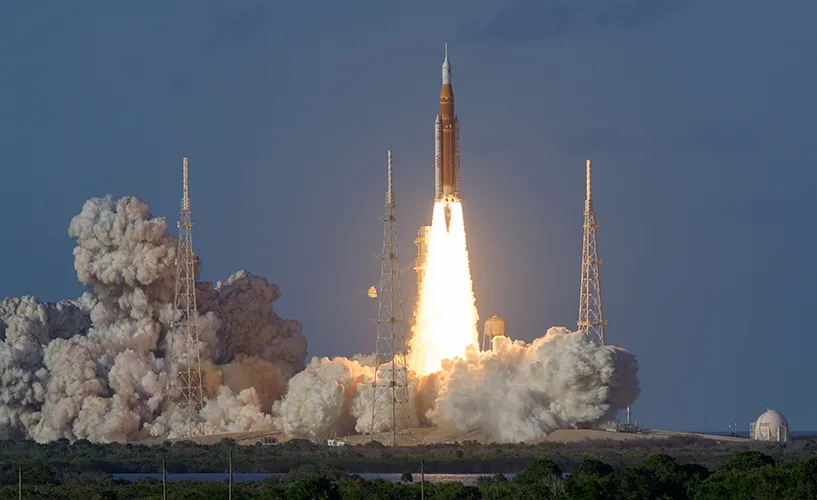
With the return of NASA’s Artemis II and the many successes of SpaceX, the public talks about space as if it’s going to be owned by rocket companies, tech CEOs and venture capitalists. While it is certainly part of the story, it misses a particularly important layer, the one determining whether humans can stay anywhere beyond Earth for more than a brief visit: physical and reliable infrastructure built on systems that must perform every single time without exception.
The moment we move from exploration to habitation, even in the early stages, the conversation shifts quickly, and it becomes less about how we get there and more about how we function once we arrive. Before there are dormitories, research stations or long-term missions, systems must first exist to provide power distribution, thermal management, water recovery, waste processing, pressure control, redundancy planning and maintenance strategies that account for failure before it happens.
Those are not abstract problems; they are the same real-world challenges the trades solve every day, only under conditions that push everything we know to a new level.
The difference this time is not the work itself, but where it begins. The first generation of that work will not be performed by people physically standing on another surface; it will be performed here on Earth, through a combination of robotics, remote operations and human expertise guiding systems in environments where precision matters more than ever.
The first jobsite is 238,900 miles away
Organizations such as NASA and SpaceX are already investing in robotic construction and infrastructure preparation as part of their “Moon to Mars” strategy and Artemis missions, not as a distant concept but as an immediate necessity (https://go.nasa.gov/49fj7iW, https://go.nasa.gov/4t61glL).
Teams at Jet Propulsion Laboratory are actively developing systems that can measure, inspect and help maintain structures in environments via data collection and modeling. This naturally leads to a model in which machines handle physical work first, while people provide intelligence, oversight and decision-making from a distance (https://go.nasa.gov/4d7m9rU).
For the moon, that model allows for near real-time interaction, meaning operators on Earth can guide robotic systems, troubleshoot issues and adapt as conditions change, creating a new kind of jobsite that is not defined by geography. While Mars introduces longer communication delays that require greater autonomy, the role of human expertise does not disappear; it evolves into planning, system design and higher-level control, reinforcing the idea that the trades are not being replaced but expanded into new environments.
One of the most important realizations in this conversation is that we are not bringing buildings with us in the traditional sense; we are bringing expectations of performance because the physics of space, reduced gravity, extreme temperature swings, radiation exposure and non-habitable atmospheres require systems that function differently, even if their purpose remains the same.
NASA has documented, through its work on lunar conditions and deep-space habitation, that these environments demand solutions behaving more like controlled ecosystems than conventional buildings.
This is where plumbing becomes closed-loop water recovery, HVAC becomes life support and thermal regulation, electrical systems become highly resilient networks with layered redundancy, and maintenance becomes a primary design driver rather than an afterthought.
This is exactly why robotics plays such a central role in the early phases, not as a replacement for skilled labor but as a natural extension of it, allowing the most demanding, repetitive and high-risk tasks to be completed efficiently while being guided by professionals who understand how systems operate (https://go.nasa.gov/4d8Bdp7).
These standards align closely with the mindset already present in the trades. From Earth, we can solve problems safely, build for longevity and plan for the realities of the environment rather than the conditions we know.
Built on Earth, deployed anywhere
One of the clearest paths forward for the trades in this space is prefabrication, not as a convenience but as a requirement because no version of off-world construction allows for rework, field fixes or second chances. This means everything has to be built, tested and proven before it ever leaves Earth. This approach to building is similar to how we already handle prefabbed bathroom groups, corridor racks and mechanical skids, only taken to its highest level.
Instead of shipping materials, we start shipping systems: fully assembled utility cores that combine water, waste and energy into a single integrated module. U.S.-factory-built, pressure-tested and ready-to-connect modularly will enhance our scalability for generations.
What makes this even more interesting is that these systems won’t be designed for our measures of efficiency; they will be designed for precision and predictability. When installed by robotic systems that rely on consistency over improvisation, we’ll learn what works best for distribution networks, standardized connections and fully integrated assemblies, reinforcing a simple idea that applies whether on our earthly jobsite or somewhere far beyond.
From deep sea to deep space
Some of the best lessons for building beyond Earth don’t come from space at all; they come from right here on Earth in places we’ve only recently learned how to operate in. Consider the deep ocean, where pressure, isolation and system reliability mirror many of the same challenges we’ll face off-world.
Submerged data centers with liquid-cooled technologies, such as those tested by Microsoft, are likely to be deployed at scale. This technology proves, through deployment, that fully sealed, prefabricated, connected infrastructure can operate extremely efficiently when you let the elements do the work.
The reason they work so well is straightforward from a plumber’s perspective: water is one of the most effective heat sinks we have, thus allowing these systems to reject and reuse heat energy far more efficiently. While sealed, controlled design reduces corrosion and contamination, it more importantly creates a stable operating environment that improves reliability and lowers consumption.
Similarly, when you go to space, instead of “relying on fresh water for cooling through evaporation towers, as many Earth-based data centers do, Starcloud’s space-based data centers can use the vacuum of deep space as an infinite heat sink,” notes Starcloud, a member of the NVIDIA Inception program for startups (https://bit.ly/4sVWSFJ). Now, that draws parallels to the powers of the sea.
That’s the real takeaway: Whether it’s deep sea or deep space, we’re learning how to build systems that work with their environments rather than fight them. By using natural conditions such as temperature and pressure as assets, these systems become part of the ecosystem. I’m confident that this mindset will carry the trades into the next phase of sustainable building.
The signal is already here
At the same time, this shift is not limited to government programs, as organizations such as Y Combinator are supporting companies such as NVIDEA’s Starcloud. “The NVIDIA Inception startup projects that space-based data centers will offer 10 [times] lower energy costs and reduce the need for energy consumption on Earth,” according to its website (https://bit.ly/4cV5wyp).
By demonstrating that off-world systems are becoming part of broader conversations around Earth’s energy, data and resiliency needs, we reinforce a simple but powerful truth that applies to all human-built systems. If there is infrastructure, there are systems that must be designed, built and maintained. Those systems require the same core expertise that has always defined the trades and our manufacturing partners.
What becomes clear through this is that the order of development does not change because the location does. Every successful human settlement has followed the same sequence: systems first, everything else second.
The opportunity here is not only to observe these changes but to recognize that the work itself is evolving. It’s changing in a way that expands its reach, by connecting the practical knowledge of building systems with emerging technologies that allow those systems to be deployed, monitored and maintained in entirely new environments. This creates a future where the skills developed on Earth directly contribute to the next phase of human progress.
Making it real
“Plumbers protect the health of the galaxy.” — John A. Mullen
For any of this to move from concept to reality, it must pass through the same gate that everything else does: tested, verified and proven safe for human use. The work being done in plumbing and mechanical research laboratories becomes as important as anything happening in space. If a system can’t meet a standard, it doesn’t matter how innovative it is; it doesn’t get deployed or scaled.
Published standards have always been the clearest archival record of progress in our industry; they show how science evolves, how materials perform and how systems can be trusted. As we begin pushing into environments such as deep sea and deep space, those same principles can be expanded through new testing conditions, benchmarks and methods to demonstrate that products are not only functional but also reliable under extreme conditions or new physics.
This is where the opportunity opens because with major investment groups putting serious capital into the trades, we want to have a deeper conversation. The ask from the trades should be simple: Bring us the next generation of tools, systems and materials, and we will do what we’ve always done — prove them, improve them and make them work.
We’ll do this fairly while recognizing that the knowledge and performance data (intellectual property) tied to our craft have real value, not only in the field but also in shaping the future of how and where we build.