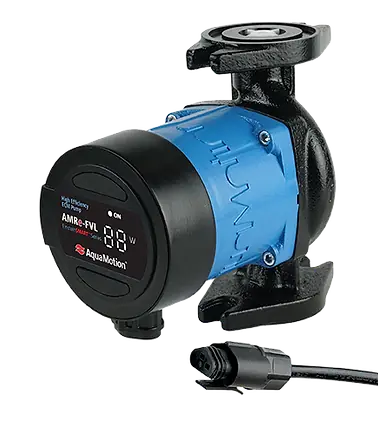
For hydronic contractors, a circulator’s value isn’t only measured by how well it moves water throughout the heating system. Installation time, ease of servicing and the prospect of returning to a job — or rather not returning — to replace a failed component all factor into the product’s overall value.
Those considerations helped convince Shawn Bryant, owner of Local Energy LLC, Gray, Maine, and Bob Laundeau, owner of Loon Pond Plumbing & Heating, Acton, Maine, to use AquaMotion’s AMRe-FVL ECM circulator in their installations.
Between them, Bryant and Laundeau have installed well over 350 of the pumps with a majority of both businesses specializing in hydronic and radiant work.
The AMRe-FVL ECM is part of AquaMotion’s EinsteinSMART series. It is a 120-volt, 45-watt ECM circulator that draws 0.68 amps. According to the manufacturer’s literature, the AMRe-FVL ECM delivers up to 20 feet of head and 18 gpm, and handles fluid from 36 degrees to 230 degrees at up to 150 psi. AquaMotion manufactures and tests the circulators at its headquarters in Warwick, Rhode Island.
Both contractors point to the product’s design as a major reason for their confidence. The detachable line cord simplifies installation. The Iron Guard addresses concerns about iron contamination in hydronic systems. The all-metal construction provides a robust alternative to circulators with plastic components, while a replaceable stainless steel cartridge offers another option if service is ever needed.
We asked Bryant and Laundeau for their thoughts on the AMRe-FVL ECM.
Less time wiring
Both contractors started with the detachable line cord, which ships with a 6½-foot cord and connector, and both said it changes how they build out their boiler jobs.
Laundeau centralizes the control board and uses the cord grips supplied with the pump.
“It’s like a cord you’d get with a dishwasher where the device is already terminated on one end,” he says. “We wire it through the cord grip directly to the control and it’s done. There’s no making up conduit lengths or whips between devices.”
Service is where Laundeau sees the biggest payoff.
“If I’ve got to swap a pump out, I don’t have to unwire it,” he adds. “I simply unplug the cord, isolate the pump, swap the pump, bleed it and then plug the cord back in, and we’re back up and running. And no one else is doing this.”
Bryant adds the cord “saves a lot of time and also neatens up the installation,” which he considers a real benefit on zone-heavy jobs. As a result, he estimates that his installations are “as much as 30%” faster with the AMRe-FVL ECM.
While we were on the subject of powering the circulator, Bryant also brought up the watt display clearly visible on the front of the product.
“Most of the time we show up to a job and we don’t know if another manufacturer’s circulator is even working,” he adds. “But with the AquaMotion, if that pump doesn’t read somewhere between 43 and 45 watts, you’ve got air in it. The pump will let you know that it is not happy and needs to be purged.”
The display also helps him sell. He uses the real-time readout to show homeowners what an older circulator costs to run. “You’re burning less power to run the circulator to heat your home than you would your average light bulb.”
Built-in protection
Iron contamination is a concern for hydronic systems, particularly older installations where accumulated debris can complicate service and contribute to equipment problems.
AquaMotion says the Iron Guard feature in its AMRe-FVL ECM circulator protects the pump against black iron oxide and other contaminants, reducing the need for a separate iron filter. According to the product description, the Iron Guard design captures iron particles by preventing them from entering the cartridge. The rotor is magnetic and attracts any rust in systems where it attaches to the outside of the rotor sleeve and bearings and can stop the pump. The goal is to address iron-related contamination at the circulator rather than rely exclusively on additional external filtration, which can cost as much as the pump.
Bryant has seen what can happen when water quality becomes a problem. In one case involving a competing circulator, a homeowner declined his recommendations for addressing dirty system water.
“Their pump ran for 24 hours and then just stopped working,” he adds.
Experiences like that reinforce the importance of protecting system components from contaminants. Bryant says those safeguards are often overlooked.
“Things that would protect the system either aren’t known or omitted in the majority of jobs, and that leads to stress and product downtime,” he says.
Contractors can recommend cleaning, filtration and other measures to protect hydronic equipment, but they cannot always eliminate every contaminant from an older system. Customers may decline additional work, and some cast-iron systems or heavily contaminated installations can be difficult to clean completely.
For Bryant, AquaMotion’s willingness to stand behind the circulator’s performance is important.
“Knowing that somebody is willing to blow that up to be the biggest print on their advertisement, that their pumps can handle anything you’re going to throw at it, is definitely meaningful to a contractor in terms of warranty callbacks and just minimizing downtime,” he says.
All-metal construction
The AMRe-FVL ECM’s all-metal construction is a point of difference in a market with a lot of other products made from plastic.
“Oh, they’re stout pumps,” Bryant says. “Drop one on your foot and you’ll find out exactly what they’re like. You can just feel the product and know that somebody took the time to engineer it properly.”
Although Laundeau didn’t suggest dropping one on your foot to prove the value of the all-metal AMRe-FVL ECM, he did describe a less dramatic method.
“The pumps are quieter than a lot of other ones,” he explains. He says some manufacturers have moved to lighter-duty bodies, and that “tends to make a louder product because the cast iron is deadening that pump noise.”
A replaceable cartridge
The replaceable stainless steel cartridge in the AMRe-FVL ECM means the circulator can be easily repaired without replacing the circulator outright.
Both contractors said they like the idea, although neither has had to replace a cartridge.
“We haven’t had to do any cartridge replacements,” Bryant says. “I’ve not once had a product failure or any of these give me any issues, period.”
Laundeau says the same: “I can honestly say that I’ve never replaced a cartridge in one of these pumps, not once.”
He explained why the design appeals to him by describing the competing line he used to stock.
“We’d always keep a cartridge on the truck,” Laundeau adds, “but it got to the point where the cartridge was 90% of the cost of the pump and it really wasn’t worth it.”
Self-adjusting operation
Both contractors said the pump’s self-adjusting operation, requiring no programming or speed settings, is a practical advantage. Laundeau explains that the variable-speed motor “can sense the load on the pump and the back pressure, so it automatically adjusts the motor wattage.”
That means he skips the flow charts.
“I don’t have to look at the flow chart for the pump and say, ‘Oh, I need to be on setting one or setting three,’” he says.
On radiant jobs, he adds, the range is what matters. Typical loops run a quarter to a half gallon per minute, so a pump rated up to 18 GPM can handle as many as 36 loops without moving up a size.
“If I start putting power heads on that device,” Laundeau explains, “now I don’t know which power heads are open at any given point, but this pump auto adjusts for the flow rate.” He adds that it also lets him serve a building up to 40 feet tall with the pump in the basement.
Bryant said the pump takes some of the guesswork out of flow-rate calculation, “one area that a lot of guys struggle with in this business.”