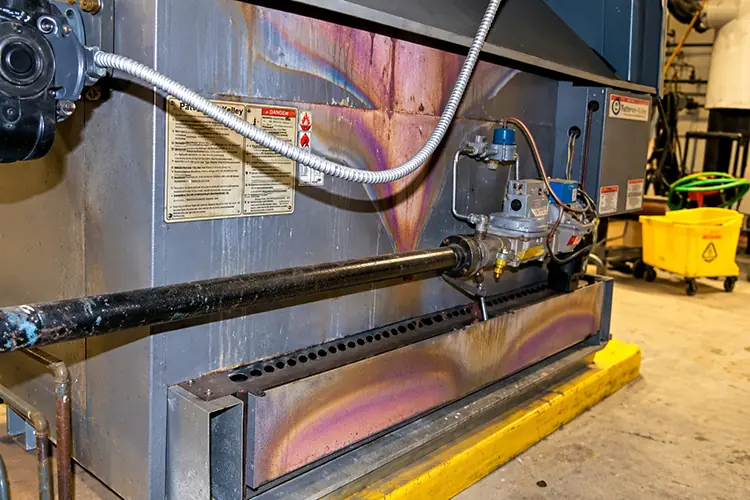
If you walked into a boiler room and saw the discoloration on the boiler jacket in Figure 1, would you be concerned? Should you. Absolutely. It’s the boiler telling you heat is not going where the manufacturer intended it to go. When flue gases take a detour around the heat exchanger instead of through it, you get incomplete combustion, damaged equipment and a higher carbon monoxide risk.
If the boiler is still operating, I treat this as a stop and investigate condition, not a watch it condition. Continued overheating of the jacket can cook wiring, controls (Figure 2), gaskets and insulation. In the worst case, it becomes a fire hazard. The discoloration is the clue. The cause is what matters.
Here is how I would work the job: make it safe, inspect the fireside, look at the building as well as the boiler, then operate it under control and measure what is actually happening.
Shut it down and inspect the fireside
Before anything else, be sure the boiler is safe. Shut off and lock out the power. Close the fuel valve. Let it cool. Look at the fireside with a flashlight.
I’m looking for warped, rusted or blocked burners, soot or leftover install material sitting in the flue gas path. I once found cardboard from the original packing left on top of a heat exchanger. It blocked the gases and baked the jacket.
Check for a cracked or warped heat-exchanger section. Look for a failed or missing gasket that lets hot gases bypass the exchanger and wash the inside of the jacket. Feel for missing insulation under the jacket. If someone removed the insulation and never put it back, the thin jacket could overheat even if combustion is otherwise acceptable.
Look for evidence of an internal water leak on the burners or on the floor under the boiler. Look for wet insulation on the jacket or base.
On a noncondensing boiler, check operating and reset control temperature setpoints. Sustained operation below 130 degrees lets flue gases condense, forming acids. The acid eats the heat exchanger, the vent and sometimes the chimney (Figure 3). On a project I consulted with, sustained low temperature boiler operation caused the chimney to collapse and block the flue gases; the gases found another way out.
Is the flue pipe pushed too far into the chimney? Is there a bird nest, a crushed connector or a cap that iced over last winter and never got repaired? If the air is direct-vented from outside, confirm that pipe is not restricted or plugged. Inspect the combustion-air openings. Are they sized for the equipment in the room?
Could the building be pulling the flue gases back?
Negative pressure. It does not take much. A negative pressure of only 0.03 inch of water column can pull flue gases out of the atmospheric boiler, or it can rob the burner of combustion air so the flame goes lazy and dirty.
What can cause negative pressure in a boiler room? An exhaust fan, kitchen hood or clothes dryer. A leaking return-air duct tied to an air-handling unit in the same room. A nonworking makeup air damper or fan.
The problem may not even be in the boiler room. The building could be affecting the boiler. That is why draft troubleshooting sometimes requires you to walk out of the boiler room. Check adjacent spaces. If the kitchen hood and the boiler fire at the same time, you may already have your answer.
Operate the boiler under control
Once the situation is safe and I am ready for controlled operational testing, the carbon monoxide detector goes on before the boiler switches on. Then I watch the burner and the carbon monoxide levels during startup.
Does the flame roll out? Does it look stable, or is it lazy, wavering or lifting off the burner? Do you smell anything burning; insulation, paint or that sharp odor of overheated metal?
Check the jacket temperature at the discolored area. A noncontact thermometer or a thermal camera is useful here. Remember, it is possible this discoloration came from an old problem that has already been repaired. I want to know whether this area is overheating now, or whether I am looking at evidence of something that happened five years ago. There is only one way to know. Test it.
Check the firing rate
Verify that the boiler is not overfired. Measure manifold gas pressure and determine whether the burner is firing at the manufacturer’s specified input. Clock the meter if you can. Someone may have changed an orifice, a regulator or a pressure setting and never documented it.
An overfired boiler dumps more heat into the same heat-transfer surface. If the flue path is even slightly restricted, the extra heat shows up on the jacket first.
Once I know the area is safe, I use a combustion analyzer. Now I can see what the boiler is doing instead of guessing from the color of the flame. I check oxygen, carbon monoxide, carbon dioxide, flue-gas temperature and draft. Those numbers could point toward an air-fuel problem, overfiring condition, draft problem or a restriction in the flue-gas path. If the readings are acceptable, I print them and photograph the printout. If they are not acceptable, the boiler does not go back into unattended service.
Document the jacket temperature at the discoloration while it is firing. Measure the room pressure relative to outdoors if you have a manometer. Those two readings, taken together, often separate a boiler problem from a building problem.
So, would this boiler scare me?
Yes, but maybe not for the reason you think. The discoloration is not what scares me. What concerns me is that I do not know what caused it yet. Something made this area of the boiler hotter than it was supposed to be. Maybe it is something relatively simple, like missing insulation. Or maybe we are looking at a combustion, venting or draft problem that could allow combustion products, including carbon monoxide, to enter the boiler room or the building.
Until I know which one it is, I am not ignoring that clue. Investigate what caused it. And there is one last thing I would check before leaving: Are there working carbon monoxide alarms in the building?