
As we self-perceived small guys whine about competing for talent, let’s pause the pity party for a moment. Of the many problems facing business today — inflation, capital, tariffs, leadership, culture, and a million more — none are feared more than talent acquisition and retention. After all, we can’t run our business without people, without talent. With all due respect to artificial intelligence (AI), people buy from people.
Speaking of AI, did you notice that during commencement season, any reference to AI by a keynote speaker was met with resounding jeers? Again, people buy from people.
Now, how in the world do we in industry, we not-so-sexy types in an underappreciated industry, compete for talent with the big boys? Walk down the aisle of the career fair on your way to your PVF booth. You’re walking past Alphabet (Google), Amazon, Apple, Meta, Microsoft, Nvidia, Tesla and all the “bigs.” Some with market caps as high as $5.5 trillion.
As the chart reflects, understand that the market cap would render you the 4th largest gross domestic product (GDP) in the world. Yep, if that market capitalization were GDP, it would be larger than the GDPs of Japan, India and the United Kingdom. In fact, let’s just say that, other than the United States, China and Germany, you’re larger than anyone else the world over!
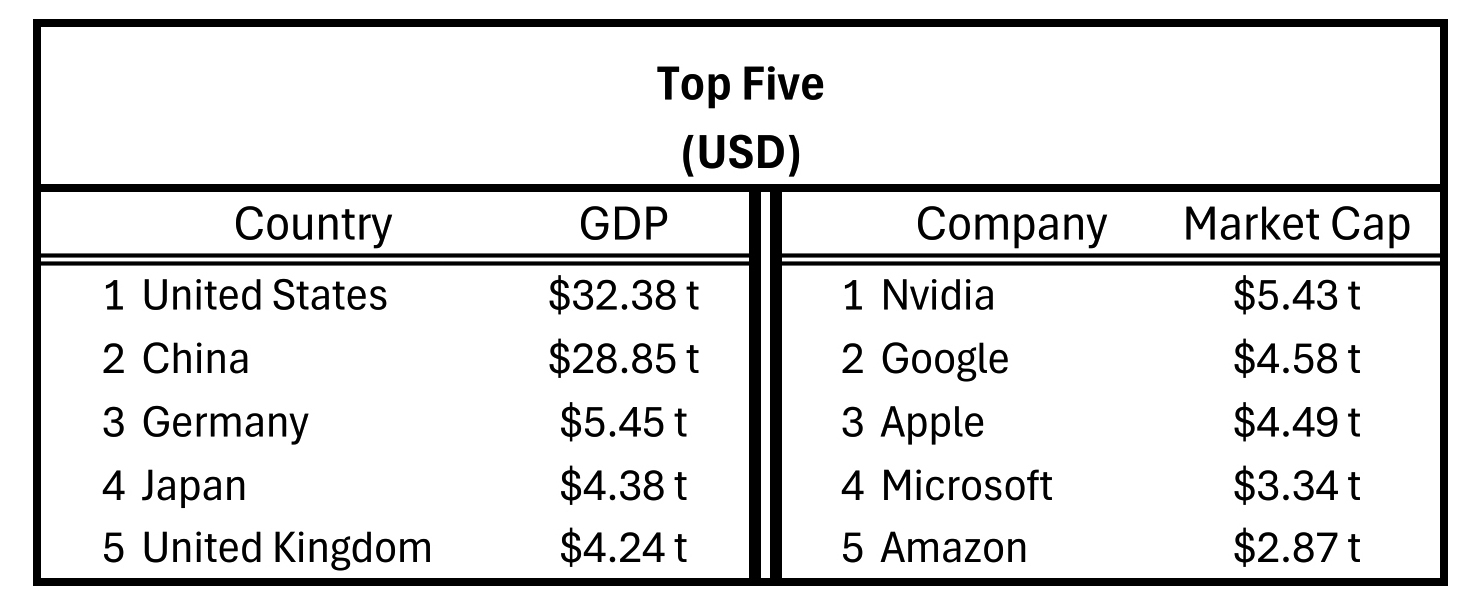
At those career fairs, we hand out keychains and koozies in our booth, while they hand out iPads while walking prospects through the pictures of their frisbee course next to the private lake outside their headquarters. Anyone up for a latte?
Yes, we have all chosen our industry as the place to spend our lives and find relevancy. Unless it’s a family legacy — and even then, we had career options. We’re not here by default but rather by choice. Early in our careers, we developed the required “chip on our shoulder.” We used that chip as motivation to prove ourselves, our industry and our company.
Here we are, an industry that, without it, nothing gets built, nothing gets moved, wars are not fought and our freedom is not defended. Notwithstanding this, there is hardly any mention of our value outside our own trade press.
Sometimes your very differentiation is not who or what you are, but rather who or what you are not.
Consider this: I often laugh when my Gen-Whatever students or colleagues lament the pressure of following the much-lauded baby boomer generation. However, the generation we followed was labeled and justifiably branded: The Greatest Generation. Talk about pressure.
So, here we are, competing with the aforementioned Magnificent 7 and the mega-industrial equivalents — all great companies whose success cannot be debated. However, understand that those seven magnificent companies have eliminated 150,000 jobs over the past few years. Perhaps that appeals to investors who see improved efficiencies and greater upward potential of stock value. However, to a talented employment candidate with a family, the desire for upward mobility and stability — perhaps not so much.
To the point at which I am struggling to articulate: In this ever-so-commoditized world, we must all differentiate our products, our services, ourselves and, yes, our organizations. I believe that, for our PVF industry, the differentiation is who and what we are not. That needs to be communicated, if not from mountains on high, then at least in our recruitment efforts.
We are not companies with mass appeal and a trillion-dollar market cap, but we are not soulless enterprises where team members anonymously toil for decades, unnoticed. We are not companies where talented employees fear the next surprise reduction in force. Nor do we lose productivity to the exhaustive job-loss rumor mill and speculation. We are not companies where talented employees fear pulling into the parking lot only to find AI parked in their spot.
Yes, recruit as you notice the sea of gray hair; you may very well prefer Enterprise Rent-A-Car with others your age and beer pong after work. However, dig a bit deeper. That gray hair suggests an industry with enough appeal that people stayed. Those people are anxious to turn their life’s work over to the next steward. Understand that pure mathematics suggests your upward mobility opportunities will be fast-tracked for those so inclined and skilled.
To my brethren, boomers and leaders, let’s stop the far-too-redundant refrain about our inability to find talent. Hold our heads a bit higher. Look closely at who and what we are. Now, go fill your talent queue with a legitimate, compelling story of relevancy.
“Relevance isn’t measured by years in the industry. It’s measured by proximity to the work.” — Anonymous