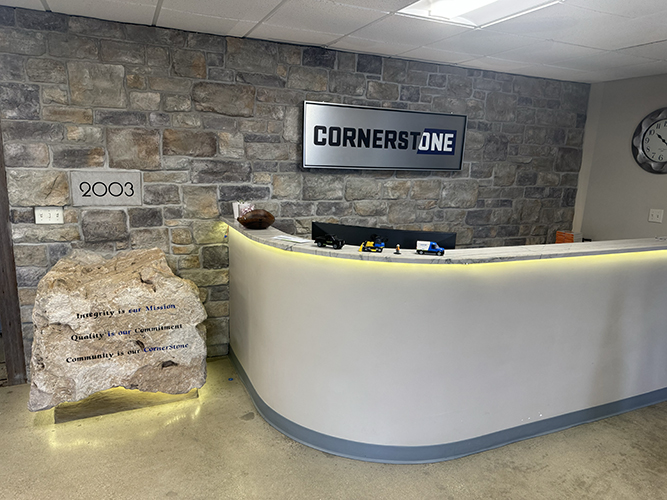
We don’t walk into many mechanical contractors’ offices and expect to find a boulder right next to the receptionist’s desk, with the following three lines inscribed: Integrity is our mission, Quality is our commitmen, Community is our cornerstone. Nor, for that matter, did we expect to find a library with shelves of books on business management, personal development and leadership skills.
But visitors immediately notice both as soon as they walk in the front door of CornerStone One, Brookfield, Wisconsin, one of the most diversified mechanical contractors in the state.
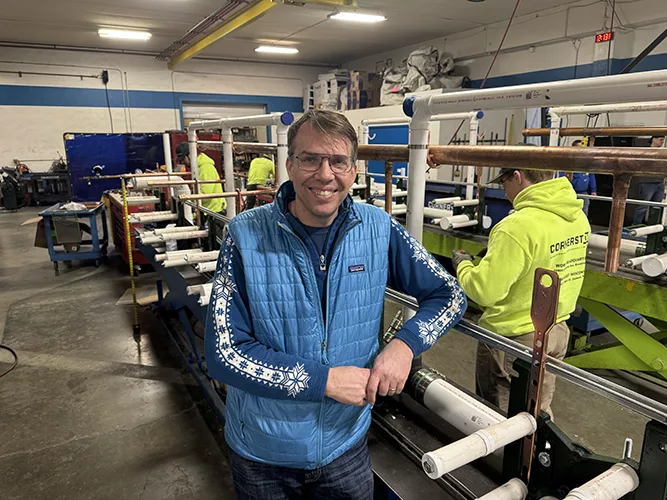
Originally, we wanted to sit down with Steve Adkins, the company’s founder, to hear the story of how he built the only contractor business covering the eastern half of Wisconsin that can deliver commercial plumbing, HVAC, wastewater treatment, earthwork, site utilities, engineering, facility service and prefabrication solutions.
While that level of diversification and expertise is what originally put the company on our radar, we learned much more about the philosophy behind CornerStone One from Adkins, who also thinks of himself as the company’s “chief storyteller” and “head coach.”
“My vision for Cornerstone One has always been one of excellence,” he says. “For me, I wanted to create a place where people could have a sense of belonging, and in that belonging, they could see a future. Building our projects is really cool, but I also love building culture and people and that sense of community where people can really, truly, feel like they belong to something special.”
Chief storyteller is an apt description for Adkins, after all. We walked in wanting to hear a story about how earthwork fit into typical plumbing and HVAC and prefab services. And we walked out with a much bigger story than that – and the hunk of rock and those books are just part of it.
“We build more than just buildings,” Adkins adds. “We build people. Our employees come first, our customers come second and our shareholders come last. That’s the CornerStone One way.”
Origins
Like a lot of people in the trades, Adkins grew up around plumbing. His grandfather owned his own plumbing business, and his uncles worked as plumbers, too. His dad was a heavy equipment operator who ran earth-moving equipment doing site utility work.
But Adkins had other plans. Through a dual-enrollment program, he finished high school while also earning a culinary arts degree. At 18, he figured cooking was his future.
Shortly thereafter, however, his father offered advice that led to a career in another skilled trade.
“I asked my dad, how I was going to raise a family working every night, weekend and holidays,” Adkins recalls. “And he goes, ‘I don’t know, but until you can figure it out, why don’t you come work with me?’”
So Adkins spent his late-teen years working alongside his father installing water mains and sanitary laterals – essentially all the plumbing and piping that’s outside a building. He loved it. His dad also encouraged him to enroll in a plumbing apprenticeship program.
“He said this work is really fun when you’re 18, but by the time he got to his age, every summer is hotter than hot and every winter is colder than cold.”
In 1996, Adkins went down to the union hall and landed number 48 on the list of 49 apprenticeships for the year. From there, he worked his way through residential jobs and into more complex commercial and healthcare projects. At the same time, he took night classes on AutoCAD and system design since he always loved the engineering side of the work.
By age 26, Adkins was hoping to move out of the field and into the office. His employer at the time had said as much. He’d just finished running a major neonatal intensive care unit addition at a hospital and felt the timing was right. However, by the end of his first week with a desk job, the employer let him go.
“I was devastated,” he says. “First time I’ve ever been fired in my life. They told me I was a great field guy, but they just didn’t think I could do this.”
He heard much of the same hunting for his next job around town. A great foreman. But no room for you in the office.
A mentor and friend
That’s when a man named Dan Parman changed his life for the better.
Parman wasn’t a plumber. The two met at their church several years before. Parman asked the newly unemployed Adkins to meet for coffee. Parman had built successful businesses before leaving the commercial world in his 40s to work full-time in ministry. Over coffee, Parman started asking questions and jotting down some numbers. What would it cost to start a plumbing company? What does a van run these days? And then, after talking it over, without fanfare, Parman opened his checkbook and handed Adkins a check.
“He did something for me that I couldn’t do for myself at the time,” Adkins says. “It was more money than I had seen in one place before. But most importantly, Dan believed in me. He saw the potential in me before I saw it in myself.”
And so, in 2003, Adkins started what was then called CornerStone Plumbing out of his garage. Adkins also hired Jason Pampuch, who’s been with the company ever since, and eventually became a partner in the business.
“He’s my best friend,” Adkins says. “And I couldn’t ask for a better partner on this journey.”
Their very first project was the Starbucks at Milwaukee’s General Mitchell International Airport. Adkins worked in the field during the day and handled sales and estimating at night. More than once, he packed up his tools with no work lined up for the next day. Then the phone would ring, and there was another project, enough to keep them moving forward.
Inside the company’s present-day training room, large posters line the walls with yearly highlights. The early numbers tell a familiar story. In 2004, $516,000 in revenue and three employees. In 2005, $1.5 million in revenue with five employees.
Early on, Adkins also pushed into CAD, robotic layout and early prefabrication.
“We built relationships with partners who gave us opportunities far bigger than our size would normally suggest,” Adkins says.
Diversification came quickly, although for a plumbing company, it wasn’t the usual step into HVAC. Two years in, they added his dad’s specialty, a site utility division. The origin of that move says a lot about how CornerStone One has grown ever since. A subcontractor the company had hired couldn’t meet the schedule, and Adkins refused to let the customer down. So he decided to offer site utility services.
“When there was a gap, we filled it and we grew,” Adkins adds. “That was a pattern that would carry us forward.”
That pattern even held through the recession of 2008-2009 when the company’s sales dropped from nearly $5 million to $2.5 million in 2010, forcing Adkins to cut half his workforce.
“Hardest thing I’ve ever had to do,” he says. “And after that, Jason and I just kept outworking our competition. It used to be you’d bid 10 jobs and get three. Now we had to bid 20 jobs to get one. So we just kept going.”
Turning point(s)
As the company climbed out of the downturn, a turning point came in 2012 when Adkins joined a cross-industry executive peer group called Vistage. This forum brought together business owners from completely different sectors — car dealerships, quarries, architecture firms, general contractors — to share problems and perspectives. Sitting in the meeting room he noticed something different. CEOs running organizations five times his size were attending every meeting with their phones quietly in their pockets. Meanwhile, his own phone never stopped ringing because, he realized, no one in his organization could make a decision without him. The diagnosis was clear: he was working in the business when he needed to be working on it.
“I was supposed to attend a meeting every six weeks, and I could barely make any of the meetings,” he explains. “If CornerStone was going to last, it couldn’t just be ‘Steve’s Plumbing Company’ where I made every decision.”
As a result, CornerStone started implementing a real management structure. By 2014, the company held its first strategic retreat. By 2016, they put words to the mission statement that would eventually be carved in that rock out front.
CornerStone also launched a company book club that spans both office and field employees. The company pays for the books or Audible subscriptions, and compensates workers for the time spent reading and discussing during the workday.
Reading is another gift Parman gave Adkins. At his peak, Adkins was working through roughly 30 books a year, pulling ideas from business, leadership and organizational thinking and applying them directly to how he ran his company.
“Dan told me, ‘You can skip a meal, but don’t skip an opportunity to learn something,’” Adkins says. “For me, that’s reading. A lot of people go through high school feeling they have to read. But Dan made me understand what reading could actually do for me.”
By 2016, the company was doing about a million dollars a month with 50 employees.
“We were starting to understand who we were,” Adkins says.
Becoming CornerStone One
Another major turning point came in 2018, when customers kept asking Adkins to take on the full scope of earthwork: grading, excavation, shaping parking lots, digging foundations. He laughed at the idea at first.
“I said, do you understand the capital required to do what you’re asking me to do?” he recalls.
And a big captial investment wasn’t the only worrisome factor. Going into the earth, Adkins explains, is where all of the risk is.
“Until they develop special glasses that let you see underground, it’s all unforeseen,” he adds. “But my customers said, we’d be really good at it. So that’s how we started the service.”
With that launch, the company also changed its name to CornerStone One. The new name reflected a new identity: one source for plumbing, site utilities, earthworks, service, VDC, prefab and eventually HVAC.
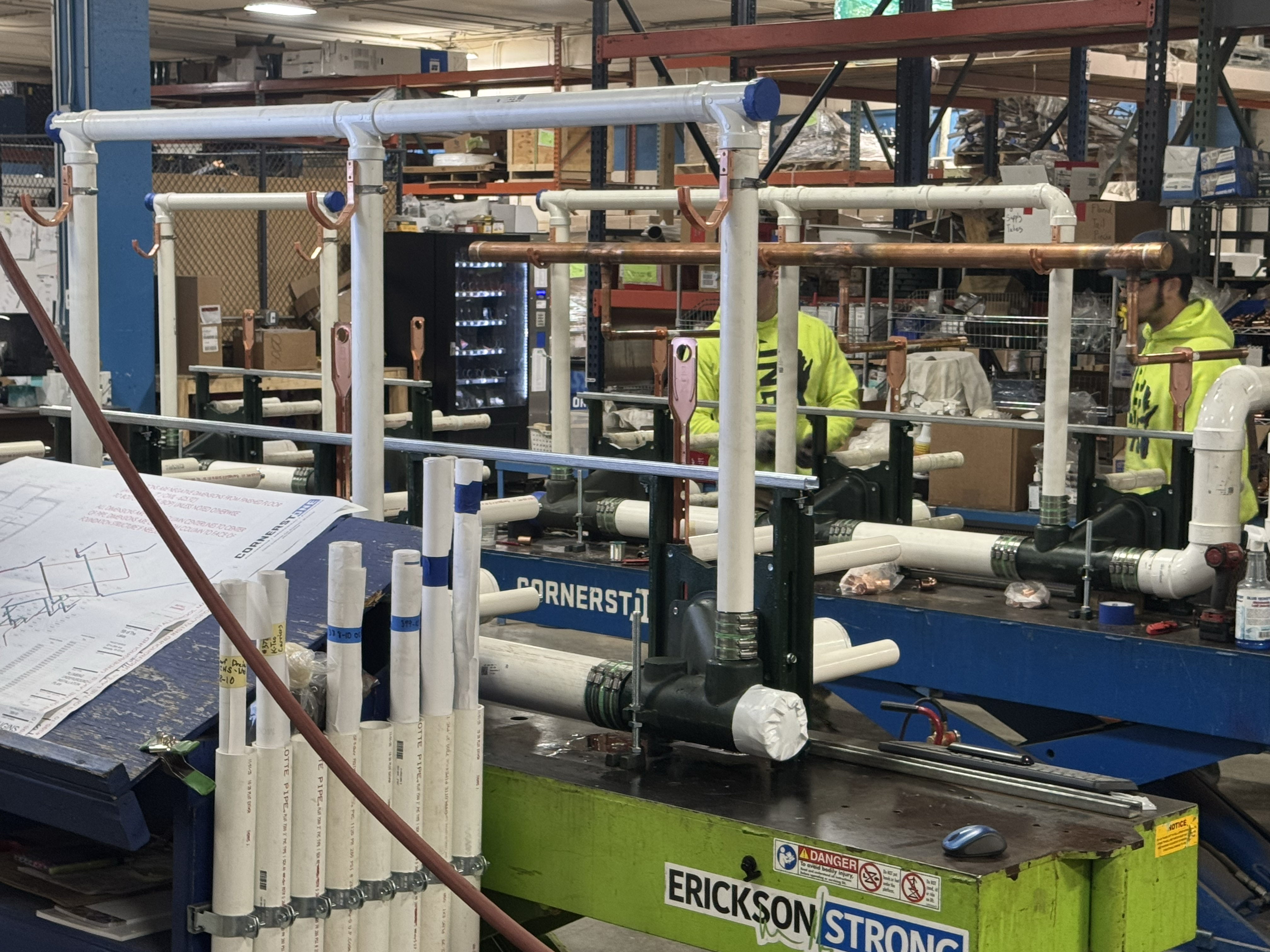
By 2023, the company also implemented Vista Viewpoint, an ERP platform owned by Trimble Inc., widely used by specialty contractors that need deeper job costing and project controls than typical accounting systems. Adkins credits Vista with accelerating the shift from mechanical contractor to manufacturing business — bringing visibility, consistency and sophistication to how the company builds.
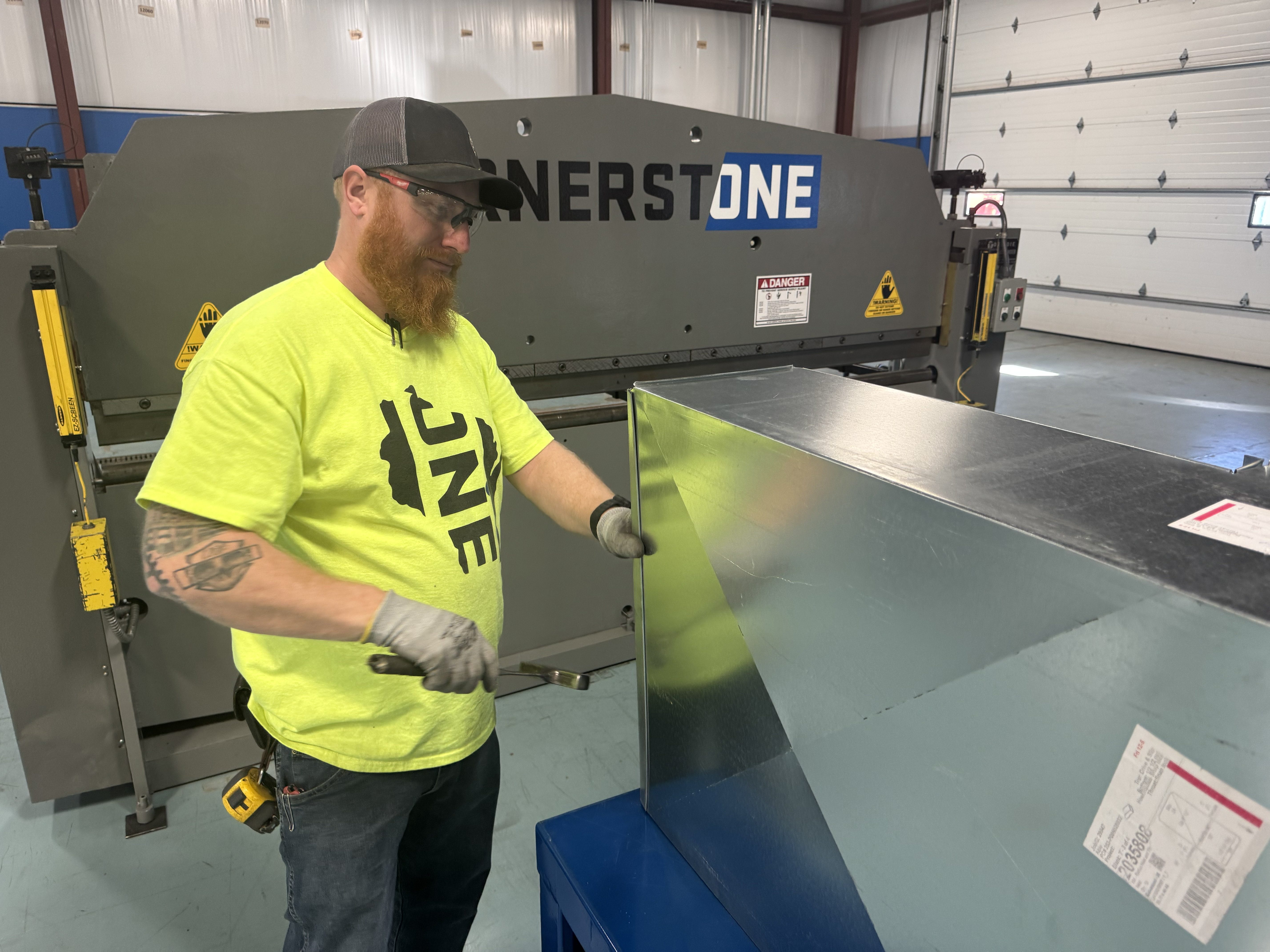
The company had been building plumbing assemblies from its Brookfield headquarters. In 2025, CornerStone One opened a new 30,800-square-foot mechanical HVAC facility in Oshkosh, Wisconsin, to manufacture ductwork and sheet metal as well as serve as an expansion into Northeastern Wisconsin. (For more information, see our sidebar.)
Two othe turning points came in 2024 when John Muraski was named president. Muraski is a plumbing veteran who started at CornerStone One as a project manager for four years, then as a plumbing division manager for another two years. Also, that same year, the company reached $50 million in revenue.
“It took CornerStone One, 12 years to reach $1 million a month in revenue,” Adkins says. “It took just six more years to reach $1 million a week.”
We asked Adkins what he’s most proud of after more than two decades of building CornerStone One.
“Watching the people here grow,” he says. “Watching them get married and start having families that depend on CornerStone One. And we’re just starting to get to the point where we’re going to have the CornerStone One retirement club. And now our employees’ children are getting to be 18 or 20 years old and starting to come work here. The fact that they trust this organization to treat them fairly — that’s probably the greatest gift.”
He spends a lot of time these days thinking about who leads the company after him.
“They’re already working here,” he says. “I don’t know who that person is right now. But they’re here.”