My infatuation with technology began when I received a Commodore 64 computer for Christmas in 1984. My first outside sales job was with Moore Business Forms, based in Andover, Mass., right at the heart of the computer revolution. We called on large computer companies such as Digital Equipment and Wang Computers. As a sales manager for the Kohler Co., I received one of the first laptop computers, which weighed in at a whopping 12 pounds. Wow, have things changed.
Artificial intelligence LLMs (large language models such as ChatGPT, Grok and Amazon’s Gemini) have released updates with mind-blowing capabilities.
Companies are trying to understand how this technology will affect our industry. How do we use this technology to increase efficiency and profitability? How are we moving from buzzword to bottom-line driver in wholesale distribution? Let’s look at some examples of AI today and in the future.
Real world examples from distribution
1) Faster product discovery and support at scale.
According to Databricks (https://tinyurl.com/Databricks-Grainger), Grainger rebuilt product discovery with a retrieval-augmented search stack. With 2.5M SKUs, the company reports significant gains in search recall and speed, helping call center agents and customers find the right part faster and cut handling time. It’s live proof that GenAI can materially improve conversion and service across extensive B2B catalogs.
2) AI-enabled omnichannel and internal copilots in HVAC distribution.
In a post from Digital Commerce 360, (https://tinyurl.com/watsco-ecommerce-sales) Watsco has leaned into digital for years; e-commerce now accounts for roughly a third of revenue. Recent disclosures show $2.5B in online sales over 12 months and widespread adoption of its HVAC Pro+ app. The company is also rolling out AI broadly: more than 2,000 employees use the internal Ask.Watsco assistant, and contractors use AI.Watsco to instantly find parts and technical specs — examples of practical GenAI that remove friction for both teams and customers.
3) Digitally assisted customer engagement for building supply & trade partners.
According to Customers.ai (bit.ly/49eYoMP), smaller distributors and dealers are also seeing measurable wins. Lincoln Davies Building Supply deployed a website chatbot to answer FAQs, promote offers, and guide product browsing. Results included a 25% reduction in online support time and a 111% increase in their customer list—evidence that conversational AI can lift sales capacity without adding headcount.
On the trades side, HVAC service businesses using voice/chat agents report fewer missed calls, faster appointment booking, and higher close rates during peak seasons—illustrating how wholesalers can support their contractor ecosystem with embedded, white-label tools.
4) Data-driven demand planning and replenishment.
Outside the storefront, distributors and building materials players are applying AI to forecasting and replenishment. Blue Yonder documents double-digit gains in forecast accuracy and significant improvements in planner efficiency; case write-ups show distributors using optimization engines to automate fair-share allocation and reduce carrying costs. While not plumbing-specific, these programs mirror exactly what our sector needs for seasonal SKUs, weather-sensitive demand and multibranch balancing.
5) Large-scale digital foundations in PHCP.
At the enterprise end, Ferguson’s multiyear digital transformation, built on Salesforce Customer 360, has focused on unified customer views and frictionless omnichannel experiences — necessary plumbing (pun intended) for layering AI into quoting, service and project tracking at scale. Salesforce highlights how Ferguson’s digital strategy underpins growth across plumbing, HVACR, PVF and more (https://tinyurl.com/ferguson-selects-salesforce)
What else can AI do?
Inventory optimization: Local demand variability, truck routes, weather forecasting, purchasing patterns, margin opportunities.
Warehouse picking: Accuracy, speed, reduction of returns and credits, reduced travel time.
Sales efficiency: Quoting systems; identifying upsells and substitutes; pricing and availability.
Contractor relationship management: Buying patterns, identifying account risks, order prediction, tracking missed opportunities.
Search and service copilots: Shortens time to answer for customers and inside sales.
Conversational entry points (chat/voice): Converts after-hours demand and deflects repetitive calls.
Forecasting and replenishment AI: Improves availability while trimming inventory.
Showroom experience: Marketing campaigns, brochures, social posts, design mockups.
Support agents: Product questions, pulls spec sheets, availability, quotes, guides customers to your location.
Strategy: Modeling scenarios, budgets, margin impacts, identifying growth opportunities.
Evolution of AI
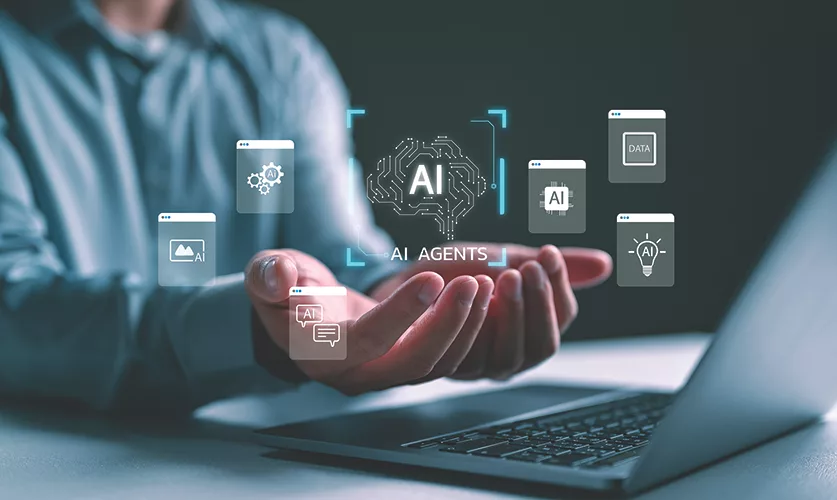
In the second half of 2025, Agentic AI burst onto the scene. Agentic AI consists of AI Agents, which take AI to the next level by mimicking human decision-making to solve problems in real time. They work independently and are goal driven.
Until now, most distributor AI has been assistive: answering a question, drafting an email, recommending a product. But AI agents go further. They act across systems—placing holds, updating quotes, checking lead times, or reconciling invoices, without constant human prompting. Making and deploying AI Agents sounds incredibly complicated, but large software companies such as Microsoft’s Microsoft Copilot Studio have already developed a guide to help you build AI Agents. You don’t have to program anything, and it supports speech recognition so all you have to do is tell the program what you want the AI Agent to accomplish.
Here is a short list of AI Agents used by wholesalers:
AI purchasing agent — Forecasting, tracking lead time, real-time updates
AI pricing agent — Daily pricing trends
AI warehouse agent — Flow mapping locations
AI marketing agent — Campaign creation, targeting, customer outreach
AI sales agent — Opportunity notifications, drafting custom communication
What’s next?
If 2025 was the year of AI agents and the rapid deployment of improved LLMs, then 2026 will see massive jumps in the use of these AI technologies. If your company hasn’t had the opportunity or hasn’t yet begun implementing AI in daily operations, at the very least, kick off the first quarter of 2026 by developing an AI strategy. Start the conversation with all employees by emphasizing that AI will affect your company and the entire industry.
In future articles, I’ll show you a path to get maximum impact from implementing AI in your company. Start looking at your data and cleaning it for AI use. Clean data is the lifeblood of AI. Garbage in, garbage out. Make sure all data is consolidated and housed in a secure system. Begin documenting workflows and identifying areas that could be more efficient by implementing AI.
If your company is ahead of the game and has already begun implementing AI in its workflows, continue to educate yourself on using AI tools. There are numerous books, podcasts, YouTube videos and email subscriptions to keep you up to date on the latest news. I’m incredibly excited about the future of AI in our industry and the many ways it will help increase productivity and profitability. Get off the bench and move forward!
Cliff D’Angelo, owner of Greencliff LLC, is a consultant and coach to the industry and a 30-year, award-winning veteran of the trade, having worked at both Kohler Co. and Ferguson Enterprises. He is a certified LEED AP Legacy, certified AI-assisted consultant, contributing columnist for The Wholesaler magazine, and developer of The Leadership Academy. He can be reached at [email protected] or 407-459-0053.