Commercial plumbing is evolving rapidly as contractors, engineers and facility managers face mounting pressure to deliver efficient, sustainable and cost-effective solutions across a wide range of building types. From tightening regulatory requirements to labor shortages and supply chain volatility, today’s challenges require manufacturers to respond in new and strategic ways.
To better understand how manufacturers are adapting, we connected with Bob Carter and Dan Danowski, product managers for finish plumbing at Zurn Elkay Water Solutions, and Kris Alderson, MBA, LEED AP, senior marketing manager for Bradley Company. They share what their customers are up against—and how their companies are innovating to support success in an increasingly complex marketplace.
Trends
Trends shape the commercial plumbing market and influence how manufacturers approach product development.
Carter explains how form and function intersect: “We’re seeing a shift toward blending aesthetics with performance. Designers and end-users are placing more value on style-forward and modern fixtures, especially in public spaces, which is driving demand for more finish options and cohesive restroom design.”
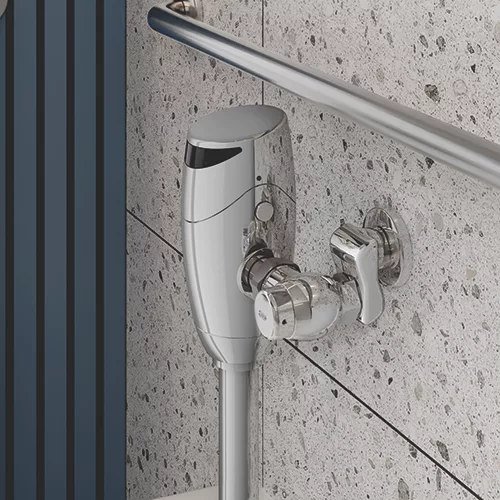
“Sustainability remains a top priority, helping to grow interest in hydro-powered sensor faucets and flush valves that reduce water and energy use,” notes Danowski. “We’re also responding to the growing strain on facility maintenance teams by creating products that are more durable, require less upkeep and support predictive maintenance.”
“These trends are helping to inform every stage of our product development, including smarter sensors and more attractive, intuitive user experience,” Carter adds.
At Bradley, Alderson sees growing interest in nonporous, seamless and sustainable basin materials. “For washbasins, smooth and nonporous materials with seamless construction such as solid surface and natural quartz are sustainable, hygienic and very easy to keep clean,” she says.
Touch-free technology is also taking center stage. “The benefits of touchless technology in today’s public restroom spaces cannot be overstated,” Alderson adds. “Bradley’s research has found that consumer preference for having access to touchless features in restrooms is very high, with the majority (80%) of Americans saying it is important for restrooms to have touch-free technology.”
Challenges and solutions
With challenge comes innovation. Commercial plumbing professionals are at the forefront of resolving complex issues.
“Facility teams today face lots of pressure, including aggressive sustainability goals and doing more with fewer people,” Carter says. “We help address both through high-efficiency, long-lasting products and a lower total cost of ownership.”
Danowski adds: “Our connected, smart plumbing systems provide actionable insights via digital dashboards, helping facilities deploy their limited maintenance and resources more strategically. These systems can even identify early signs of issues like leaks and health risks such as Legionella before they escalate.”
Alderson agrees: “Smart technology and IoT are key drivers of operational efficiency in commercial restrooms.” From refill alerts on soap and paper dispensers to occupancy sensors and predictive maintenance data, smart solutions are improving how restrooms are managed.
Labor shortages also affect design and implementation. “The lack of skilled workers is a major issue right now in the commercial plumbing industry,” Alderson says. “Bradley is committed to providing washroom products that are easy to install, service, and maintain — requiring less overall work, lower costs and less frustration from the building/maintenance staff.”
One example is Bradley’s Top Fill Multi-Feed Soap System, featuring a 1.3-gallon tank that can supply up to three WashBars. “Its smart-sense system with LED indicator lets staff know when soap/battery levels are low and provides audible and visual indicators to prevent overfilling,” she explains.
Codes and regulations
Environmental regulations and evolving plumbing codes are shaping the future of commercial plumbing. Manufacturers must not only meet today’s standards but also anticipate tomorrow’s.
“Evolving regulations around water conservation continue to shape commercial plumbing design,” says Carter. Danowski adds, “We’re seeing a tightening of specs on everything from tank-type toilets to lavatory faucets, demanding innovative solutions that reduce water without compromising functionality or performance.”
Alderson points to material concerns: “PFAS and other material restrictions have become ubiquitous in the regulatory landscape. Some material restrictions have made their way into drinking water standards and will need to be phased out. Bradley is gathering information about where these chemicals may be in the supply chain and is seeking alternatives.”
Plumbing sectors
We asked what sectors are currently driving demand.
“For Zurn, demand is coming from multiple sectors, including K-12 and higher education, where funding is being allocated for healthier, more sustainable facilities,” Carter says. “In healthcare, we’re seeing a focus on behavioral health environments, with fixtures designed for safety as well as hygiene.”
Danowski adds: “Hospitality and stadium projects are also active, particularly with operators upgrading restrooms to be touchless and design-forward.”
Alderson agrees demand is strong in hospitality and healthcare and emphasizes, “Right now, schools, in particular, are driving the highest demand for our products. Traditionally, the summer season — when many schools are out of session — is when these facilities focus on conducting the majority of their repair and renovation work.”
What’s next in innovation?
Innovation is accelerating, and 2025 promises new advancements in commercial plumbing.
“We’re excited about product lines that merge visual appeal with unmatched performance,” Carter notes. “The expansion of finish options in commercial faucets and flush valves allows customers to create beautiful spaces without compromising on reliability or durability.”
Danowski adds: “We’re also developing more maintenance-friendly designs that make servicing faster and more intuitive, reducing downtime and labor.”
Alderson says Bradley’s WashBar fixture “continues to set the standard in touchless all-in-one handwashing technology.” Its design, sensors and durability continue to evolve in response to customer needs.
Looking ahead, Carter notes a broader shift: “Design influence in commercial plumbing is evolving. We’re seeing a growing European-style aesthetic take hold in the U.S., with more architects driving fixture selection. This marks a shift from strictly utilitarian choices made by mechanical engineers to a more holistic, design-conscious approach.”