Building codes and standards are often used interchangeably in discussions about building construction, but they are two distinct thing. A building code is a set of requirements written in mandatory language for designing, constructing, altering and maintaining buildings, ensuring public health, safety and welfare by covering structural integrity, fire safety, plumbing, electrical systems, energy efficiency and accessibility.
Sometimes people confuse building codes with industry standards; building codes include referenced industry standards.
How building codes are developed and enforced
The model code organizations hold code hearings to review proposals and vote on code changes for minimum building construction requirements for health and safety. Various interest groups have representatives participating in the code process to protect their interests and help keep construction costs down.
Building codes have the force of law only when adopted by a local authority having jurisdiction (AHJ) as part of state or local ordinances. The AHJ can adopt a model code or develop its own codes.
There are two primary model code organizations that develop codes for adoption by AHJs. The International Code Council (ICC) develops a complete, coordinated family of codes. It uses the National Electrical Code published by the National Fire Protection Association (NFPA), which pre-dates the model codes, and has its own Fuel Gas Code. IAPMO developed a model plumbing code and mechanical code. It uses the NFPA for building, electrical, fire, and fuel gas codes, and American Society of Heating, Refrigerating, and Air-Conditioning Engineers (ASHRAE) for energy conservation standards.
The responsibility to adopt and enforce the codes falls on the AHJ, but the responsibility to comply with the codes falls on the building owners, architects, engineers, designers and contractors working on the project. It is important to note that building codes (and the referenced standards) set minimum requirements for compliance, but good design practice typically calls for designs that exceed those minimums.
Keep in mind that in some cases, additional jurisdictional compliance requirements may be imposed on a given project by health departments, fire departments, insurance companies and even sophisticated owners with their own minimum design standards that also must be followed. A thorough code survey should review these issues in the early stages of a project to identify the applicable codes and edition years.
Understanding industry standards
Standards are established performance criteria, specifications and testing criteria for safety, quality, performance and compatibility that apply to products, or minimum qualifications that must be met, ensuring they function correctly, protect consumers and work with existing systems.
- Standards are developed by many organizations, including:
- American National Standards Institute (ANSI)
- American Society of Heating, Refrigerating, and Air-Conditioning Engineers (ASHRAE)
- American Society of Mechanical Engineers (ASME)
- American Society of Plumbing Engineers (ASPE)
- American Society of Sanitary Engineering (ASSE International)
- American Society of Testing and Materials (ASTM)
- American Water Works Association (AWWA)
- American Welding Society (AWS)
- Cast Iron Soil Pipe Institute (CISPI)
- Compressed Gas Association (CGA)
- Industrial Safety Equipment Association (ISEA)
- Manufacturers Standardization Society (MSS)
- National Fire Protection Association (NFPA) (fire protection standards and several model codes for adoption)
- NSF International, formerly the National Sanitation Foundation
- Plumbing & Drainage Institute (PDI)
- Underwriters Laboratories (UL)
Many of these standards (and others) are referenced in the model building codes.
The first standards developed were for weights and measures to ensure that scales accurately weighed products bought at one location and then weighed and sold at another. People noticed that the scales were different for the same bag of grain from one location to another.
Another early standard dealt with fire hose threads. In the early years of our country, several large fires — or conflagrations — consumed entire cities of mostly wooden structures. When remote fire departments were summoned for assistance, they discovered that their fire hoses used different hose threads and did not match from one fire department to another. This prompted the development of national standards for fire hose threads.
 |
 |
Legal status of standards
Industry standards provide a common reference for manufacturers, regulators and consumers, covering everything from materials and design to testing and environmental impact, promoting safety, health, consistency and trust. Key parts of industry or product standards include safety, performance, material quality and compatibility.
A standard only becomes a legally enforceable document when it is referenced in the adopted code or separately adopted by ordinance in a jurisdiction.
A standard must include mandatory language for adoption and enforcement. Often, new standards are developed and full of what is called “permissive language,” such as “may be,” “could be” or “should be,” which give optional compliance instead of mandatory language. Proper mandatory code language includes “shall be” or “must be.” Many new standards proposed for inclusion in the codes have been rejected because of these grammatical errors.
Some standards are written and intended to be adopted and enforced as a code.
Good examples of this are the National Electrical Code (NFPA 70) and the National Fuel Gas Code (NFPA 54). These were developed by the NFPA to minimize the risk of electrical shock, fires and explosions before building codes were established.
A design professional starting a new project should determine the applicable codes for the project’s location. A code review is necessary to determine the appropriate edition of the codes (and standards) for the jurisdiction in which the designer is working. Some jurisdictions may be using an older version of a code; that is, they may not be using the most current edition. It is important to note which year and edition of the code or codes apply and whether any local code amendments apply.
All ANSI standards are on a continual update process. Generally, within five years, a standard is either opened for revision or, if no changes are needed, simply reaffirmed. As a result, within a year of the code books’ publication, about 20% of the listed standards will have been revised.
That is OK. The standard referenced in the code can continue to be enforced with the older version, but the list of standards will be out of date. However, when a code is revised every three years, about half of the referenced standards should be reviewed by staff. The standards developing organization can identify the latest edition of that standard.
 |
 |
The consensus process in standards development
Also note that ANSI approves many standards as American National Standards (ANS). ANSI is the organization in the United States overseeing the development of national consensus standards. In most cases, ANSI does not develop standards; rather, it ensures that standards are developed in a balanced, fair and consensus-based process.
The consensus standards development process requires that the standard committee overseeing the development of a particular standard be balanced among the interest groups. For example, for a material standard, producers (manufacturers), users (engineers) and general-interest representatives would be on the committee.
 |
 |
Generally, no interest group category may hold more than half of the votes on a standard and, in some cases, the percentage for any one interest group may be less than half.
The consensus process also requires that standards be made available for public review, and the committee must attempt to resolve all comments. As a result, standards are developed through fair and open procedures.
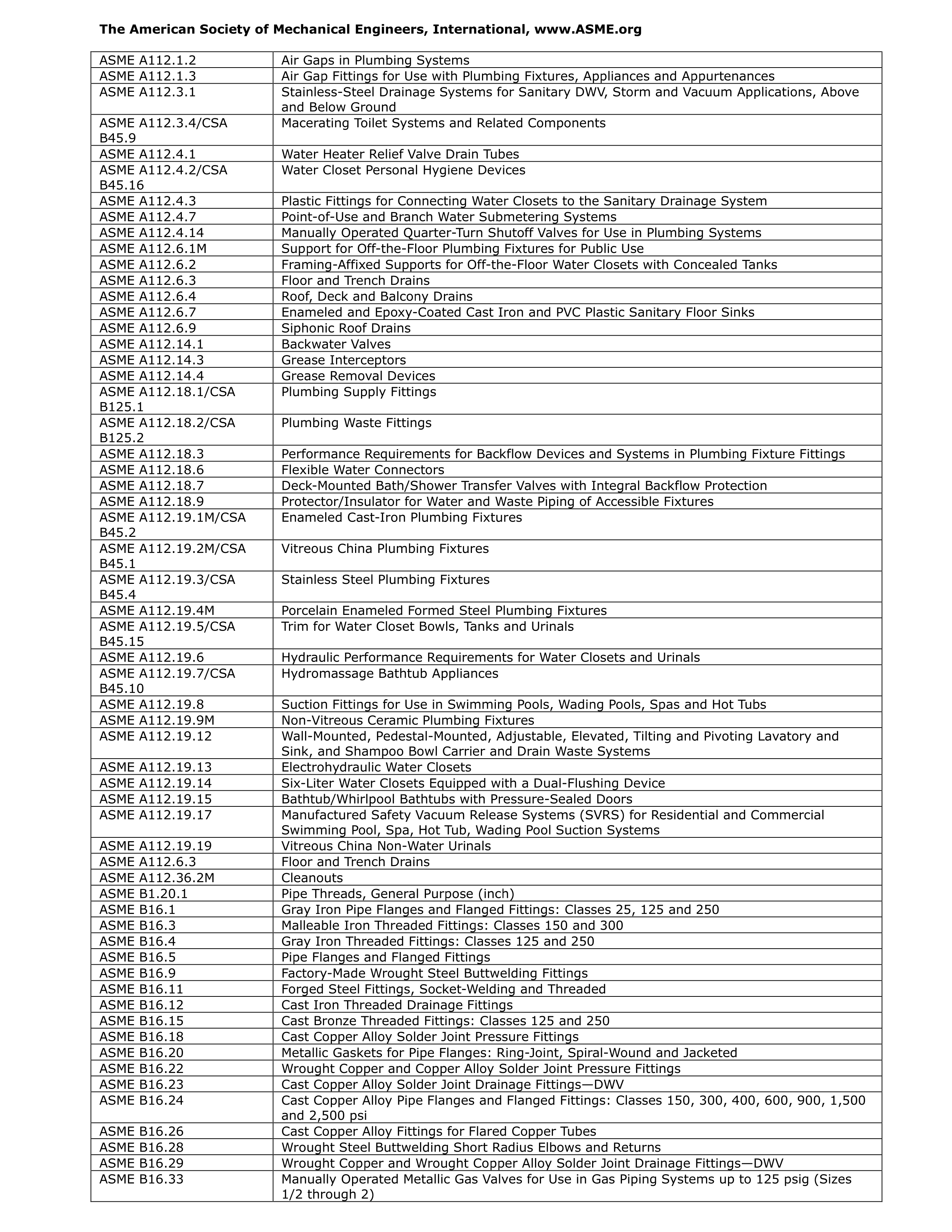
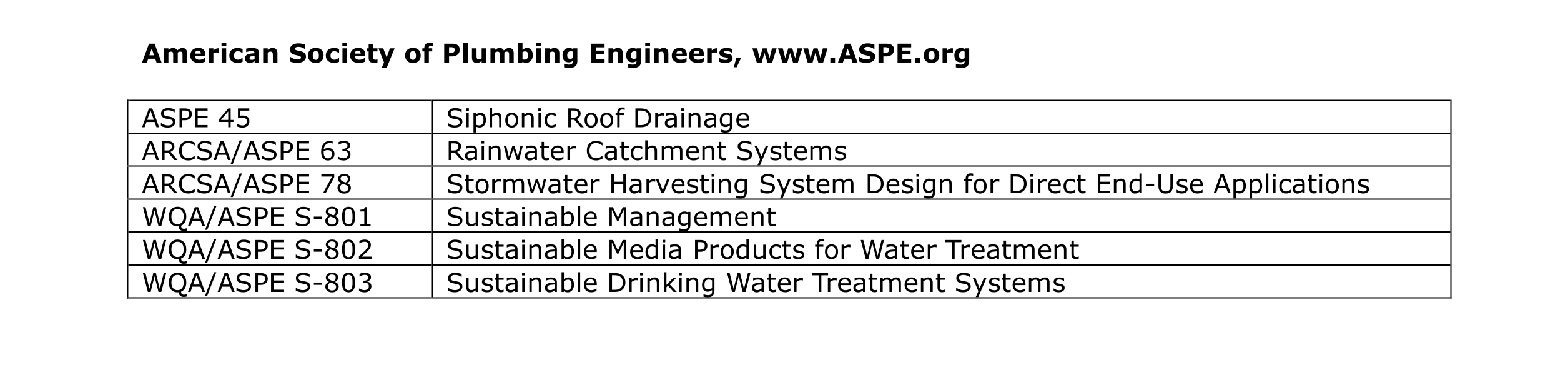
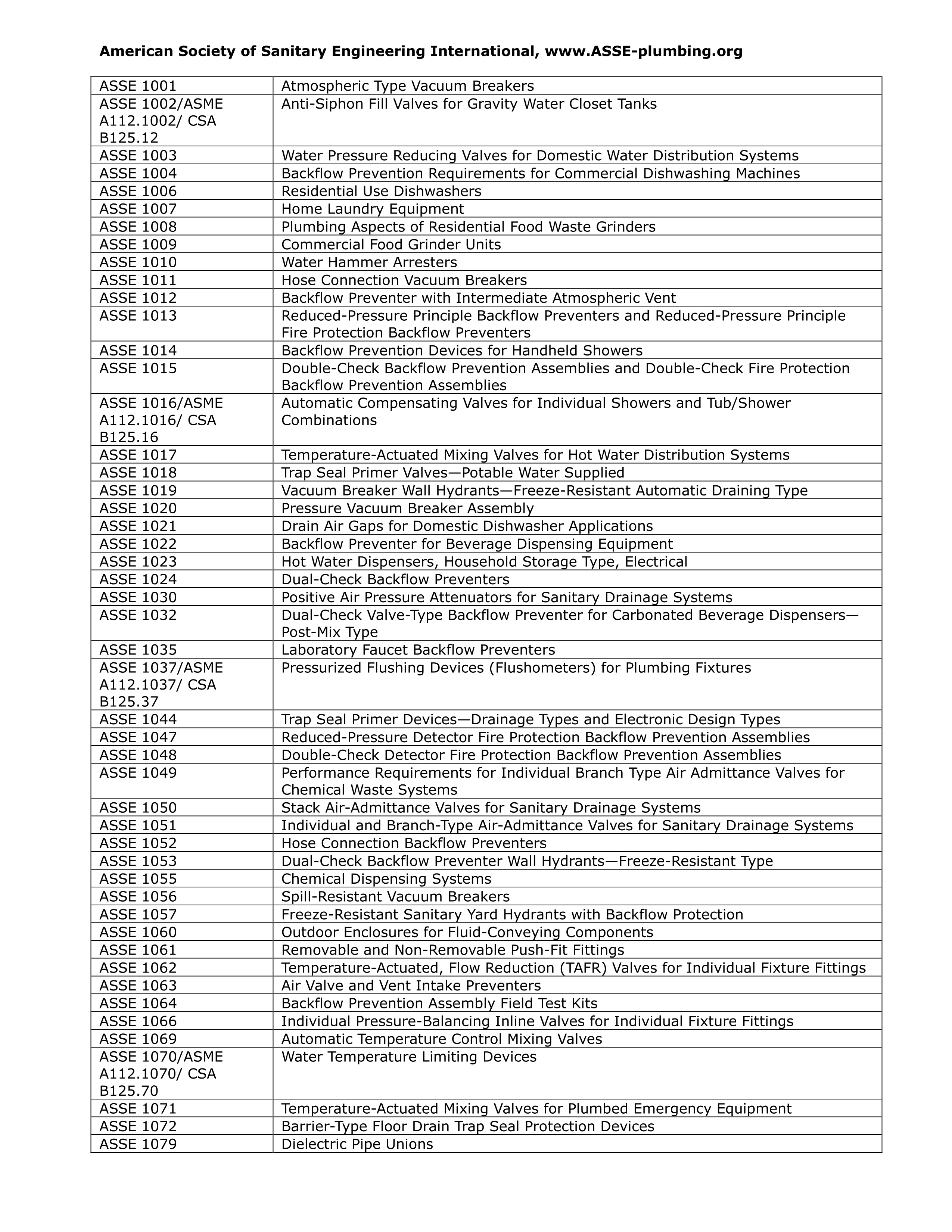
Although most standards are country-specific, the industry has seen a trend toward harmonization to make cross-border design and installation more efficient. Thus, many standards carry the acronym of two or more standards development organizations from different countries, such as the American Society of Mechanical Engineers and the Canadian Standards Association’s harmonized standard ASME A112.19.2 / CSA B45.1, Ceramic Plumbing Fixtures.
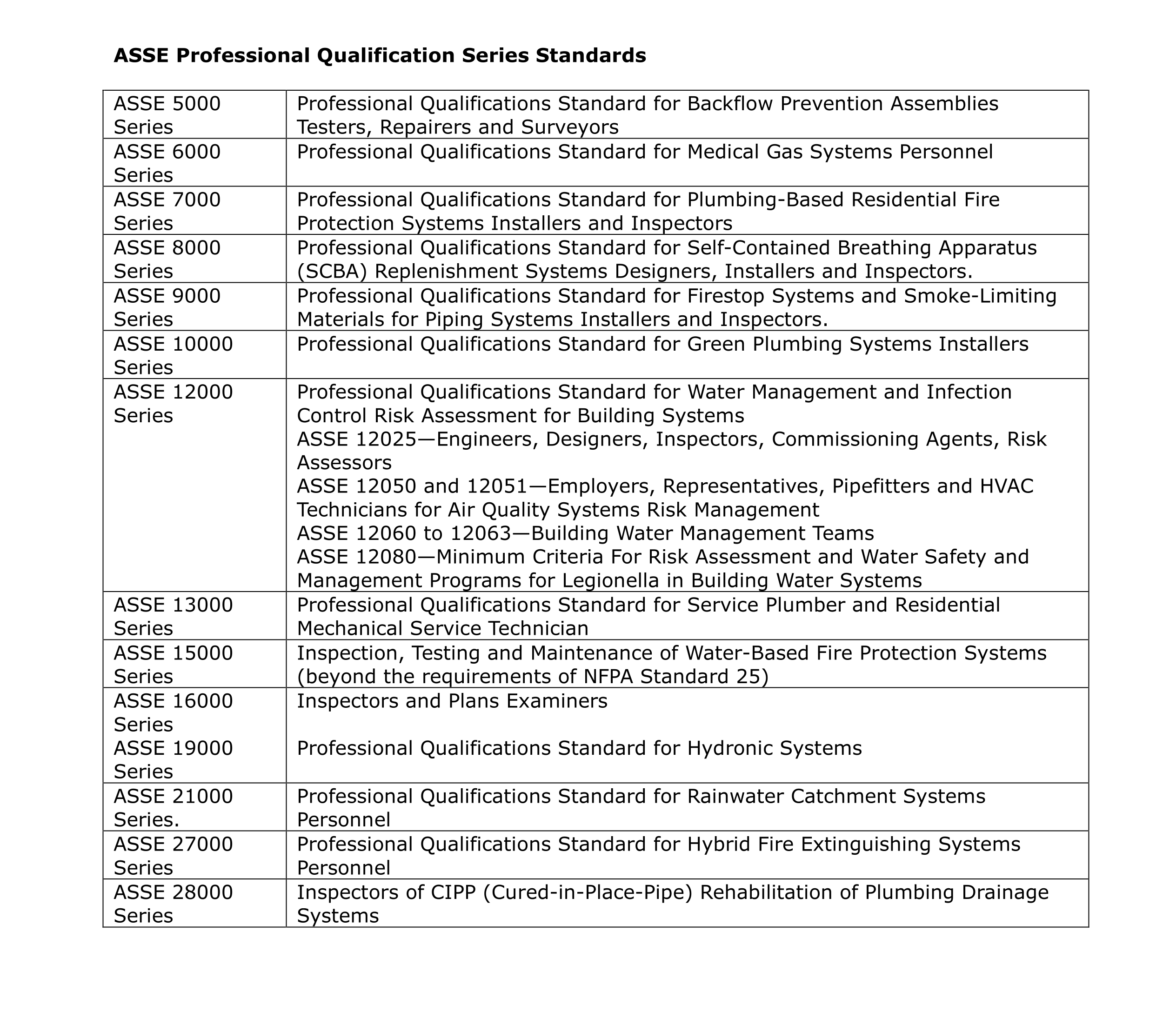
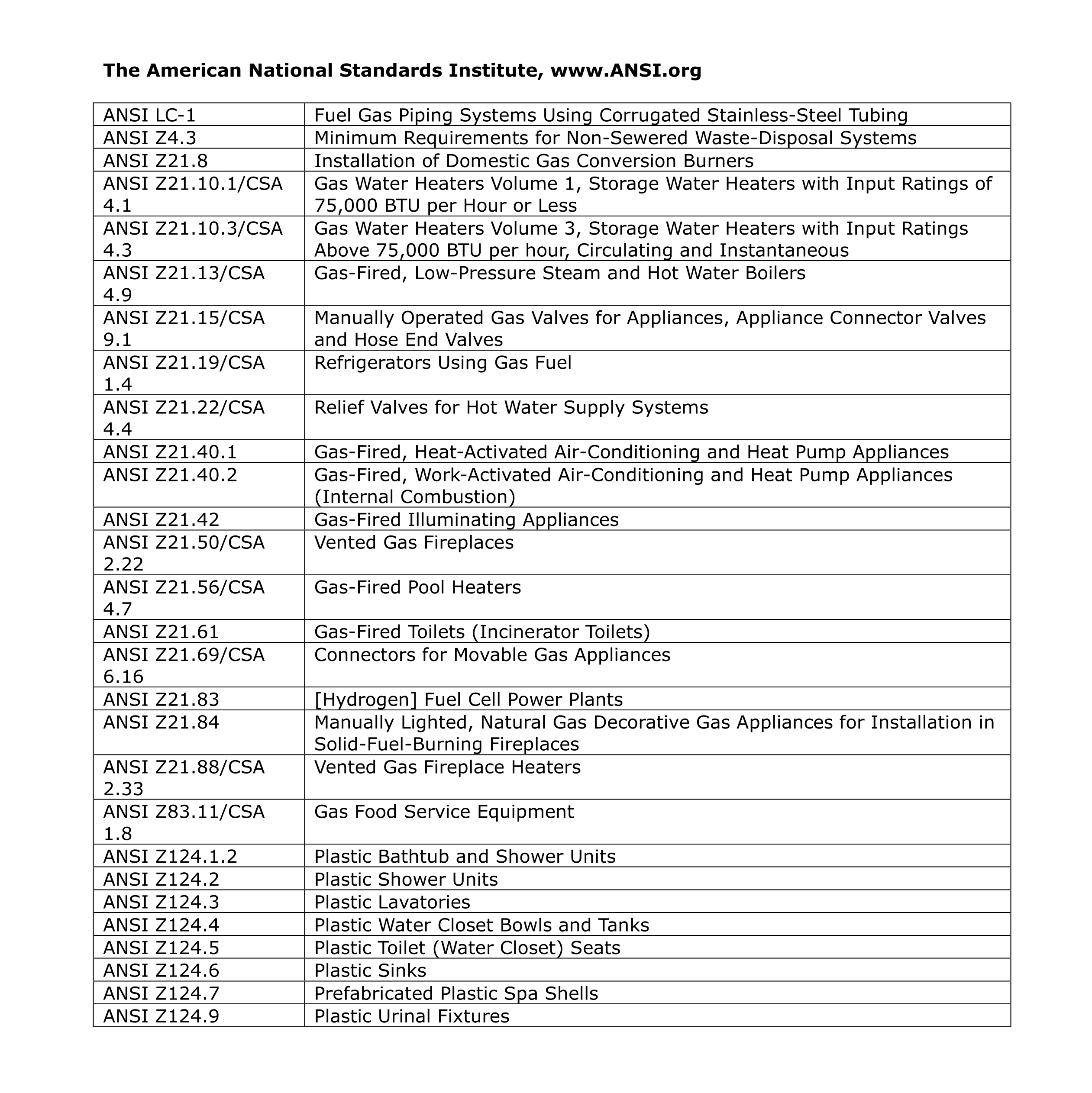
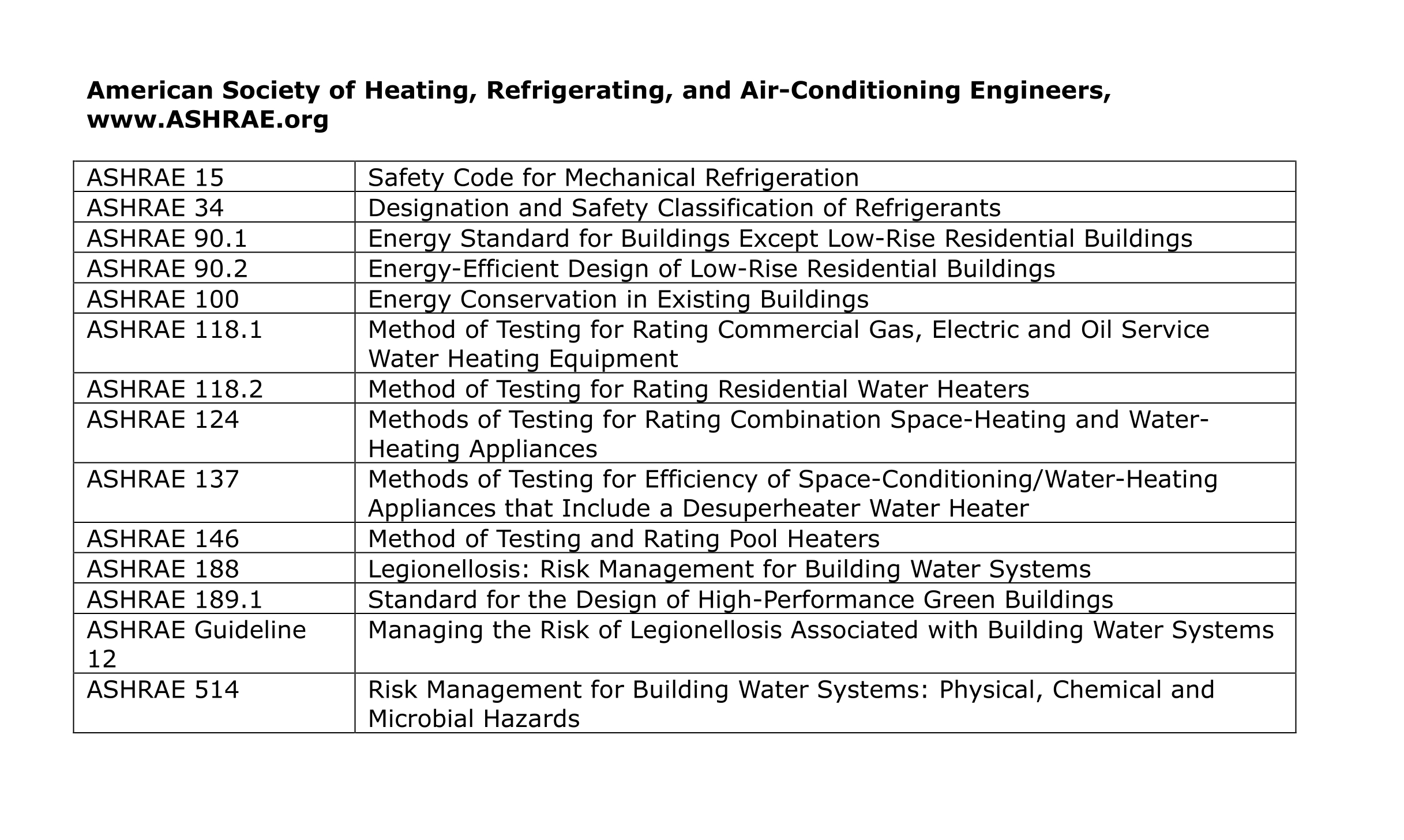
Note: Plumbing-related standards developed by various standards development organizations are shown in Charts 1 through 6, which you can find with this column on www.phcppros.com. l
Ron George, CPD, ASSE 12080 Legionella Management Professional, is president of Plumb-Tech Design & Consulting Services. Visit plumb-techllc.com for more information or call 734-755-1908.