Earlier this year, President Donald Trump jumped head-first into the world of metals and minerals as he sought to reinvigorate the coal industry, protect the nation’s steelmakers from unfair overseas competition, and beef up domestic production of minerals deemed critical to the nation’s well-being. Industrial Info Resources (IIR) is following these developments.
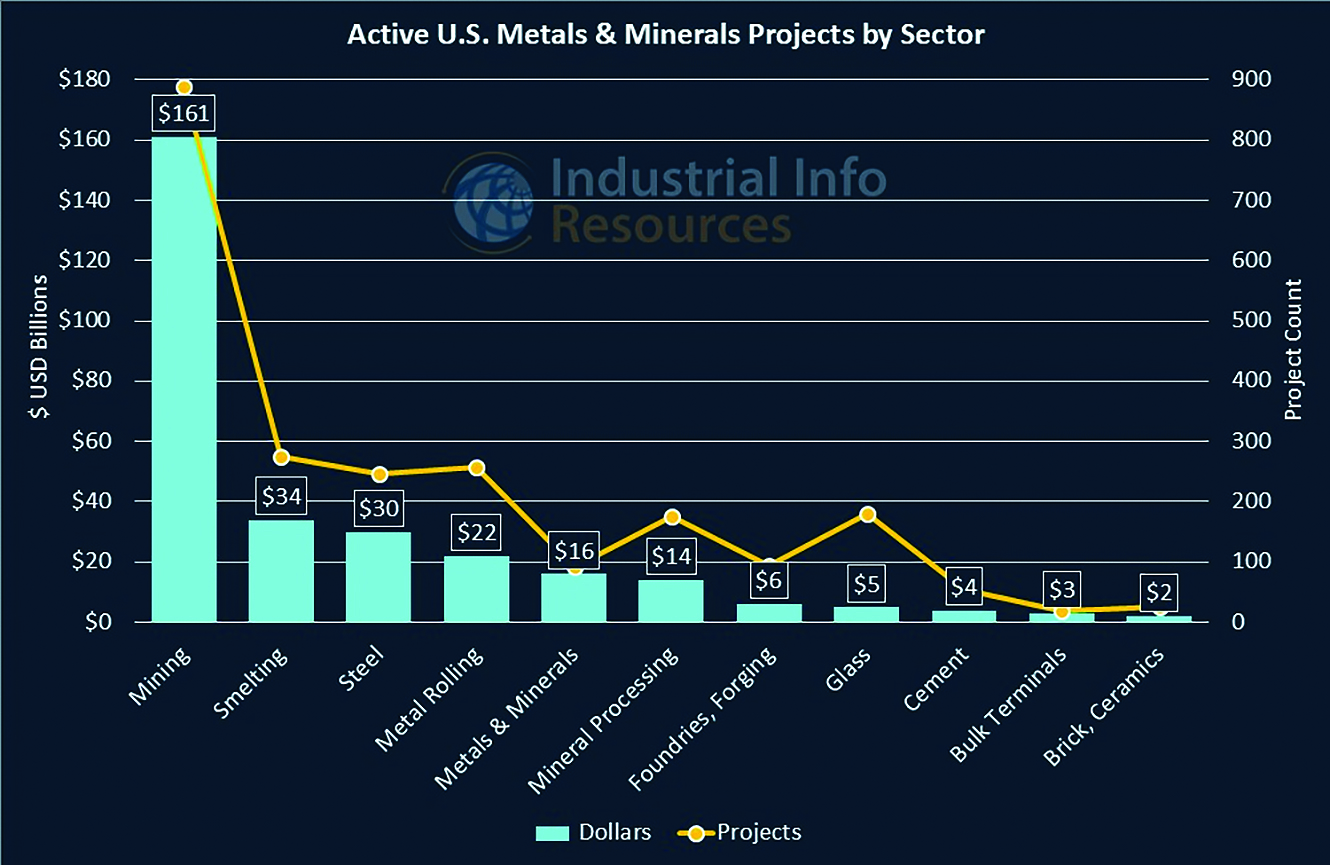
In addition, IIR is tracking more than 2,300 active metal and mineral projects in various stages of development across the country, totaling more than $300 billion of investment. Nearly all these projects list pipe, valves and fittings among their key equipment needs.
Projects in the mining sector easily outpace those in other sectors, with 888 projects worth $161 billion. Smelting projects come in second, with 276 projects worth $34 billion.
In April, President Trump issued executive orders designed to promote the use of coal in industry and power plants. “It’s cheap, incredibly efficient, high-density and it’s almost indestructible,” he added.
According to the U.S. Energy Information Administration (EIA), U.S. coal production (578 million tons) in 2023 was less than half that of the industry’s peak production in 2008. The EIA said rising mining costs, environmental regulations and competition from other sources of electric power generation contributed to declines in domestic coal production. The EIA expects U.S. coal production to drop from 512 million tons in 2024 to 483 million tons in 2025 and 467 million tons in 2026.
President Trump directed all departments and agencies of the federal government to end all policies negatively affecting the coal industry. Specifically, the executive orders end a leasing moratorium preventing new coal projects on federal lands. They also aim to accelerate permitting and funding for new coal projects.
Rare earth minerals critical for national defense
He also invoked the Defense Production Act to promote the domestic production of critical infrastructure minerals, saying U.S. mineral resources “can create jobs, fuel prosperity and significantly reduce our reliance on foreign nations.”
Targeted minerals include uranium, copper, potash, gold and any other element, compound or material, as determined by the National Energy Dominance Council chair.
Rare earth minerals are in focus. President Trump directed the Secretary of Commerce to investigate how imports of these materials affect America’s security and resilience. “This investigation will assess vulnerabilities in supply chains, the economic impact of foreign market distortions, and potential trade remedies to ensure a secure and sustainable domestic supply of these essential materials,” according to a White House fact sheet.
According to the U.S. Geological Survey, China accounted for 70% of U.S. rare earth element (REE) imports from 2020 through 2023.
How important are these minerals? It’s a big deal in several areas, but national defense tops the list.
According to the Center for Economic and International Studies (https://bit.ly/4m9WNMs): “The F-35 fighter jet contains [more than] 900 pounds of REEs. An Arleigh Burke-class DDG-51 destroyer requires approximately 5,200 pounds, while a Virginia-class submarine uses around 9,200 pounds.”
Fast-41 mineral mining projects
The administration is working to speed up permitting for a variety of mining projects under the U.S. Fast-41 program, including mines for copper, silver, antimony, lithium, metallurgical coal and others. IIR is tracking these projects.
IIR’s Joe Govreau, senior vice president of research operations for metal and mineral research, has seen some mining projects take as long as 25 years to wind their way through the permitting process.
However, the realities of possible state and local delays will affect the Fast-41 projects, some of which already have faced years of litigation, Govreau said.
Indeed, the government website listing the Fast-41 projects features a disclaimer designed to inject reality into expectations (https://bit.ly/4d9UWDr): “It is important to note that a project’s inclusion on the Permitting Dashboard does not imply federal endorsement of, or support for, the project or create a presumption that a covered project will be approved, favorably reviewed by any agency, or receive federal funding.”
The note adds that any project could be reconsidered due to changes in the scope of the federal review.
Global metals/minerals project spending
In a podcast earlier this year, Govreau and Shaheen Chohan, IIR’s vice president of global analytics, discussed global project spending for the industry.
“Metals demand continues to increase; the main driver, at least over the last 10 years or so, has been the energy transition,” Govreau says. “That’s going to continue going forward.”
Growth in electricity consumption, driven in part by a surge in data center construction, is sparking greater demand for copper, aluminum and steel, among other materials.
As a result, Govreau notes that the world’s top mining companies were planning to spend more this year on projects than they did in 2024.
“We’re looking at about a 7.3% increase (in capital expenditures) compared to last year,” he adds, citing data from IIR’s Global Metals & Minerals Project Spending Index.
However, market uncertainty caused by international tariff and trade issues could impact the spending scenario.
“The longer that uncertainty hangs over the market, the longer projects will be delayed,” Govreau says.
He adds that downstream sectors are more impacted by tariffs: “When you look globally, steel is at overcapacity. The Chinese produced more than a billion tons of steel last year, and they exported about 10% to 15% of that. When the tariffs go up, they block those (imports) from coming in, but those tonnages go to other countries, and it messes up their steel production.”
On the other hand, tariffs can boost U.S. steel producers and encourage the reshoring of manufacturing capacity to the United States, he notes.
“We’ve already seen this with a couple of foreign producers who are now looking to build steel mills in the United States,” Govreau explains. First, to take advantage of the U.S. market, which is healthy, and second, to avoid the impact of tariffs on their downstream operations.”
Domestic metals/minerals project spending
States like West Virginia are destinations for the metals and minerals industry. One of the state’s largest projects comes from the steel sector: Nucor Corp.’s steel sheet mill in Apple Grove. The 3 million ton/year mill will produce hot-rolled sheet products, accompanied by downstream processing, including a cold mill, annealing capabilities and two galvanizing lines.
Upon completion, which is expected early next year, the mill will begin ramping up toward its planned product mix of 1.1 million tons/year of galvanized steel, 800,000 tons/year of cold-rolled coil, 750,000 tons/year of hot-rolled coil and 350,000 tons/year of pickled and oiled steel sheet.
Nucor is also underway with a transloading and processing plant in New Cumberland, where the Ohio River can provide a means of shipping the company’s products. Other Nucor projects across the country include the 430,000 tons/year rebar micro mill in Lexington, North Carolina, which will cater to developers of roads, buildings, sidewalks and other structures; and a new 500,000-tons/year galvanizing line in Berkeley County, South Carolina.
Indiana-based Steel Dynamics is growing its aluminum business with the commissioning of a flat-rolled aluminum mill in Columbus, Mississippi. At full capacity, the mill will process an estimated 900,000 metric tons/year of aluminum slab — producing 650,000 tons of finished products annually to serve the beverage can, automotive and common alloy sectors.
Not all big steelmakers fared as well during the first months of this year. Reporting disappointing first-quarter earnings results, Cleveland-Cliffs discontinued plans for a transformer production project in Weirton, West Virginia, and fully or partially idled six of its facilities.
Meanwhile, the smelter sector, which involves the processing of metal ores to extract metal and remove impurities, has been active.
“Companies are moving to shore up their supply chain around security issues and get away from Chinese market control,” Govreau said during the global outlook podcast. Projects are on the rise in downstream refining and the smelting of metals, including those from recycled batteries, copper, lithium and rare earth oxides.
Brian Ford is editor in chief at Industrial Info Resources and has been with IIR since 2014. With global headquarters in Sugar Land, Texas, and 18 offices worldwide, IIR is a provider of global market intelligence specializing in the industrial process, heavy manufacturing and energy markets. To contact IIR, visit www.industrialinfo.com or call 713-783-5147.