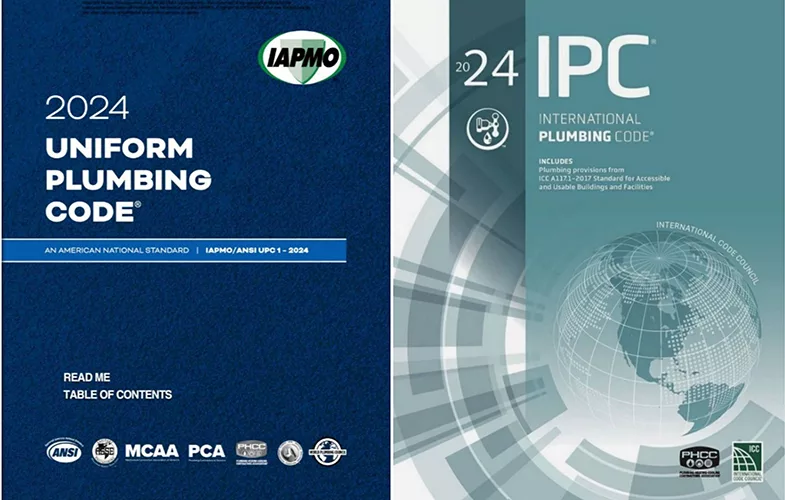
The 2024 editions of the Uniform Plumbing Code (UPC) and the International Plumbing Code (IPC) represent the latest versions of the two model plumbing codes. Each code is developed by a model code organization, which have their own unique approach to code development.
The UPC is sponsored and published by the International Association of Plumbing and Mechanical Officials (IAPMO), while the IPC is sponsored and published by the International Code Council (ICC). Both codes aim to safeguard public health and safety through comprehensive plumbing regulations, yet they exhibit differences in scope, structure and specific provisions.
Organizational background and development processes
1. UPC history. The UPC began on May 17, 1926, when the Los Angeles City Plumbing Inspectors Association (LACPIA), which later became the Western Plumbing Officials and then IAPMO, was officially formed. Forty-two plumbing inspectors banded together in response to people becoming ill and dying from poor plumbing practices. They recognized the need for plumbing design and installation standardization in their jurisdictions. Their objectives, as written in their first constitution, were as follows:
“To advance the latest and most improved methods of sanitation; To promote the welfare of and the harmony between the owner, builder and the craftsman; To accomplish a uniformity in the application of the provisions of the ordinances; and to promulgate the mutual benefit of the members, the City Division of Plumbing and the General Plumbing Fraternity.”
The LACPIA, which is now IAPMO, published its first plumbing code in 1945. It has gone through many changes since then and is now developed through a consensus process and accredited by the American National Standards Institute (ANSI).
2. IPC history. The ICC was first mentioned when talks about merging all the codes into one model code began in 1994. A “One Code Summit” was held in three different cities in 1995 to explore the possibility of all the model codes combining into one code.
Though the efforts failed, the committee exploring the merger continued meeting to explore combining the three model building code organizations, and, in 2000, this culminated in the creation of the International Code Council. Those three model code organizations were the Building Officials and Code Administrators (BOCA), the Southern Standard Building Code Congress International (SBCCI) and the International Council of Building Officials (ICBO).
The Southern Building Code Congress (SBCC) was created in 1940 and developed and published the first Southern Standard Building Code (later shortened to the Standard Building Code) in 1945. The SBCC changed its organization name to the Southern Building Code Congress International and maintained its headquarters in Birmingham, Alabama.
It did this to appeal to a wider international audience but missed the opportunity to remove the regional word “Southern” from its name when adding the word “International.” SBCCI compiled and published model building codes used by southern U.S. state governments to protect public safety. It eventually merged with ICC.
BOCA was established in 1915 as a nonprofit organization dedicated to professional code administration and enforcement for public health, safety and welfare by building officials from nine states and Canada with the aim of exchanging knowledge and ideas about building safety and construction regulation. In 1950, BOCA published its first model code: the BOCA Basic Building Code. It eventually merged with ICC.
ICBO only published the Uniform Building Code (UBC), and it relied upon IAPMO for its plumbing and mechanical codes. When ICBO decided to merge with all the other model building code organizations to form ICC, IAPMO did not have a building code organization partner. IAPMO quickly worked with the National Fire Protection Association (NFPA) and encouraged the development of NFPA 5000, a new model building code standard loosely based upon the construction documents and specifications developed for the Reedy Creek Development near Orlando, Florida — the basis for the construction and ongoing development for Disney World.
When BOCA, SBCCI and ICBO merged into the ICC, they produced the International Codes, which were the first full family of cross-referenced and correlated model building codes. The IPC is updated every three years, incorporating feedback from proposed code changes, public code hearings and technical committee and inspector voting. The ANSI-accredited consensus process for the entire code development process addresses code change proposals, emerging issues and technological advancements in plumbing systems.
Model code differences
• Enforcement power. One of the notable distinctions between the UPC and the IPC organizations is the power they grant to local code inspectors. The UPC gives code officials wide authority to administer and interpret code issues and determine what they will accept, and they can require additional requirements. This is covered in many code sections where, after a code requirement, it also states “… or as required by the authority having jurisdiction.”
The IPC covers most of the conditions in plumbing systems, and the administrative authority having jurisdiction, or code official, is simply there to inspect and enforce the code language as written. This ensures more uniform enforcement from one jurisdiction to another. The international codes are correlated and cross-referenced across different construction code disciplines.
• Common code format. Back in the 1990s, an effort was made to develop a common code format with subject matters for model plumbing codes, so that it would be easier to go from one code to another and know what topics are covered in each chapter. To address this, a common code format was suggested, and most model codes simply reorganized the order of their chapters into that format.
The UPC and IPC both follow the common code format for the most part: Chapter 1 covers administration, Chapter 2 covers definitions, Chapter 3 covers general conditions, Chapter 4 covers plumbing fixtures, Chapter 5 covers water heaters, Chapter 6 covers water supply and distribution systems, Chapter 7 covers drainage, etc.
• Water conservation and efficiency. The IPC has introduced provisions to limit showerhead flow to 2.0 gallons per minute (gpm), aiming to conserve water without compromising performance. It also includes requirements for vacuum testing of drain-waste-vent (DWV) systems and mandates tracer wire for buried plastic sewer piping to enhance system integrity and facilitate future maintenance.
The UPC has similarly focused on water efficiency, incorporating temperature-actuated flow reduction devices for individual fixtures and updating water supply fixture unit and drainage fixture unit values for bathroom groups. These adjustments are intended to optimize water usage and system performance.
• System resilience and safety. The IPC has added requirements for supporting buried piping beneath buildings situated on expansive soils, addressing potential ground movement that could affect plumbing systems. It also specifies standards for chemical waste piping materials, ensuring compatibility and safety in handling hazardous substances.
The UPC has introduced provisions for tileable shower receptors and kits, enhancing design flexibility and accessibility. Additionally, it includes updated provisions for appliance condensate drains serving multiple appliances, promoting efficient waste management and reducing the risk of system overloads.
• Innovative installations and sustainability. The IPC has incorporated standards for solvent-cemented plastic piping joints and plastic pans for gas-fired water heaters, requiring testing in accordance with ASTM E84 or UL 723 to ensure fire safety. It also emphasizes the integration of the updated ICC A117.1, Accessibility Standard.
The UPC has introduced new appendices addressing plumbing requirements for indoor horticultural facilities and tiny houses, reflecting the growing demand for specialized plumbing solutions in these areas. It also includes provisions for onsite stormwater treatment systems, aligning sustainability goals and promoting responsible water management practices.
Adoption and jurisdictional considerations
The adoption of the UPC and the IPC varies by jurisdiction. The UPC is predominantly adopted in the western United States, while the IPC is more commonly used in the eastern regions. Typically, a state legislature, by statute, determines which model code to adopt. Authority is provided to a governmental agency or board to review and make any changes to the model code based on factors such as politics, union influence, regional climate, infrastructure and specific community needs.
Local jurisdictions of a state, such as cities and counties, may also adopt the code as adopted by the state board, or may enact more stringent provisions, depending on the particular state’s laws.
It’s essential for plumbing professionals and contractors to be familiar with the specific edition of the model code requirements adopted in their areas and be aware of any local amendments for that code edition. The effective dates of a model code, as amended, in a state or city may be a couple of years after the date printed on the cover of the model code book.
This is important when determining compliance with the codes. If there is an addition, alteration or revision to a plumbing system, establishing the correct code in effect is important. It is especially important to know which code applies when there is property damage, injuries or death and litigation is involved.
The plumbing industry has witnessed substantial advancements in the 2024 editions of the UPC and the IPC. At the time of this writing, both model code organizations continue moving forward with hearings planned in 2025 and 2026 for the 2027 editions of their model codes. These updates in the 2024 editions of the plumbing codes reflect the latest effort to enhance them and address public health, safety, sustainability and accessibility for plumbing systems.
The following items summarize key code changes introduced in both codes. These changes are highlighted for the benefit of users, design professionals, contractors, inspectors, manufacturers and other stakeholders in the plumbing industry.
Code changes: UPC 2024
The 2024 UPC, published by IAPMO, has several noteworthy changes:
1. All-gender facilities
Recognizing the growing demand for inclusive facilities, the UPC now includes provisions for all-gender (unisex) restrooms. These guidelines cover fixture counts, privacy compartments and partitions, ensuring equitable access for all individuals.
2. Water supply and distribution manifolds
New requirements have been established for water supply and distribution manifolds. These provisions aim to enhance system efficiency and reliability, reducing the risk of leaks and facilitating easier maintenance.
3. Hot-water recirculating systems
The code has updated provisions for hot-water recirculating systems, promoting energy efficiency and ensuring that hot water is readily available at fixtures, thereby reducing water wastage.
4. Private well water tanks
Recognizing the importance of private water sources, the UPC now includes provisions for private well water tanks. These guidelines ensure safe and efficient installation and maintenance practices for private water systems.
5. Nonpotable water systems
The code has updated minimum water quality provisions for on-site treated nonpotable water systems, including harvested rainwater systems. These changes aim to promote sustainable water use while ensuring public health and safety.
6. Tiny houses
A new appendix (Appendix R) provides minimum plumbing system requirements for tiny houses. This addition addresses the unique challenges posed by compact living spaces, ensuring that plumbing systems are both functional and compliant.
7. Indoor horticultural facilities
With the rise of indoor agriculture, the UPC has introduced Appendix Q, which outlines plumbing requirements for indoor horticultural facilities. This ensures that such operations adhere to safety and health standards.
8. Stormwater treatment systems
Appendix S has been added to address provisions pertaining to onsite stormwater treatment systems. This inclusion supports sustainable water management practices and helps mitigate environmental impact.
IAPMO publishes the following codes:
- Uniform Plumbing Code;
- Uniform Mechanical Code;
- Uniform Swimming Pool, Spa, & Hot Tub Code;
- Uniform Solar, Hydronics & Geothermal Code.
UPC jurisdictions separately review and adopt these codes:
- NFPA 5000 Building Code or the IBC;
- NFPA 54 National Fuel Gas Code or the International Fuel Gas Code (IFGC).
The uniform codes do not offer a separate residential code.
Code changes: 2024 IPC
The 2024 IPC, developed by the ICC, has several updates to enhance plumbing system resilience, sustainability and accessibility:
1. Support for buried piping
New provisions have been added for the support of buried piping beneath buildings where expansive soil conditions exist. This measure aims to prevent damage to plumbing systems caused by soil movement.
2. Vacuum testing for DWV systems
The IPC now offers the option for vacuum testing of DWV piping. This alternative testing method provides flexibility and ensures the integrity of DWV systems.
3. Showerhead flow limitations
To promote water conservation, the code limits showerhead flow to 2.0 gpm, with performance complying with high-efficiency requirements. This change aims to reduce water usage without compromising user experience.
4. Chemical waste piping standards
New standards have been added for chemical waste piping and fitting materials. These guidelines ensure that plumbing systems handling hazardous materials are safe and compliant with health regulations.
5. Integration with accessibility standards
The 2024 IPC integrates the updated ICC A117.1, Accessibility Standard, enhancing building accessibility and ensuring that plumbing systems accommodate individuals with disabilities.
For residential occupancies (one- and two-family dwellings), many jurisdictions adopt the International Residential Code.
The international family of codes prioritizes system performance, sustainability, handicap accessibility and efficiency. They include:
- International Building Code (IBC);
- International Residential Code (IRC);
- International Fire Code (IFC);
- International Plumbing Code (IPC);
- International Mechanical Code (IMC);
- International Fuel Gas Code (IFGC);
- International Existing Building Code (IEBC);
- International Energy Conservation Code (IECC);
- International Property Maintenance Code (IPMC);
- ICC Performance Code for Buildings and Facilities (ICCPC);
- International Private Sewage Disposal Code (IPSDC);
- International Swimming Pool and Spa Code (ISPSC);
- International Wildland-Urban Interface Code (IWUIC);
- International Zoning Code (IZC);
- International Green Construction Code (IgCC).
The 2024 updates to the UPC (https://bit.ly/3GwBUuA) and IPC (https://bit.ly/44A2pcv) represent a significant step forward in modernizing plumbing practices. By addressing emerging needs such as sustainability, inclusivity and system resilience, both codes ensure that plumbing systems are safer, more efficient and better equipped to meet the challenges of the future.
Engineers, contractors, inspectors, building owners and the public should stay informed and adapt to these changes to uphold the highest standards of public health and safety.