Eastern State Hospital, located in Medical Lake, Washington, about 15 miles west of downtown Spokane, has served as a beacon of hope since its opening in 1891, providing inpatient care and treatment for adults with mental illness. Nestled beside a lake believed to possess medicinal properties, this grand facility was constructed with an architectural approach featuring long, meandering wings that extended from a central building. The wings allow each section to bask in sunlight and fresh air – elements well-known for their curative effects on patients.
For more than 125 years, the Medical Lake campus staff have helped guide patients through their mental health challenges, combatting illnesses and the stigma frequently attached to them. ESH supports the most severely affected individuals, operating as a psychiatric facility with 375 beds that carefully separates men, women, elderly patients, and individuals facing criminal charges. The commitment to humane care is maintained with a focus on reintegrating patients into society through increased community engagement before their full release.
The grand hospital was constructed in 1891. At that time, hospital practices shifted dramatically with the adoption of the French approach to “moral treatment.” This revolutionary paradigm marked a departure from the harsh methods of the past, transitioning from brutal treatments, such as chains and heavy straps used for full-body restraint, to a more compassionate model focused on patient dignity.
Practices such as providing access to a library, facilitating family visits and promoting outdoor rest and relaxation became the standard, fostering an environment conducive to healing.
Enhancing patient care
As part of the ongoing mission to enhance the comfort of patient care, ESH recently embarked on an ambitious project: a well-planned hydronic retrofit of its mechanical systems.
“Our significant upgrades have modernized the facility’s infrastructure, ensuring more efficient temperature control and a much more comfortable environment for patients and staff alike,” says Dean Davis, director of facilities. “Even our culinary efforts, with an expanded menu and much greater control of hydronic cook pot temperatures, have improved dramatically.”
Davis explained that an old, deteriorating facility served as the campus’ central heat plant for more than 100 years. In it, two huge, decades-old steam boilers had also deteriorated, while also losing efficiency. The old hydronic systems also required routine repairs and maintenance. With the assistance of federal and state grants, funding was secured to replace the entire heat plant facility, including the building, with enhancements to equipment, control and piping.
Davis knows a thing or two about large health facility operations. Though he’s already spent more than seven years at ESH, he spent considerable time at medical centers during his more than 20 years in the U.S. Air Force. He served at Providence Alaska Medical Center in Anchorage, and then at Deaconess Hospital in Spokane prior to his role at ESH.
Davis spent much of his military service in various roles with Civil Engineering Squadrons, including those as a generator technician where he got most of his mechanical experience. He retired from the Air Force as a safety officer.
“We now have a new, 12,000-square-foot, all-brick heat plant facility with pipes in underground tunnels that provide continuous space and domestic water heat to three main facilities on campus – the hospital itself, an admin building and the kitchen facility where we make about 1,200 meals and 400 snack packets a day for patients,” Davis adds. “We also prepare 250 to 300 staff meals each day.”
Crown jewels
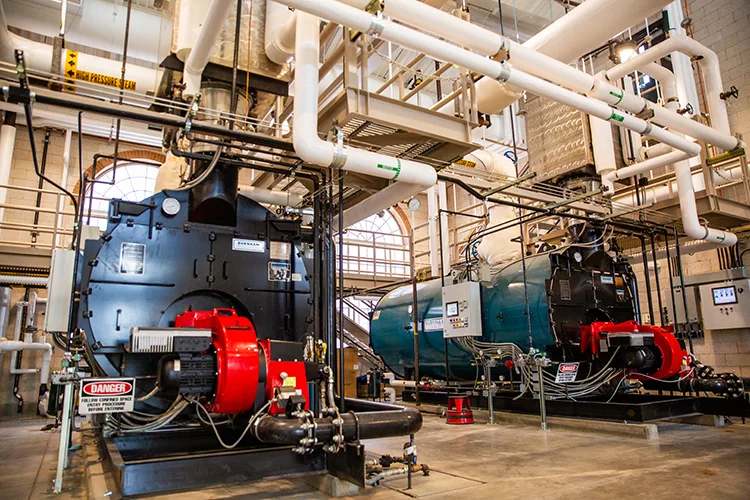
The crown jewels within the new heat plant facility are three 6,700 MBH, four-pass firetube Burnham commercial steam boilers connected in a lead-lag configuration. Combined, the boilers provide greater capacity than is required, allowing for full redundancy of operation. Jutting from the boilers, in front, are large red Weishaupt oil-fired burners.
According to Brad Snow, PE, LEED-AP, senior mechanical engineer, MSI Engineers, Spokane, Washington, ESH facility staff requested use of Weishaupt burners with the new Burnham boilers because similar Weishaupt burners were used successfully at another state facility.
MSI Engineers was the engineer of record for the ESH facility. Brad Snow was the lead mechanical engineer; Aaron Donnelly was the principal in charge.
“Pre-design studies addressed the design recommendations for all the major mechanical systems,” Snow says. “The aging steam plant had reached its time of retirement.”
Snow adds that the plant steam pressure was selected to operate at 100 psi nominal pressure, with pressure reducing valves provided to allow the campus delivery pressure to be adjusted to a lower pressure for distribution, nominally set at 60 psi.
“Both the surge tank and deaerator storage tanks are designed for approximately 20 minutes of make-up water supply, based on two boilers firing at full capacity, which is rare,” Snow explains. “This is good engineering practice and provides a buffer of available feedwater capacity for downstream condensate interruptions, start-up transients or maintenance activities.”
Part of the new mechanical system, said Snow, is a 615-gallon Shipco surge tank, and a “DA” (deaerator) tank by the same manufacturer. Both are used for boiler make-up feedwater.
A deaerator tank plays an important role in boiler feedwater systems. Its key role includes removing dissolved gases, such as oxygen or carbon dioxide, from boiler feedwater; otherwise, entrained gases can cause boiler or piping corrosion.
It’s an important advantage to heating the feedwater because this minimizes thermal shock to the boiler and improves overall system efficiency. And, by storing heating feedwater, the tanks provide a storage capacity for the treated feedwater, ensuring a consistent supply to the boiler.
Make-up water is added to the surge tank. The flow between the surge and the DA are modulated according to the DA’s feedwater level, ensuring that the deaerator always has consistent operating conditions, helping to maintain optimal system performance. An added benefit is that the surge tank can perform as an emergency backup source of fluid if the DA is offline for any reason.
Food service
Davis explained that in addition to the provision of space and domestic water heat, the boilers send high-temperature dry steam to three 25- to 75-gallon, jacketed steam kettles, three large, stacked steamers and a large, commercial steam dishwasher. The steam cookpots, providing ideal, even heat across kettle surfaces when making stew, gumbo, chowder, soup, and vegetable entrées, are used almost around the clock for preparation of hospital patient meals.
A network of underground concrete service tunnels provides easy subterranean passage between facilities by maintenance crews while also providing space for the many interconnected pipes to and from the heat plant. A 10-by-40-foot control room there has a glass wall that looks into the spacious boiler room.
Service and maintenance of the facility’s new boilers and connected near-boiler equipment is performed by personnel serving with members of a state agency, the Maintenance Operation Division/Consolidated Support Services. The group has a separate facility located on campus to support the hospital, LakeLand Village, Martin Hall, and the nearby Washington State Veterans Cemetery.



