The Plastics Pipe Institute (PPI) has announced its support for the Plastic Health Research Act (H.R. 4903), the bipartisan legislation introduced by Reps. Haley Stevens (D-MI) and Frank Lucas (R-OK) to expand and coordinate federal research on plastic exposure and potential impacts on human health. The bill is currently pending in the House of Representatives. PPI is the major North American trade association representing the plastic pipe industry. The organization’s member companies provide piping solutions widely used in water, wastewater, stormwater drainage, energy, industrial and communications infrastructure across the United States and Canada.
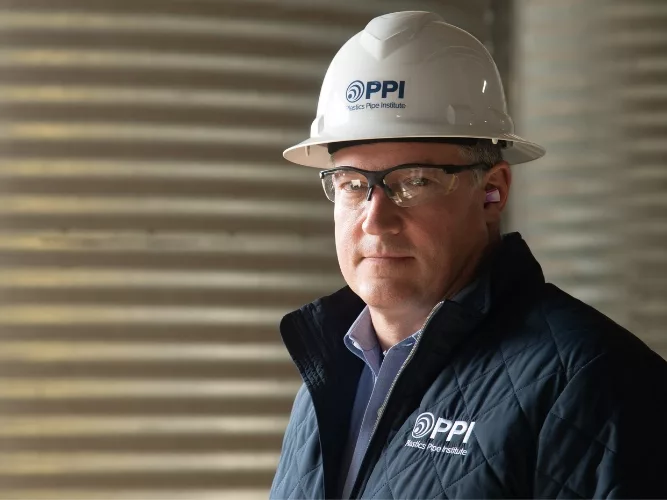
“There is a great amount of interest in microplastics, but much of the information circulating is mixed or inaccurate,” said David M. Fink, PPI president. “The Plastic Health Research Act will help deliver clearer answers by supporting coordinated federal research, consistent definitions, and reliable testing methods. This means that conclusions are based on strong science. And this approach will help reduce confusion by making research results more consistent and comparable.”
The legislation directs the U.S. Department of Health and Human Services to carry out, expand, and coordinate research on plastic exposure, including through consultation with key federal scientific agencies such as EPA, FDA, NOAA, NIST, and NIEHS. The bill also prioritizes reproducible research methods, standard definitions for microplastics and nanoplastics, and the development of validated testing methodologies and reference materials to improve comparability across studies. To support this work, the bill authorizes $10 million annually for FY2026–2030 for research grants and contracts and an additional $10 million annually for FY2026–2030 to support Centers of Excellence focused on improving the quality and comparability of research.“PPI supports the Plastic Health Research Act and recognizes Representatives Stevens and Lucas for advancing this bipartisan legislation. We urge Congress to act now and move this bill forward,” Fink added.