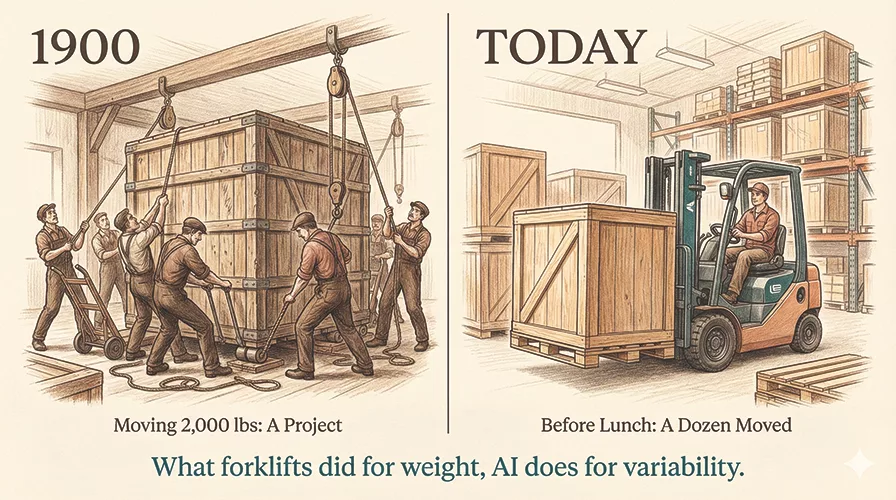
There’s a tax being levied on your business right now. It doesn’t appear on any financial statement. Your accountant can’t quantify it. But it’s compounding daily, and the rate just increased. This isn’t a technological cost. It’s a learning cost. Every day your competitors operate with AI tools, they’re accumulating organizational intelligence your team doesn’t have. That knowledge compounds. And unlike software licenses, it cannot be purchased off the shelf.
A pattern of problems
Consider a problem you’ve lived with so long it feels like gravity “quote velocity.” For decades, the hard truth was simple—if you wanted to materially increase how fast you could turn quotes, you needed more people. That constraint felt like physics, an immutable law of the business.
It wasn’t.
There are multiple documented benefit cases showing a 90% reduction in quote processing time. This is not marginal improvement, it is transformation. The companies achieving these results aren’t just faster. Their quotes are more complete, more accurate, more competitive. They didn’t trade quality for speed. They achieved both and earned an even better benefit, higher win rates.
There are thousands of problems of this same type in your organization. We now have a tool, currently called AI, that solves this type of problem. Your forward-leaning competitors are learning how to use these new tools to accelerate and smooth customer, supplier, and employee experiences.
A different kind of tool
That “different kind of tool” is a crucial difference with far-reaching implications. AI isn’t a better tool in a familiar category. It’s genuinely alien technology that requires a fundamentally different mental model for identifying problems and crafting solutions.
These systems reason—sort of. They hallucinate—definitely. They require conversation and iteration, not commands and configurations. The skills that make someone effective with AI aren’t always the skills you’d expect. Your best database administrator might be viscerally repelled by a system that occasionally fabricates information with complete confidence. Meanwhile, the employee who studied philosophy or English—trained in precise language and comfortable with ambiguity—might be your secret weapon.
The familiar playbook doesn’t apply here. “Learn the interface, train the team, deploy across the organization” assumes a stable, predictable tool. AI is neither. It’s a moving target requiring continuous learning, and a tolerance for uncertainty most organizations haven’t had to develop.
An accelerating target
About that moving target - the pace of capability advancement isn’t just fast. It’s accelerating.
In early October, AI systems gained the ability to produce publication-ready Word documents, PowerPoints, and Excel spreadsheets—capabilities that simply didn’t exist months earlier. What was impossible in spring became routine by fall. The AI tools available today will look primitive compared to what arrives in 2026. You’re not learning a stable system you can master and move on from. The organization must incorporate continuous learning in its culture to build organizational muscle for perpetual adaptation. The next five years will be some of the wilder ones in business history.
This is what makes standing still so expensive. You’re not maintaining position while you evaluate options. You’re falling behind at an increasing rate, watching the gap widen as the technology accelerates away from you.
Here’s what your competitor who started eighteen months ago actually acquired. It wasn’t software. It was a fundamental rewiring of how they operate. They have begun their Commercial Process Renaissance.
Institutional intelligence
They’ve learned to see problems they’d been blind to for decades—constraints they’d accepted as physics, now revealed as merely unsolved challenges. They’ve developed intuition for what AI handles well versus where it stumbles. They’ve built management muscle for orchestrating human and AI capabilities together, knowing when to trust the output and when to question it.
They’ve accumulated failure knowledge. They know what doesn’t work in their specific context, which prompts produce garbage, which workflows create bottlenecks, which use cases aren’t worth the effort. That negative knowledge is as valuable as their successes, and it only comes from doing.
They’ve created permission structures for experimentation. Their people aren’t afraid to try things, to fail small, to iterate. They’ve trained their staff to collaborate with AI rather than compete with it or fear it.
This institutional intelligence compounds daily. Every week of operation adds another layer of organizational capability. And here’s what should keep you up at night: none of it can be purchased.
You can buy the tools—those are the easy part. You can hire consultants to accelerate implementation. You can even acquire a competitor who built what you didn’t, paying a capability premium. But you cannot buy the journey itself. The scar tissue, the pattern recognition, the hard-won judgment about when to lean in and when to hold back—that only develops through months and years of actual operation.
This isn’t a technology implementation. It’s an operating system upgrade for how you run a company. It requires vision to see what’s newly possible when old constraints dissolve. It demands intense, sustained learning to build operational intuition. And it takes genuine management acumen to orchestrate a transition of this fundamental without breaking what already works.
The executives who frame this as “buy software, train staff, done” will discover they’ve purchased tools without developing the organizational intelligence to wield them. They won’t catch up. They’ll just have expensive software and the same capability gap they started with.
The choice
You’re standing at a fork with two paths.
Path One: Start now. Accept that the learning curve is steep and the technology is strange. Build institutional knowledge through operation, not observation. Accumulate the organizational intelligence that only comes from doing the work. It will be uncomfortable. Your people will struggle with the ambiguity. You’ll make mistakes. Those mistakes are the tuition for capability.
Path Two: Wait. Evaluate. Study the market. And discover, in eighteen months or three years, that no check you can write purchases the journey your competitors already walked. The tools will be available for sale. The institutional intelligence will not.
The laggard tax rate just increased. Not on the technology—on the understanding your organization doesn’t yet have.
What is your competitor learning today that your team won’t learn for another six months?
Brooks Hamilton is the founder of AI Strategy Advisors, specializing in AI advisory services for wholesale distribution and manufacturing companies. He can be reached at [email protected]