As compute density soars and AI workloads scale at unprecedented rates, the data center industry is facing a new kind of bottleneck. It’s not bandwidth or storage that’s holding things back—it’s heat. That’s why managing temperature has become one of the most urgent challenges for sustaining performance.
“The industry was very status quo for the past 30 years,” says Nolan Foran, national sales manager, mega project works at Watts Water Technologies. “You just pushed cold air past the cabinets, and performance was good. But now, with higher-performance chips driving generative-AI and language learning models, we’re experiencing a revolution in cooling design.”
Across hyperscale builds and colocation environments, technical teams are rethinking not just how heat is removed, but how systems are designed from the ground up to support reliability, resilience, and rapid change.
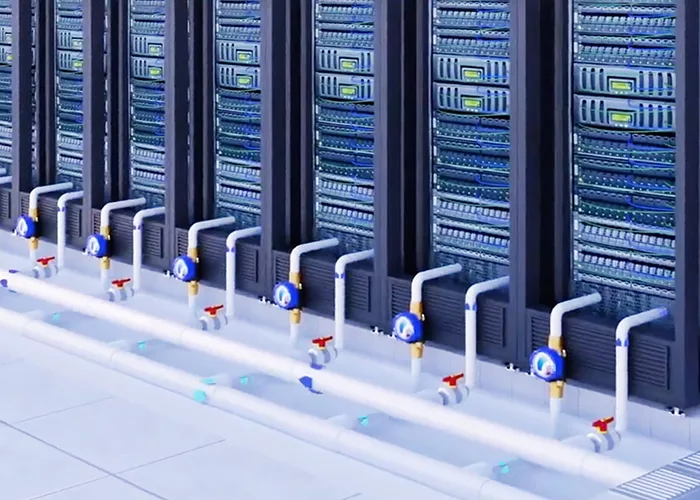
This shift has catapulted data center cooling design into uncharted territory, where hydronic cooling systems are no longer considered a niche but a necessity. Traditional air-cooled systems simply can’t handle the heat generated by today’s high-density AI workloads. And while hydronic cooling offers powerful thermal advantages, adapting existing infrastructure is no small feat
“It’s not just the thermal challenge,” Nolan explains. “Engineers are trying to do more within existing physical limitations, so there are structural and mechanical constraints too. Can the building handle the weight and layout of chilled water piping? Do the floors support the necessary cabinet density?”
The push for future resilience means engineers must consider not only the thermal loads of today’s chips, but also the increased heat output expected from tomorrow’s.
“They’re being asked to design for what’s next, not just for what’s now,” Nolan says. “And they’re doing this under pressure from hyperscalers and enterprise clients who demand modularity, speed, and geographic flexibility.”
Modular data centers
Modular data centers have become a go-to strategy for quickly deploying scalable infrastructure. This prefab approach allows stakeholders to work around labor shortages and supply chain delays by building systems wherever resources are available.
However, it also requires extreme coordination across teams and locations, with each module needing to seamlessly integrate with others. And geographic variables—from climate to water availability to local regulations—can further complicate things.
“Regions like Arizona or California, where water is scarce, are pushing for closed-loop systems,” Nolan adds. “Open-loop systems with evaporative cooling just aren’t viable in places where every gallon counts. So now we’re talking about systems with higher upfront investments in equipment but better water efficiency.”
Mission-critical
In these mission-critical environments, failure is not an option. That’s why redundancy is built into every layer of cooling system design.
“You’ve got duplicate lines, duplicate power, and in some cases, even duplicate water sources,” Nolan says. “We’ve seen systems with massive storage tanks designed to maintain operation during outages, just long enough to bring chillers back online or reroute flows.”
Some designs even incorporate geothermal cooling or thermal energy storage—freezing water overnight to be used during peak loads or emergencies.
“It’s not common yet,” Nolan says, “but we’ve seen it from at least one of the major hyperscalers.”
These innovations provide a buffer against unexpected disruptions, helping to ensure that compute workloads—especially those tied to healthcare and other high-stakes industries—stay online.
Maintenance matters
Even the best-designed system can falter without proper maintenance, and hydronic systems bring new requirements for cleanliness and monitoring.
“One of the biggest issues we’re seeing during startup is clogged strainers,” Nolan explains. “Especially in technical water loops, where you’ve got very fine mesh strainers designed to keep particulates out of microtubules and cold plate technologies.”
Contaminants introduced during construction or from unflushed piping can wreak havoc on these sensitive systems. That’s why Nolan emphasized the importance of thorough flushing before bringing a system online—and the value of ongoing monitoring afterwards.
To that end, Watts has introduced smart strainer technology that actively monitors differential pressure and can automatically flush itself when blockages begin to form. This proactive solution offers visibility into system health before a problem disrupts operations.
Smarter materials
Another area where Watts is seeing change is in the materials used for cooling systems, particularly in direct-to-chip technical water loops.
“There’s growing interest in high-purity thermoplastics,” Nolan says. “They’ve been used in the semiconductor industry for decades to carry ultrapure water, and now we’re seeing the same materials being adopted in data center cooling.”
Thermoplastics offer several advantages over stainless steel or brass: They’re more resistant to scaling and corrosion, easier to install, and often more cost-effective, especially for large-diameter piping. Plus, they support modular construction and off-site fabrication.
“They’re ideal for systems that need to maintain purity over time, especially with glycol or other additives to prevent microbial growth,” Nolan adds. “We’re also exploring water quality management systems that can monitor turbidity, conductivity and chemical concentration to keep systems operating at peak efficiency.”
Air traps, leaks and flow
Beyond contaminants and corrosion, operational issues like air entrapment, leaks and flow imbalances can silently degrade system performance. And unless operators are armed with the right diagnostic and monitoring tools, these issues may go unnoticed until they cause bigger problems.
“If everyone’s doing regular maintenance, facility managers should catch most of it,” Nolan adds. “But the reality is that these facilities run 24/7, and more touchpoints are always better.”
That’s why Watts has developed an ecosystem of smart and connected devices, such as pressure regulators, flow switches, and advanced leak detection systems, that integrate directly into a building’s management platform. These tools can detect erratic pressure changes, unusual flow rates, or even pinpoint the location of a leak using cable sensors or “hockey puck” moisture sensing devices placed near vulnerable equipment.
“It’s all about awareness,” Nolan adds. “The more data you have, the more proactive you can be.”
Performance metrics
Ultimately, success in hydronic cooling comes down to performance metrics—and being able to react when those metrics slip.
“If you see water on the floor, you’ve already got a major problem,” Nolan says. “But more subtle indicators come from metrics like power usage effectiveness (PUE) and water usage effectiveness (WUE).”
PUE measures how efficiently a data center uses power, ideally approaching a ratio of 1.0, where nearly all energy goes to powering IT equipment rather than cooling. WUE looks at how much water is consumed and discharged. If either metric drifts from optimal values, it’s a signal that something in the cooling system isn’t working as it should.
“These are high-level KPIs,” Nolan says, “but they can help flag systemic issues. And when paired with smart sensors and device-level data, they give operators the full picture.”
Smarter cooling
As data centers scale in size and complexity, Watts is positioning itself as a partner in solving cooling challenges. From smart strainers that prevent fouling to advanced leak detection and water quality monitoring, the Watts product line is built around visibility, automation, and modularity.
“We want to be more than just a piece of hardware,” Nolan adds. “We’re helping design smarter, more efficient systems that are ready for the future—whatever that looks like.”