
The world envies the U.S. economy for its sheer size. Only in America can you find 10 industries greater than $1 trillion in size, no other country comes even close. The benefit of this scale is that when one, or even several, industries weaken, there are alternative destinations for people and capital. This has made America’s economy exceptionally resilient and bolstered its global status for nearly a century.
Yet when looking back on 2025, an overwhelming amount of focus fell on just one industry, with everything else amounting to background noise. That industry, as you may have already guessed, was artificial intelligence (AI) and its accompanying data centers.
In 2025 business leaders across all spectrums spoke about how they were investing in AI to stay ahead of the competition with the goal of unlocking new capabilities and efficiencies. Preliminary estimates indicate that data center construction doubled for a fourth consecutive year to approximately $60 billion, while hundreds of billions of dollars in future investments have already been promised.
Manufacturing construction also appears to have nearly doubled in 2025 to nearly $100 billion, up from $58 billion a year ago. Much of this growth was driven by record-high investment in chips and other high-tech infrastructure again related AI.
The rising influence of megaprojects and data centers
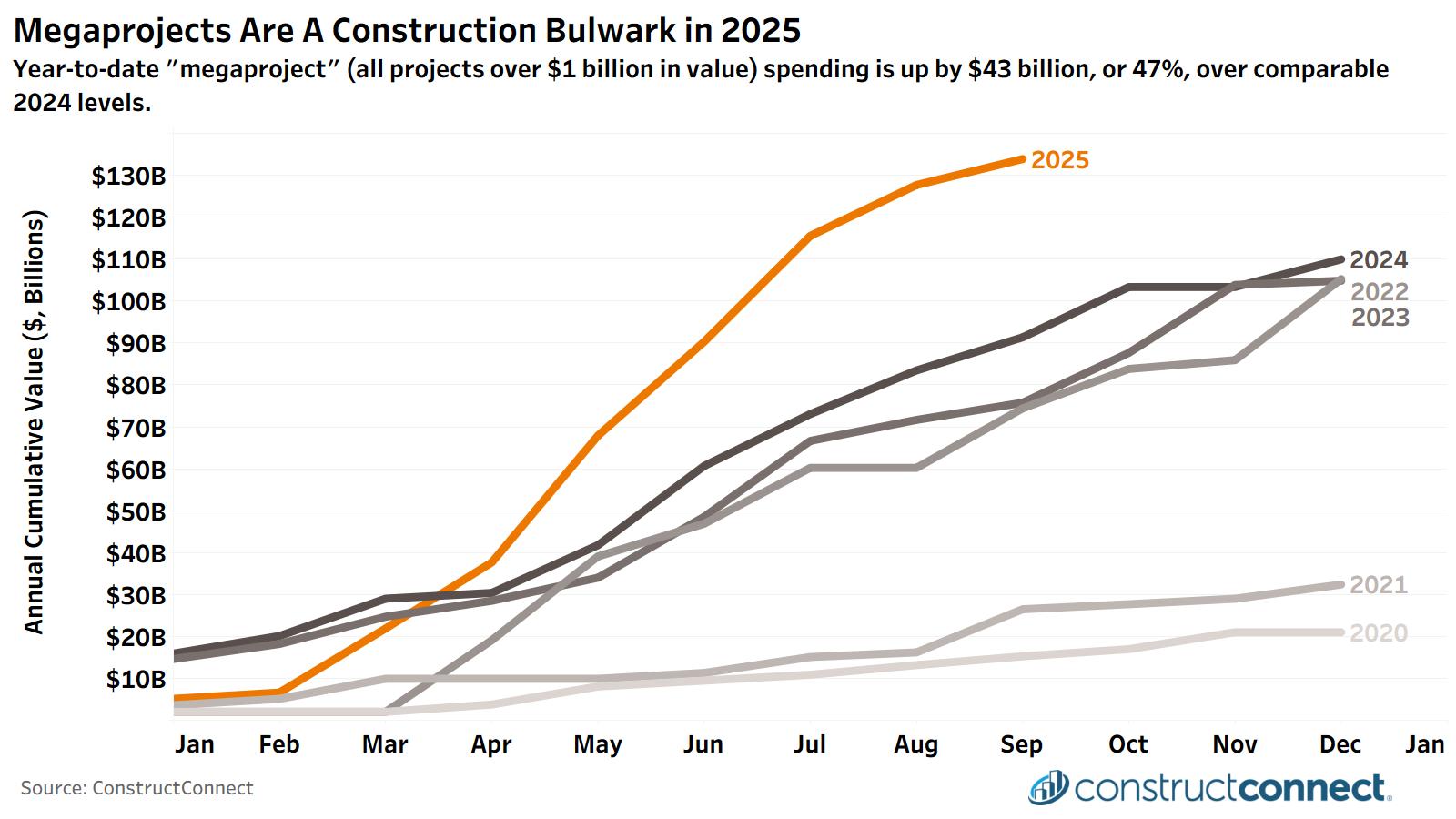
Construction’s positive performance in 2025 would not have been possible without the incredible growth of megaprojects, defined as projects greater than $1 billion in total construction value. Through the third quarter of 2025, megaprojects totaled $134 billion, an increase of $43 billion, or 47%, over the same period in 2024. It should not be surprising, then, that many of the best-performing subcategories in 2025 favored megaprojects, including manufacturing, airports, data centers, and sports and convention centers (see Figure 1).
No subcategory has experienced greater growth than data centers. Additionally, this growth has been geographically widespread with at least 38 states benefiting from some new data center construction and 10 reporting at or more than $1 billion in new construction.
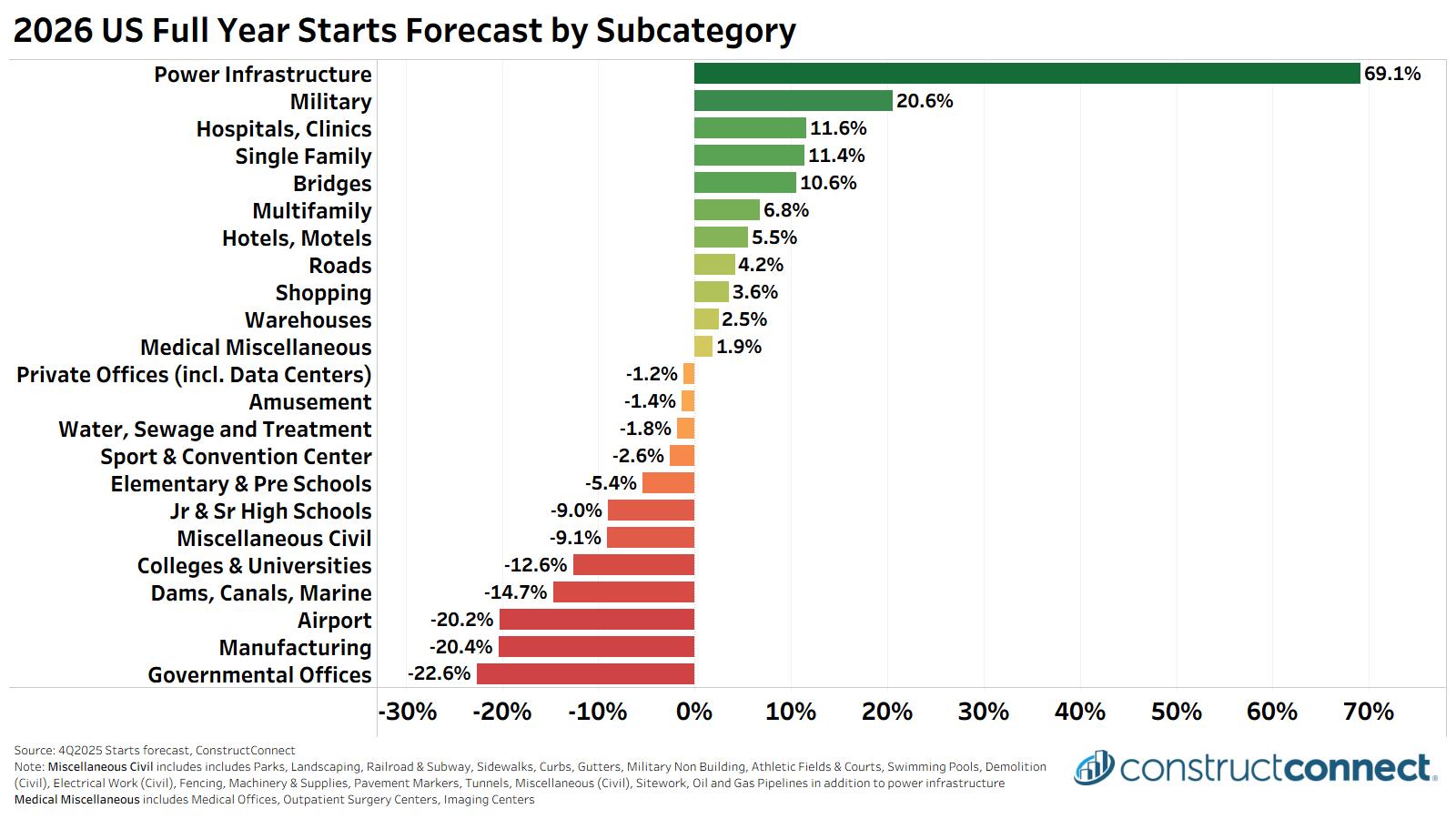
Looking ahead, the size and scope of these centers continues to grow, with many now reaching eye-watering price tags of $10 billion or more. Because of the nation’s insatiable demand for data centers, we forecast power infrastructure starts to rise by 70% in 2026, while water, sewage, and treatment spending also remains near all-time highs (see Figure 2).
For those in construction who aren’t positioned to build data centers or AI chip fabrication sites, it was difficult to discern what else was happening in the industry. When one excludes the above-cited investments, the rest of the construction industry appears to have modestly contracted. However, this does not mean that all markets outside of the few highlighted above struggled in 2025.
There were plenty of combinations of geographies and sub-markets that performed very well in 2025, and many will do exceedingly well in 2026 and beyond — but it may take more work to dig through the noise to identify where these opportunities exist.
Policy implications on the industry
Investment in 2025 was promoted by the One Big Beautiful Bill Act (OBBBA), which will help drive construction in the near term through two key measures. The first is favorable depreciation rules allowing firms to write off 100% of qualifying construction investments, freeing up capital by lowering tax burdens. The second consists of tax cuts that may bolster additional consumer spending across a multitude of income levels.
Conversely, conditions were made more difficult as the presidential administration rolled out new immigration enforcement measures. For the construction industry, this was particularly damaging, as around 35% of construction workers are foreign-born and an estimated half are believed to be unauthorized workers according to recent surveys.
No other industry comes close to being as reliant on foreign-born labor as construction. The Association of General Contractors Workforce Survey reported that 28% of surveyed firms saw direct or indirect impacts from immigration enforcement, highlighting the effect this is having on the industry’s labor force. Construction wages, which have been rising in excess of 4% annually since COVID, are only expected to rise faster in 2026 to balance a shrinking supply with constant demand.
Additionally, volatile tariff policies continue to drive construction materials prices broadly higher, with the full impact still unknown. Between January and August of 2025, year-over-year construction material prices moved higher by 5.2%, marking one of the steepest price increases in the last 15 years outside of COVID.
As more firms pass along more of these costs and stop paying for them at the expense of their operating margins, we should expect prices in 2026 to climb higher (see Figure 3).
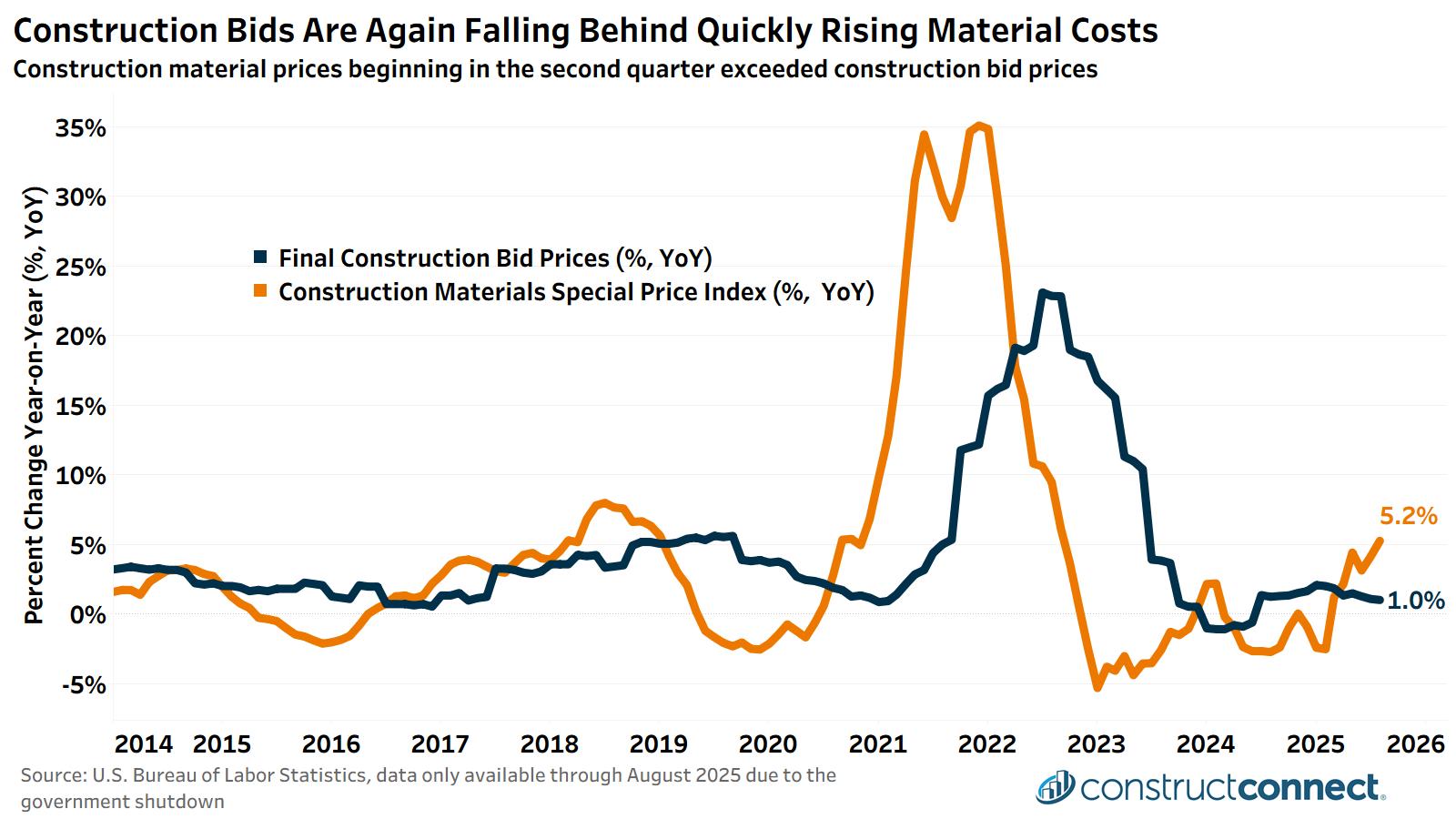
This two-front combination of rising costs will put significant pressure on profits for firms that are not ruthless in controlling expenses. As we observed during the relatively small rise in tariff rates during the first Trump administration and again during COVID when supply chains faltered, construction bids have a history of lagging behind rising prices.
Don’t expect interest rates to fall anytime too soon
In recent months the Federal Reserve Bank began cutting its Fed Funds Rate (FFR), which has only modest ramifications on mortgage rates, commercial real estate and commercial and industrial loans. However, ideas that a lower FFR will result in lower rates are misguided.
The truth of the matter is that inflation is a much more significant driver of interest rates. Presently near 3% and rising, inflation continues to act as a floor that is preventing rates from significantly dropping. Until a significant driver of lower prices appears there is little reason for firms to expect lower inflation and thus also lower interest rates.
Firms that are patiently waiting for lower interest rates before borrowing new capital, or to refinance existing loans, may have to wait far longer than hoped for.
Finance is becoming more opaque, but also more open
Traditional bank lending has significantly throttled back in recent years, with loan officer surveys continuously signaling tightening standards for commercial and industrial and commercial real estate loans since the second half of 2022. Inflation-adjusted lending remains flat or down, persistently constraining capital availability and hindering construction growth. However, non-depository financial institutions (NDFIs) have aggressively filled this gap.
These private lenders offer faster approvals and more flexible terms for projects that banks might reject due to their stricter lending standards. However, NDFIs charge significantly higher interest rates that can narrow margins.
The shift toward NDFIs creates both opportunities and risks, while their lower regulatory reporting standards make it harder to detect emerging financial troubles in the construction sector.
2026 construction industry top line outlook: Nonresidential
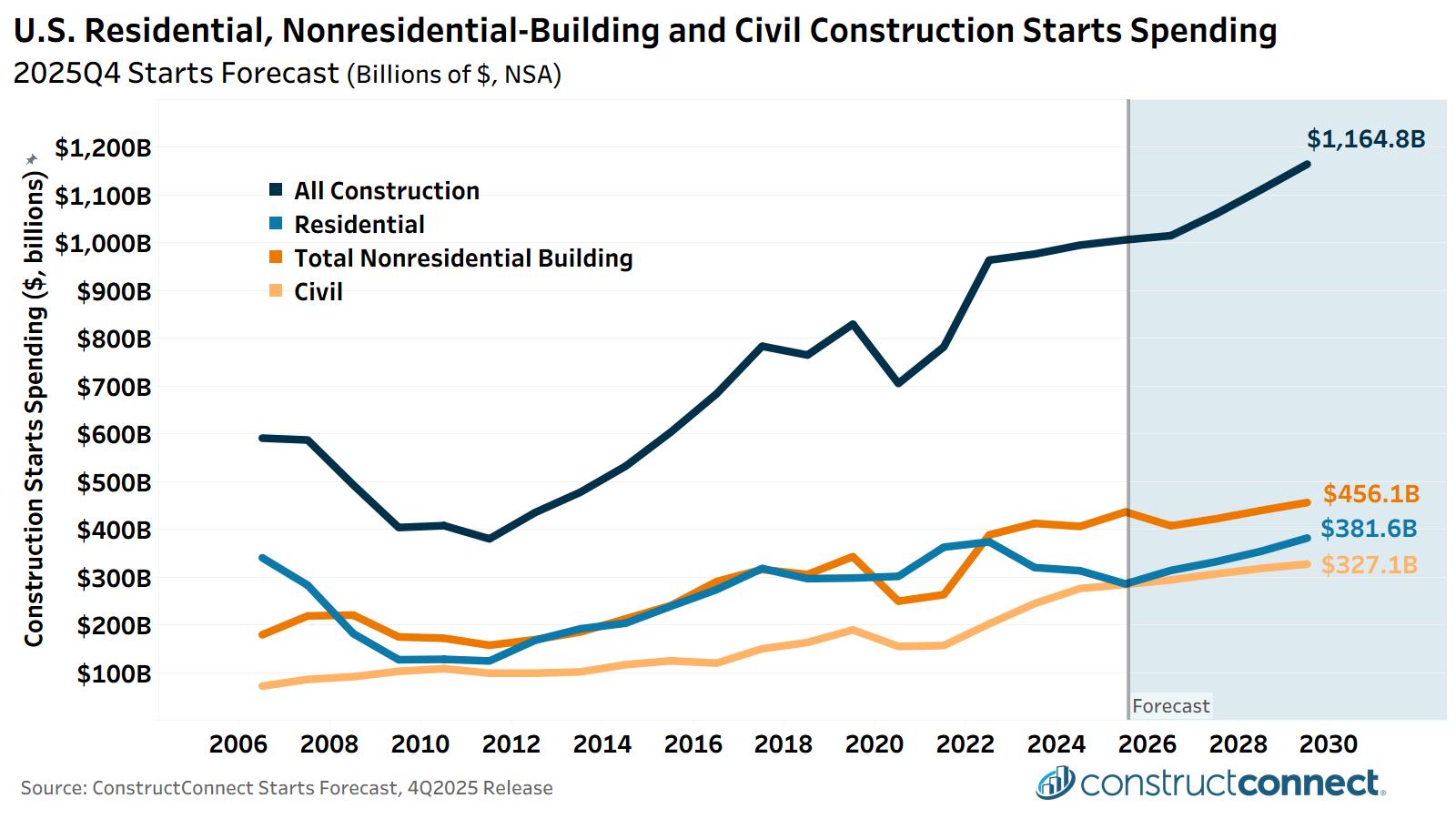
Total construction starts spending in 2026 is forecasted to grow by less than 1% compared to 2025’s full-year estimate of 1.1% growth, representing total starts of $1.01 trillion. Under this outlook, total construction spending will have seen four consecutive years of sub-2% growth.
As is often the case, the behavior of civil construction and nonresidential building, which collectively account for total nonresidential construction, are expected to follow contrasting paths in 2026. This divergence will create opportunities for shrewd construction firms willing to market themselves broadly in pursuit of top-line growth.
In recent years, civil construction has served as a significant source of construction spending growth, with annual increases often in the double digits. For 2026, ConstructConnect forecasts another year of civil growth, but at a lower rate of 3.4%.
Nonresidential building is expected to fall for the second time in three years by 6.7%, largely on account of slowing manufacturing construction. The combination of civil and nonresidential building activity is expected to send total nonresidential construction lower for the year by 2.7% (see Figure 4).
2026 construction industry top line outlook: Residential
Given our modest outlook for nonresidential activity, our growth expectations for total construction lean heavily on our double-digit growth expectations for residential construction. Residential activity in recent years has been hindered by two powerful forces. The first has been relatively high mortgage rates; however, this reason alone would be insufficient if not also for recent years of strong home price appreciation.
Nationwide, prices have increased by almost 52% since 2020, putting housing affordability close to all-time lows. However, even a modest decline in rates, which is expected by many analysts, coupled with the possibility of flat to slightly declining home prices, will help unlock residential activity beginning in 2026. For these reasons, ConstructConnect expects single-family construction starts growth of 11.4% in 2026 and 8.3% in 2027.
Multifamily construction activity is also expected to recover beginning in 2026, but with a slower initial rebound of just 6.8%. It is not until the latter half of our forecast that multifamily growth truly begins to accelerate, with 10% growth in 2028. (see Figure 5).
 Risks to the outlook
One of our largest near-term concerns involves political uncertainty. The net effect of the OBBBA, tariffs and supply chain disruptions, and the degree to which executive orders have been used to institute broad policy actions all bring uncertainty to our outlook. The impact of policy changes will continue to have a significant influence on our manufacturing and public sector spending outlook.
Second, as evidenced by 2025’s remarkable jump in manufacturing starts, is the volatile impact of megaprojects on our outlook. While it is quite possible that megaprojects will continue to proliferate, forecasting the growth of any industry based on the chances of a small number of extremely large projects is fraught with risk. This is why our forecasts — developed with the help of Oxford Economics — primarily utilize enduring macroeconomic factors while giving modest consideration to the influence of megaprojects expected to break ground only in the very near term.
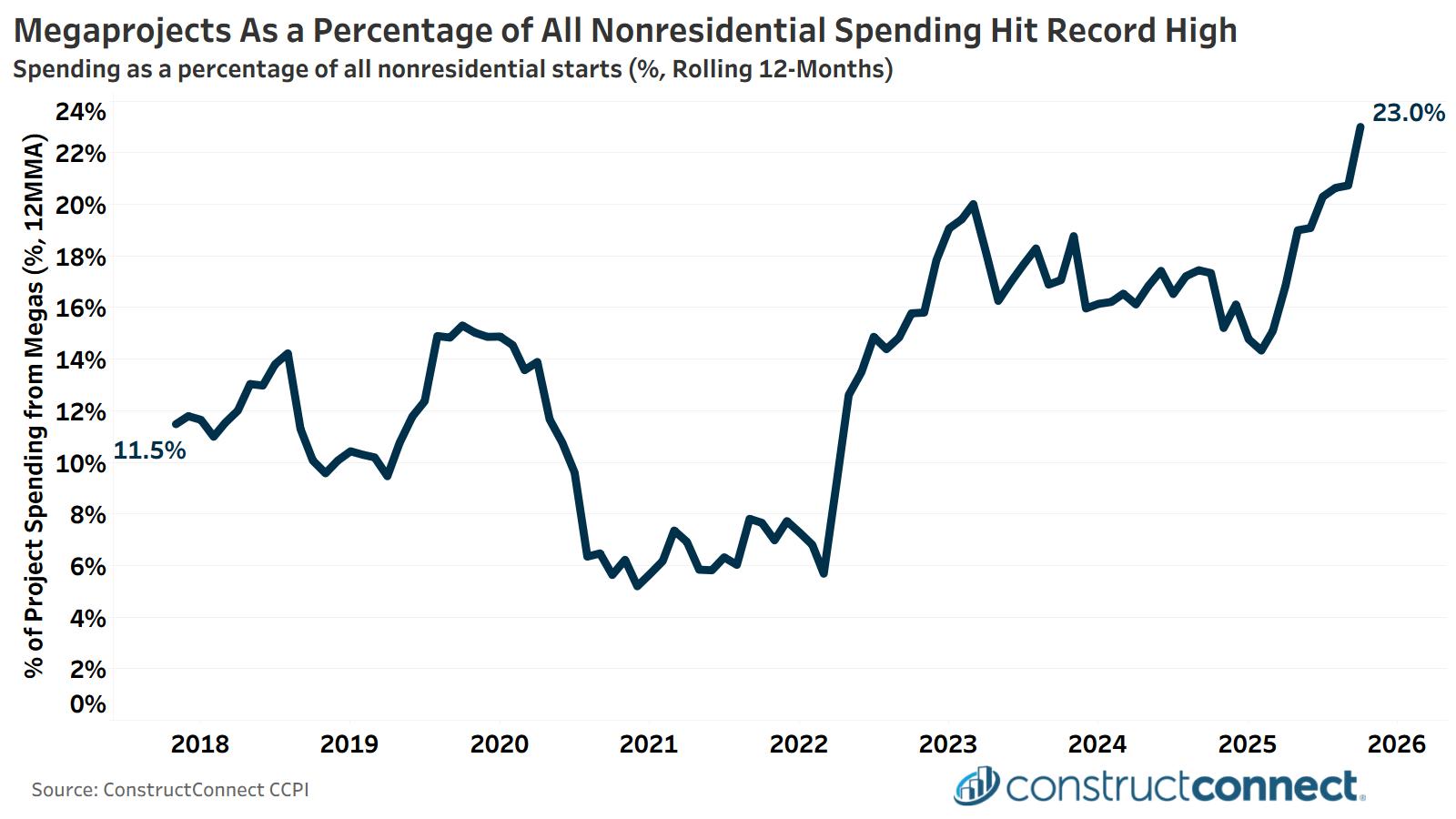
Megaprojects are uniquely vulnerable to both individualistic and market forces. While impressive in accounting for a record one-fifth of all 2025 nonresidential construction spending, one must always remember that these are ultimately sizable investment bets from a small pool of large firms.
Like all projects, they are subject to financial and market forces that can cause them to miss their financial targets, resulting in delay or abandonment. Unique and esoteric events that impact just a few of these firms could have a noticeable impact on national-level results. Consider, for example, that in 2025, half of America’s total growth in manufacturing construction was the result of a single $25 billion chip fabrication plant.
That megaprojects often require considerable construction time only adds to their financial risk. Miscalculations in distant market conditions could significantly impact expected profitability. One need only examine the recent list of electric vehicle and battery megaprojects that were halted mid-construction due to changing market conditions to understand the risks associated with these long-term investments.
It is therefore important to understand that construction’s growth outlook is made fragile when dependent upon a small pool of extremely large projects.
2026 outlook action items for PHCP business owners
As we look to 2026 with a somewhat modest outlook, it has become more important than ever to work smarter, not just harder. Here are three critical strategies for plumbing, heating, cooling and piping (PHCP) businesses to consider for 2026:
1. Think smarter: Target high-growth opportunities
Despite forecasted overall decreases in total nonresidential construction starts in 2026, strong sectors and geographies remain available for growing revenues with minimal resistance. The explosion in data center construction and the 70% projected increase in power infrastructure starts present significant opportunities for PHCP contractors specializing in industrial and infrastructure work. Water, sewage, and treatment spending is expected to remain near all-time highs, directly benefiting PHCP professionals.
Additionally, residential construction’s anticipated double-digit growth — 11.4% for single-family and 6.8% for multifamily — offers substantial opportunities for contractors serving these markets. Having a superior opportunity-search methodology will allow your firm to grow by out-smarting competitors, not just working harder. Focus your business development efforts on the high-growth sectors in your geographic footprint.
2. Protect your labor force
As the foreign-born labor force continues to diminish and the construction worker population ages, firms must find talent wherever possible. Annualized construction wage growth has remained persistently above 4% since COVID, and as the pool of workers is diminished by the removal of unauthorized workers, shrinking supply is likely to push wage growth even higher.
Make sure you are building employee loyalty through competitive compensation, training programs, clear career paths and positive work culture. A shortage of labor will result in good workers being poached from inside and outside the industry.
Invest in your people now — retaining experienced plumbers and pipefitters will be cheaper than constantly recruiting and training replacements in an increasingly competitive labor market.
Finally, use technology whenever possible to maximize the value of each employee, especially in back office roles where software can act as a force multiplier.
3. Be relentless in your operational controls
Firms must be ruthless in managing costs in 2026. Within just the past 10 years, we are now experiencing the third time that costs have caught businesses off guard. In each previous instance, firms that were slow to manage costs and control prices unwillingly sacrificed profits.
Staying on top of cost pressures and finding ways to mitigate them will be essential to protecting profit margins. Proactively search for alternative sources of supply so you can be ready if more shocks come.
Avoid bidding fixed-price contracts and build escalation clauses into contracts where possible. The combination of rising labor costs and materials price inflation means that operational discipline will separate profitable firms from struggling ones in 2026.
Although the overall growth outlook for 2026 is rather modest and the year is expected to bring more than its share of challenges to business owners, this does not mean that 2026 will be a lost year. Rather, it should encourage firms aiming for a standout 2026 to take steps now to invest in serious planning and strategy discussions.
Consider how — and what resources — you will use to find growth opportunities within a volatile industry that is intensely focused on just a few markets and overlooking so many others. Expecting that costs for both wages and materials are likely to move higher in 2026, think of ways to protect both your labor force and manage your inventory costs.
Proactively manage expenses and cultivate alternative supplier relationships, all for the sake of staying ahead of rising costs. While 2026 presents real headwinds, thoughtful preparation and strategic focus can position your firm to not just weather the challenges but emerge stronger.
Michael Guckes has been the chief economist at ConstructConnect since 2024. Before joining ConstructConnect he served as chief economist at Gardner Intelligence, a manufacturing consulting group. Michael has over 20-years of economics experience including 8-years in civil construction and 6-years in manufacturing. In the span of his career, he has also served in the Investment, Banking and Insurance industries. He received his BA in economics and political science from Kenyon College and his MBA from The Ohio State University.
Devin Bell is the associate economist at ConstructConnect, where he analyzes the construction economy. He began his career working for the Georgia Senate Finance Committee before transitioning to the construction industry when he joined ConstructConnect in April 2025. He received his bachelor’s degree in economics from Georgia Southern University and is currently pursuing a master’s degree in economics at Georgia State University.



