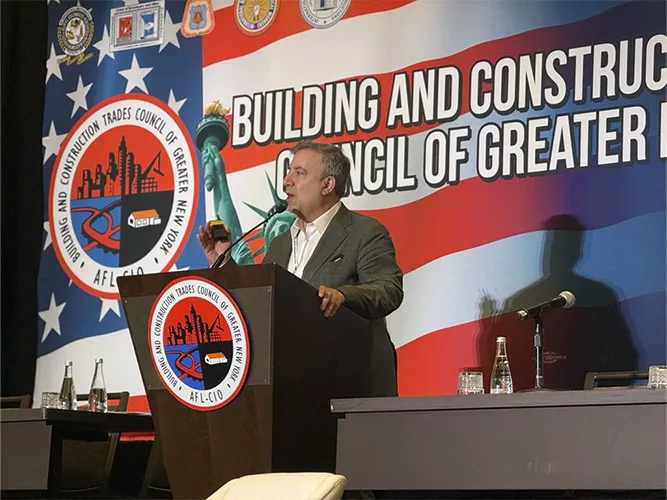
On March 5, The Building & Construction Trades Council of Greater New York (NYC BCTC) announced the launch of its Building Trades Peer Support Network (BTPSN), an initiative designed to reduce suicide rates and mitigate the adverse impacts of stress among workers in New York City’s unionized construction industry.
This initiative was made possible through funding from The New York Building Foundation, the charitable arm of the New York Building Congress, which covered the cost of developing a training curriculum that was built in partnership with the NYC BCTC, Local Unions Affiliated MAP Directors, and The Worker Institute at Cornell.
Construction workers are six times more likely to die from suicide than from jobsite-related injuries and four times more likely to commit suicide than the average American, resulting from a combination of several factors, including the inherent danger and stress involved with construction work, the instability of the availability of work and pay. At 53.3 per 100,000 U.S. workers, the suicide rate in the construction industry is second only to mining.
The BTPSN is designed to develop a scalable system in New York City’s unionized construction industry that can combat this crisis and create a discernable culture shift that will make mental wellness an industry priority and ultimately prevent crises and suicides through peer-led support.
Through this curriculum, BTPSN will build a network of approximately 1,000 rank-and-file Peer Supporters throughout the trades who will:
Offer confidential peer-to-peer support on jobsites.
Conduct basic risk assessments during conversations.
Refer medium or high-risk cases to MAP directors and/or union-designated support staff, which will automatically initiate a referral process for direct counseling, care, or suicide prevention methods.
Maintain professional boundaries and limit initiating contact, except in specific and rare circumstances addressed in training.
“The creation of the Building Trades Peer Support Network is a critical step toward treating mental health with the same seriousness as physical safety on our job sites,” said Gary LaBarbera, president of NYC BCTC. “Far too many construction workers are lost each year to suicide, and this initiative recognizes that protecting our workforce and ensuring they return home to their families each day also means recognizing their mental health. Through the mobilization of a Peer Supporter Network across job sites in New York City, BCTC alongside Cornell and the New York Building Foundation, is giving workers the tools to look out for themselves and each other. This program will save lives and sends a clear message that the men and women who build this city their entire wellbeing truly matters.”
“‘It is not weak to speak’ is a phrase used in relation to this peer support network, and this work being done to de-stigmatize mental health issues will transform our industry,” said Carlo Scissura, president and CEO of New York Building Congress. “For far too long, too many workers have needed help they could not find, but this program — spearheaded by Gary LaBarbera and the Building Trades and delivered by the Cornell Worker Initiative — will light the way for workers to find that help in each other.”
"This is more than an initiative; it is a fundamental part of our mission,” said Elizabeth Velez, chair of the New York Building Foundation. “Backed by our board and in lockstep with the BCTC and Cornell, we are taking decisive action to save lives. We are proud to lead this charge and provide a paradigm for an industry that desperately needs to prioritize the mental well-being of its workers.”
“Cornell’s Worker Institute is proud to partner with the NYC BCTC and NY Building Foundation on the development of this potentially path-breaking intervention to confront the suicide crisis in the construction industry,” said Patricia Campos Medina, executive director at The Worker Institute at Cornell. “This is precisely the kind of initiative that Cornell ILR supports as we pursue our public service mission.”


