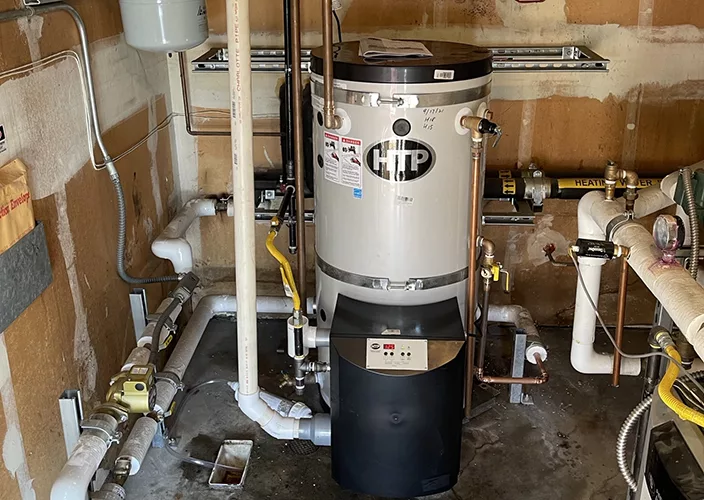
Failure is not an option for students at Stanford University. That mentality extends to the mechanical systems that deliver creature comforts to students in university housing. Joao Escorico, who serves as the university’s plumbing process control, found tank failures in water heating systems that serve nearly 60 multiresidential units and impacted hundreds of students. The system delivered hot water to 6–12-unit bungalows.
“We were seeing high failure rates,’’ Escorico says. “Some of the units were just 2-3 years old.”
Over the past five years, Escorico and his team have slowly chipped away at replacing all of the units with 55-gallon HTP Phoenix units. The HTP units have solved a problem that frustrated students and the mechanical team at the exclusive California university.
“The last thing you want to worry about as a student is hot water,’’ Escorico explains. “It would leak into the apartments and was an issue students shouldn’t be faced with. Having a quality, reliable product in place is a big deal.”
Failing units
Prior to the swap, hot water came through a standalone water heater and condensing boiler.
“We were seeing high failure rates,’’ Escorico says. “We were seeing rust in the water. We saw heavy rust barnacles in the heat exchanger tubes that were clogging up the units.”
In most cases, issues with water quality can impact water heater components. That was not the case at Stanford.
“We’ve got excellent water,’’ Escorico adds. “Around here, water heaters can last 18-30 years. We’ve seen some that were more than 50 years old.”
The degradation of the water heaters confounded Escorico, and representatives from the manufacturer cited improper installation.
“They scratched their heads,’’ Escorico says. “I know it wasn’t the installers, because I installed one. Unfortunately, they just weren’t working for us.”
Further complicating the problem was the inconsistency of failure rate and undependability of the existing units. There was simply no telling when, or if, the units would fail.
“Out of the 60 that were installed, there are still four or five that are still up and running,’’ Escorico explains. “We never know when we’re going to get a failure.”
Making the switch
Beset by problems, Escorico decided to switch to the HTP Phoenix 55-gallon units. He became familiar with the product in a previous job and found it reliable.
“In that job, they were installed 15 years ago and they’re still in use today,’’ Escorico says. “Out of around 12 that we installed, they’re still in use today. We replaced the control board on one of them, but we’ve had no issues with other components, and all 12 are still in use today. We love the fact that it’s a stainless-steel tank and we thought it would be a good option for Stanford.”
The Phoenix also features a connection point similar to the units that were replaced, which helped reduce labor time in making the conversion.
Versatility and efficiency
The HTP Phoenix is a versatile water heater that can be installed in residential and commercial applications. It is available in 55-, 80- and 119-gallon sizes with four BTU inputs ranging from 100,000 to 199,000.
“The 55-gallon tank is smaller and lighter, and easier to get into place,’’ Escorico says. “I liked having the flexibility of the different BTUs. For some of the larger buildings, we installed 133 kBTU models. We also have 100 kBTU models.”
The Phoenix is also recognized for its efficiency. The unit has up to a 96% thermal efficiency rating, compared to a standard unit that provides 60 percent thermal efficiency. The Phoenix has a 5:1 turndown ratio, which provides high system efficiency even during low load conditions.
The tank is constructed with 316L stainless steel to resist corrosion and last longer. The unit also includes a hybrid cupronickel/stainless steel heat exchanger, which expands and contracts rapidly with the change in temperature. That process eliminates scale buildup and promotes self-cleaning. An outdoor sensor auto adjusts for maximum efficiency.
Reliability factor
For Escorico, the most significant advantages of the HTP Phoenix were reliability and warranty. The unit is backed by a limited three-year warranty for commercial installations, with the option of upgrading to a five-year warranty. Units installed for residential jobs include a seven-year warranty.
“Another manufacturer only provided a one-year warranty,’’ Escorico says. “When the other manufacturer’s unit failed, they said sorry, there’s nothing we can do. HTP offers a three-year warranty, no questions asked. It says a lot and they know it’s going to last. The warranty was a big selling point.”
The reliability of the Phoenix has been a relief for Escorico, who no longer wonders if he’ll get a middle of the night message to repair a failing water heater.
“In a situation where housing is expensive and students are coming from all over the world, you want to make sure they have hot water,’’ he adds. “You want to make sure there’s a quality product. We’re happy with the HTP Phoenix and it solved a problem that we’ve been facing for a few years.”
Thomas Renner writes on building, construction and other trade industry topics for publications throughout the United States.