In my column last month, I tried to convince readers to be honest with themselves about whether they were charging enough to provide themselves with a high quality of life, pay their employees well and have surplus to grow.
I ended the article by saying that the right customers value quality and value their relationship with a contractor who’ll be around in the years to come. Let’s pick it back up there.
By raising prices, you inherently weed out some of the price shoppers. To further that goal, you should be marketing to the right customer. What does that mean?
It doesn’t necessarily mean sending fliers to the neighborhoods full of 15,000-square-foot houses. That might not be a bad play, but far more people who appreciate value live in well-kept brick ranchers. You need to cast a wider net and let folks filter themselves out. You do this with the correct marketing.
Now, before we dive into marketing, I want to cover something I hear people in the trade say all the time.
“I don’t market because I’m already too busy!”
Are you saying that you’re so busy you can’t handle more work? Or are you saying that you don’t have time for marketing? Probably both, and I believe you.
If you don’t need marketing to stay busy, how about marketing to bolster your local reputation, which will let you raise prices? Do less work for the same money and reward yourself and your team with a slower pace! Or do the same amount of work for more money. Take your pick.
The right marketing approach
If you want to avoid price shoppers, don’t market like a discount brand. Your website, truck wraps, uniforms and messaging should all reinforce professionalism, reliability and quality. Because you’re reading this trade magazine, I’ll assume you’re already professional and reliable. Hacks don’t bother educating themselves or keeping up with the industry.
Your marketing should, at all costs, avoid language like: “Lowest price in town,” “Budget heating,” “We beat any estimate,” “Cheap plumbing,” etc.
These phrases are a death knell to profitability. You’re just begging for someone to work you over on price.
Instead, say: “Trusted by homeowners in your metro for 20+ years,” “Upfront pricing, no surprises,” “Licensed, insured and code-compliant.”
This language builds buyer confidence before you even meet your customer.
Use customer testimonials, photos of your work, guarantees and warranties to reinforce your value. The right customers will notice. The customers who want a cheap deal will still call, but they’ll end up hiring the guy whose truck says, “Affordable Plumbing Repair.”
Fire the wrong customers
Not every job is worth taking. My grandfather used to say, “The best job you never got was the one you walked away from.”
Some customers are hyper-focused on price and will always choose the lowest bid, no matter what. These people want to negotiate everything. They don’t respect your time, or they complain about the price after the work is done. I’ve even had people push me to skip permitting and inspections.
Be polite, but firm. Say something like, “I understand budget is important. We’re not the cheapest, but we’re committed to doing the job right, safely and to code. We only hire professionals, and we pay them well for their skillset. We might not be the best fit for this project, but I appreciate the opportunity.”
Every time you say “no” to the wrong customer, you make time for the right ones. Turning away work might be scary at first, but it’ll grow on you.
Communicate value, not cost
Customers will pay more when they understand what they’re getting. In the service provider/customer relationship, you are the educator. Most customers know very little about our industry. I don’t know how many times I’ve heard a homeowner say, “They explained everything very well. That made the decision easy.”
Humbly conveying your knowledge and experience builds trust. If you explain what you plan to do and why without coming across as condescending, the customer will take your bid over your competitor’s if the prices are similar. Be sure to let the customer know if they’ll be inconvenienced, and for how long.
“Miss, you will be without hot water for about three hours, probably between noon and 3 p.m.. Does that work for you? After that, you’ll have all the hot water you need. This water heater will save you about $200 in natural gas per year. It’s quieter than your old one, too, and you’ll have a little more storage space in the basement.”
The key is to communicate benefits, not only features or price. For example, don’t say, “This water heater install is $4,500.”
Instead, say, “This high-efficiency, on-demand unit is the premium option, and we’re providing it with same-day installation, haul-away and a full workmanship warranty. It’s turn-key, with no surprises.”
Train your team
Even if you believe in your pricing, your techs and salespeople might hesitate when customers question it. That hesitation can sabotage profits.
Invest time in training your team to understand your pricing philosophy. Each member of your team should be able to speak confidently about the value your company delivers. They should be proud of the work they do and proud of the company they work for.
Teach them to upsell ethically. I don’t mean pushing premium options on customers. I mean offering the high-end solution. If the customer doesn’t know there’s a premium option, they’ll never choose it. However, it must be made clear that every option you present — even the lowest-cost option — will provide a quality solution.
Teach them to ask open-ended questions. We all like it when someone takes an interest in us and what we want. “What are you hoping to get out of this new system?” “How important is long-term reliability?” “Would you like to hear what most of our customers choose?”
An installer must understand the demands of the household to present the right option.
Does the customer live alone in a big house with his wife all year, only to host a dozen out-of-state family members over the holidays? If so, the water heater you install better be sized for peak demand, or you’ll be getting a call on Christmas. You won’t know if you don’t ask.
Empowering your team to sell value makes it easier to defend your margins. If you have a team member who struggles in sales, put them in a truck with your best salesperson for a month. Quiz him once a week on what he’s learned. If he balks, remind him that it’s an investment in his future.
Avoiding the race to the bottom isn’t just a pricing strategy; it’s a mindset. It means believing in your work, understanding your costs, training your team and walking away from jobs that don’t make sense. It’s about building a business that’s profitable, professional and proud of the service it delivers.
Price with confidence. Deliver with integrity. That’s how you break free of the vicious low-price cycle — not by being the cheapest, but by being the best you can be, and humbly letting the world know you’re true professionals.
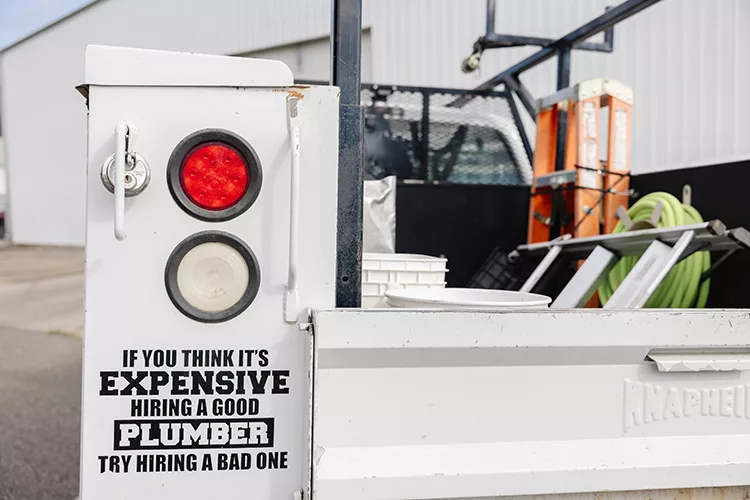
As I’ve written these past two columns, I kept thinking back to a bumper sticker I saw on a service truck once. It read, “If you think it’s expensive hiring a good plumber, try hiring a bad one!”