For decades, water heaters were like 1980s computers. They weren’t interactive and had few contemporary features. But the latest innovations in high-efficiency residential water heaters have truly transformed the market. From tankless to condensing gas to heat pump water heaters, they help homeowners and contractors meet sustainability goals, while offering customizable and user-friendly features that simplify work and life.
HPWH innovations
Some HPWHs are roughly four times more efficient than standard electric models. Many modern HPWHs feature demand response and time-of-use capabilities that save even more money by integrating into a utility’s smart grid program.
Here are some of the benefits that maximum-delivery HPWHs can provide:
• Advanced operating modes that deliver up to 40 percent more hot water. The homeowner gets three levels of increasing performance while maintaining the temperature set point.
• Guest mode is available for up to seven days at a time, providing more hot water during higher-than-normal hot water usage periods, making these units the perfect fit for short-term rental properties.
• High-performance HPWHs include innovative smart valve technology that delivers increased hot water while providing increased savings.
• Some HPWHs come with contractor-preferred top connections, with zero clearance required on sides and back for easy installation in tight spaces.
• Connectivity allows for convenient remote monitoring of the unit. Recent models can instantly detect leaks and automatically shut off, notifying the homeowner via a mobile app.
The latest generation of gas condensing tankless water heaters offers benefits for homeowners and installers. Many of today’s condensing tankless units offer the convenience of smaller diameter venting in a variety of materials, various gas connection options and universal indoor/outdoor installation for improved installation flexibility. Homeowners often select condensing tankless units that have an integrated recirculation pump that provides hot water more quickly to even the farthest tap. These models typically have an assortment of premium integrated features and optional accessories including wi-fi capability for easy remote monitoring.
Scale prevention is a game-changer
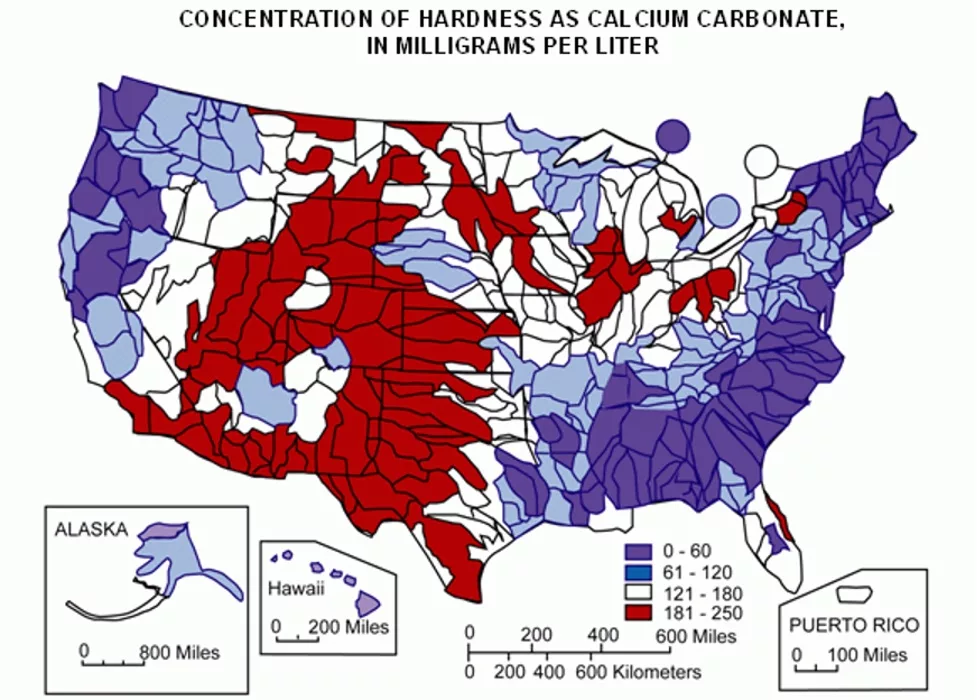
For decades, the lifecycle of water heaters was cut short by scale buildup due to hard water in many parts of the U.S. Water is considered “hard” when it has a high mineral count, especially calcium and magnesium. Water with greater than 3 grains per gallon is considered hard. These minerals leave behind scale that builds up and reduces water flow through pipes and fixtures and damages the heat exchanger in tankless water heaters.
This chart shows the areas of the U.S. where hard water is most prevalent:
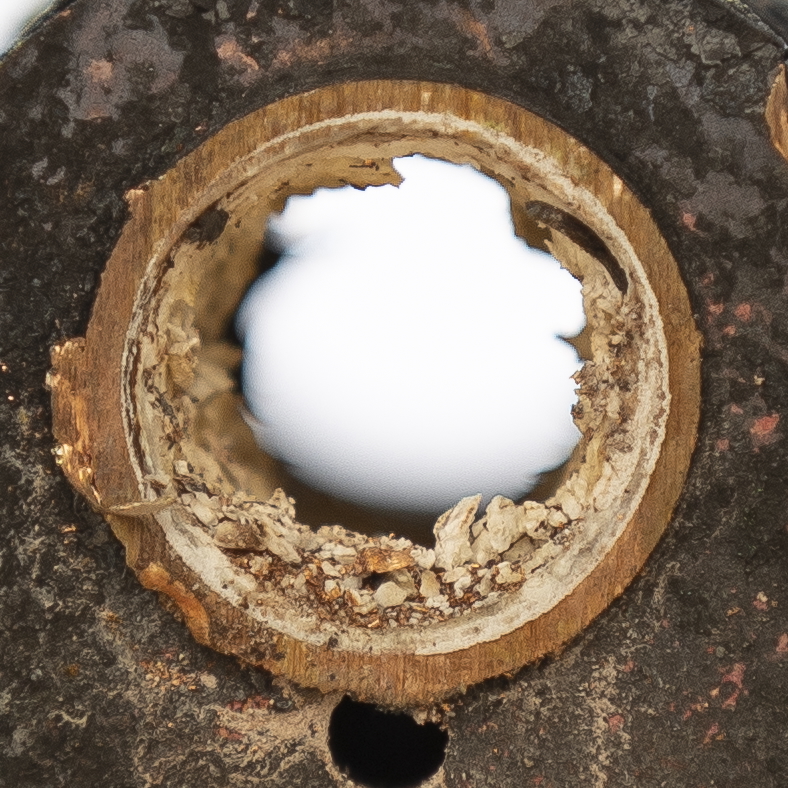
To combat the problem of scale buildup, many tankless units now incorporate some type of scale prevention technology. While many products on the market have optional accessories to attempt to manage this, A. O. Smith is the only tankless heater on the market with integrated scale protection, thanks to the patented X3 Scale Prevention technology that greatly reduces scale accumulation and extends the life of a tankless water heater up to three times longer than a conventional unit. Ordinary tankless units require periodic descaling maintenance, which is a hassle for both the contractor and homeowners – and increases the overall cost of ownership. But units with X3 Scale Prevention technology are descaling maintenance-free and have no warranty exclusions for hard water.
Photo 1 shows an unprotected tankless unit that experienced heavy scale buildup and failed at just under six years of simulated use and 136,000 gallons:
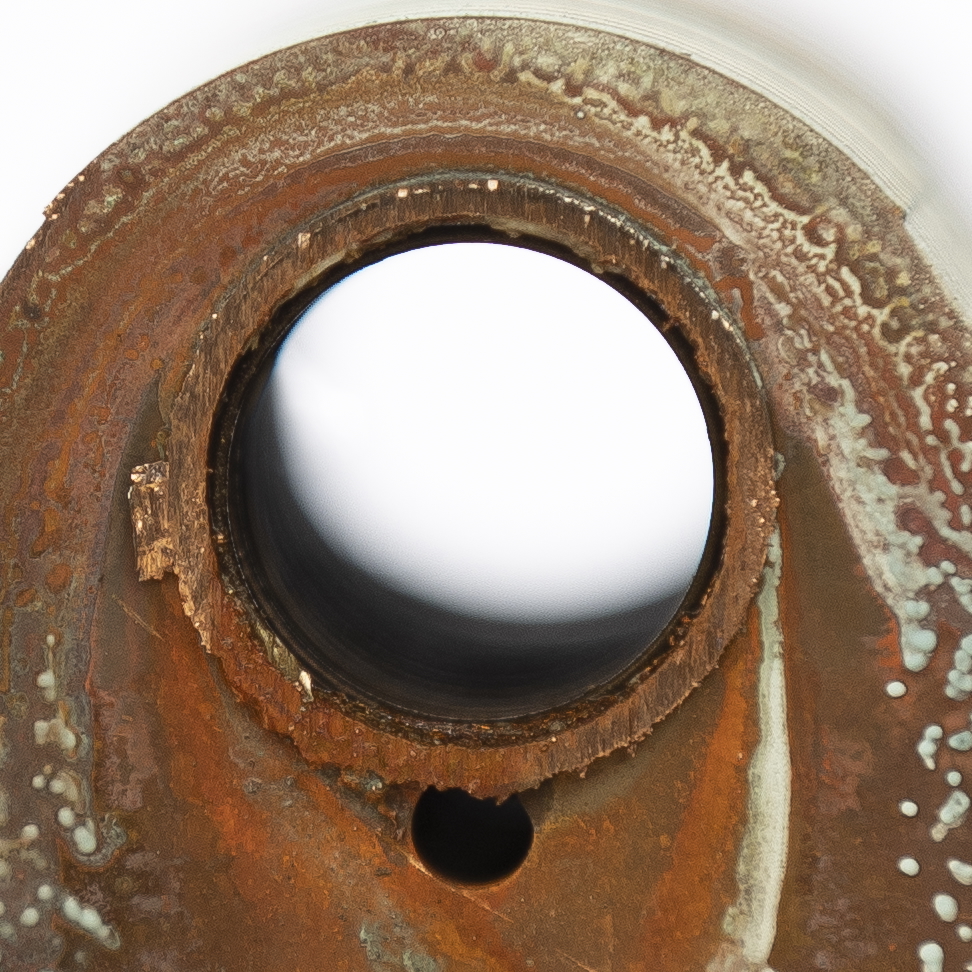
In contrast, Photo 2 shows a tankless unit protected by X3 Scale Prevention technology. The water heater was still running after nearly 20 simulated years and 460,000 gallons of use:
Sustainability starts with great engineering
When specifying a new unit, many contractors strive to help homeowners meet their sustainability goals. Heat pump water heaters help lower a home’s carbon footprint and deliver greater efficiency than standard electric water heaters. Alternatively, condensing gas tankless water heaters that offer scale prevention technology are also highly efficient and are engineered for ultra-low NOx (nitric oxide and nitrogen dioxide) emissions. This reduces the air pollutants that contribute to smog and acid rain.
Today’s tankless units also help the environment by ensuring much longer installed life. When a condensing tankless water heater lasts three or four times longer in the home than a conventional model, it’s a win/win for both the homeowner and the environment.
Highly efficient water heaters are a great option for those looking to meet sustainability goals, while getting the latest that technology has to offer. These units provide a number of cutting-edge advancements that were largely unheard of only a decade ago, and the industry continues to push for innovation, to ensure ease of use for homeowners and contractors alike.
Megan Konieczka Darr is product manager in the residential heat pump water heater segment, and Chris Daniel is product manager in the tankless segment at A. O. Smith in Ashland City, Tennessee.