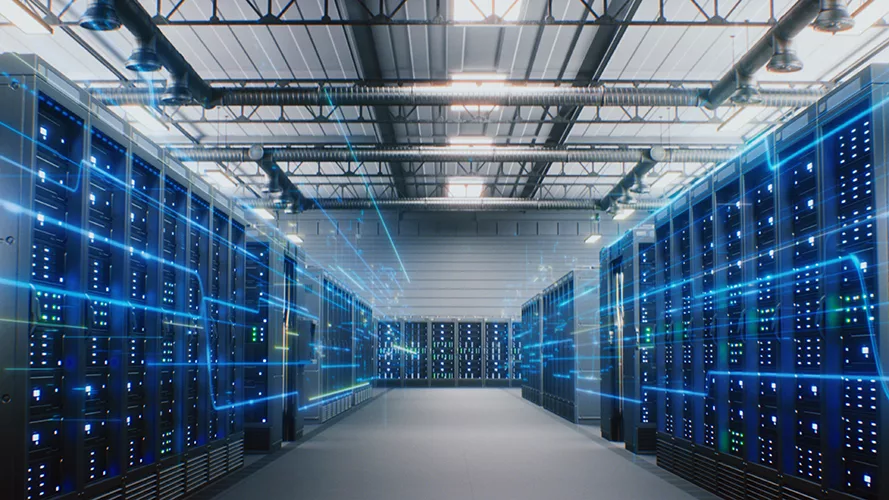
Hyperscale data centers are massive computing facilities designed to support the enormous data processing needs of today’s digital world. Typically starting at 100 MW of power and scaling up to a GW, these facilities are the backbone of cloud computing, artificial intelligence and massive online services.
Traditional data centers used forced-air cooling, pushing 70-degree air through server racks to prevent overheating. However, companies such as Prometheus Hyperscale are innovating the industry with immersion cooling technology. In this approach, servers are completely submerged in a specialized dielectric fluid, allowing for a more compact design and more efficient heat management.
Key advantages of hyperscale data centers include:
• Massive computing power in a compact space: Advanced systems are designed to deliver robust computing performance while taking up minimal physical space. This technology is ideal for businesses looking to maximize efficiency without requiring extensive infrastructure.
• Reduced cooling requirements: Thermal management technology ensures less heat generation, reducing the need for heavy-duty cooling solutions. This saves on energy costs and fosters a more sustainable operational environment.
• More energy-efficient operations: Optimized power consumption provides high performance with lower energy usage. This translates to reduced operational costs and a smaller carbon footprint, making it a great choice for eco-conscious companies.
• The ability to handle complex computational tasks: Built to process massive datasets and execute advanced algorithms, these systems are perfect for machine learning, AI development and data analytics, handling demanding functions with speed and precision.
Emerging technologies, such as geothermal cooling, are making these centers even more sustainable. For instance, Prometheus is developing a model using ground-temperature water to cool servers, eliminating the need for traditional refrigeration and significantly reducing water consumption.
To ensure the continued evolution of hyperscale data centers, advancements in energy efficiency and resource management must remain a top priority. Innovations such as modular designs, AI-driven cooling optimization and renewable energy integration are paving the way for more resilient and sustainable operations.
Additionally, edge computing is emerging as a complementary approach, bringing data processing closer to the source and reducing strain on centralized data centers. By investing in new technologies and forward-thinking strategies, the industry is positioning itself to meet the escalating demands for data while minimizing its environmental impact.
“The whole industry is at an inflection point where the old density was 10 to 15 kW in a rack for cloud services, and AI racks are pushing 50 kW per rack,” notes Trenton Thornock, Prometheus Hyperscale’s founder and CEO.
He explains that Prometheus can handle up to 300 kW per rack in its design, so there could be a myriad of retrofit expenses for existing data centers to modify them to work with the equipment used for both AI training and AI inferencing.
“And that’s where we have an advantage because we don’t have any existing infrastructure,” Thornock adds. “Prometheus Hyperscale doesn’t have anything that needs modification. It’s all fit for purpose, and as we build it, it will be built specifically to host those kinds of workloads.”
In Wyoming, at 7,000 feet above sea level, Prometheus Hyperscale is building a 1 GW facility using cutting-edge cooling and efficiency techniques. Instead of traditional air cooling, its servers are submerged in a special dielectric fluid, and cooling is handled using ground-temperature water exchange — no active refrigeration needed. This proprietary immersion cooling technology reduces water and energy consumption, making it a more sustainable option.
To showcase this technology, Prometheus Hyperscale is starting with a 1 1/2 MW model facility. The project is led by a former BP CEO, Barnard Looney, and backed by a prominent Wyoming land-owning family. They’re even exploring creative uses for waste heat, such as powering greenhouses to grow tomatoes.
What makes this even more exciting is the environmental impact. Prometheus is addressing some of the most significant challenges in the data center industry, including high water usage and energy demand, while demonstrating how sustainable computing infrastructure can be implemented effectively. It’s a huge step forward for efficiency and innovation in the tech world.
The future of data centers
The ever-increasing demand for data has put a strain on traditional data centers, leading to concerns about their sustainability and efficiency.
To address these challenges, the data center industry is looking at modular design, which enables the flexible expansion of data centers, making it easier to scale operations up as needed. By using prefabricated components, construction time and costs are reduced while also ensuring consistency in quality. This approach also facilitates easier maintenance and upgrades, as individual modules can be removed and replaced without disrupting the entire system.
Another trend is the increasing use of cloud computing. As more businesses rely on cloud-based services, data centers are shifting toward a hybrid model combining both on-premises infrastructure and cloud resources. This not only improves cost-efficiency but also provides better disaster recovery capabilities.
In addition to these technological advancements, sustainability has become a top priority for data centers. With their high energy consumption, data centers have a significant impact on the environment. As a result, many companies are now investing in energy-efficient solutions, such as renewable energy sources, efficient cooling systems and virtualization technologies, to reduce their carbon footprint.
Data centers are focusing on reducing e-waste by recycling and reusing old equipment. They are also implementing green building practices, such as using eco-friendly materials in the construction of new facilities.
While data centers may have faced criticism in the past for their high energy consumption and environmental impact, many have now embraced sustainability efforts and set an example in doing so.