Part one of this series outlined foundational steps for optimized ground heat exchanger (GHEX) design. It also emphasized the importance of hydraulically decoupling the GHEX from the building-side heat pump loop to improve control and reliability (See https://shorturl.at/w06nN).
This second installment presents a modular system architecture backed by U.S. patents that has been field-validated for delivering high pumping efficiency and system reliability under both full-load and part-load conditions. The discussion includes the use of iterative performance simulations to refine GHEX design and operational parameters, as well as key considerations for developing construction documents that enable cost-effective implementation without compromising technical performance.
The most common design in residential or small commercial geothermal systems using a single hydraulic circuit between the ground heat exchanger (GHEX) and the heat pumps erroneously assumes identical optimal flow rates for both components. Although this approach minimizes the capital cost for systems under 10 tons, it often results in oversizing pumps to meet peak load conditions at high head pressures.
In reality, the ground-source heat pump (GSHP) requires only the minimum flow necessary to maintain performance at the imposed load, whereas the GHEX operates most efficiently at a flow rate that optimizes thermal exchange with the GHEX relative to pumping energy. This fundamental mismatch underscores the performance advantages of decoupling the building GSHP and GHEX flow loops.
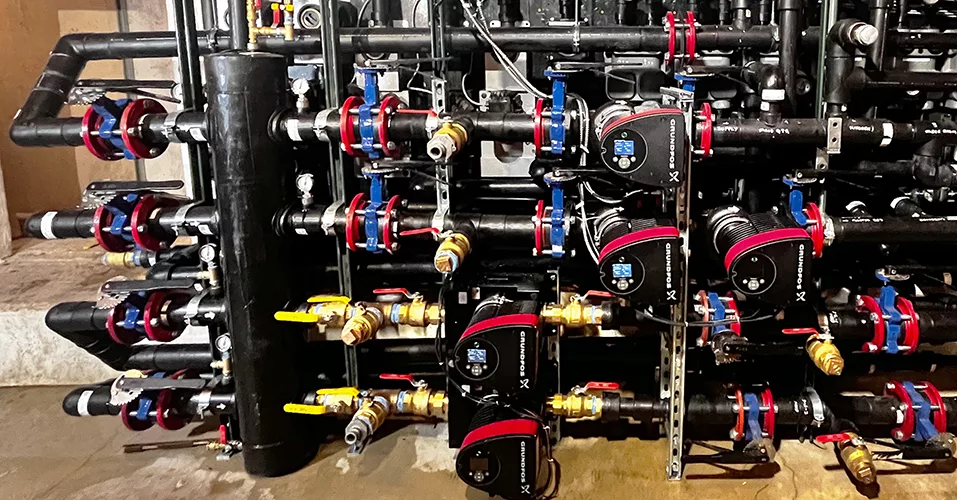
An ideal design hydraulically separates GHEX and GSHP source flows using dedicated variable-speed pumps on each circuit (see Figure 1). GHEX pump speed is controlled by differential temperature to match real-time thermal loads with GHEX capacity.

On the building side, variable-speed pumps and modulating valves — responsive to compressor speed or differential temperature — optimize flow to each operating GSHP. This approach enables proper flow regulation, reduces combined pump sizing, and lowers both capital and operating costs.
Developing an optimal pumping strategy for GHEX and GSHP source piping
An efficient pumping architecture and strategy is an area where many legacy GSHP designs fall short. An optimal pumping design should meet the following four goals:
Deliver an acceptable GSHP flow rate and capacity under peak load conditions;
Minimize pumping energy use during the predominant partial load conditions;
Be easily accessible and maintainable;
Balance capital costs with operating costs to maximize long-term value.
In large GHEX systems, traditional designs often employ a duty-standby pump configuration in which each pump is sized to deliver 100% of the peak design flow, providing full redundancy. While this ensures operational reliability, it frequently results in over-pumping. This inefficiency is especially significant in GHEX applications, where pumping energy can represent up to 17% of the total energy consumption of a GSHP system.
Pump sizing should be based on a hydraulically optimized GHEX layout and piping design to minimize required flow rates and reduce head losses. Designing pumps solely for peak load conditions is generally inefficient. In the duty-standby configuration, both pumps follow the same system curve, which often results in suboptimal efficiency (see Figure 2).
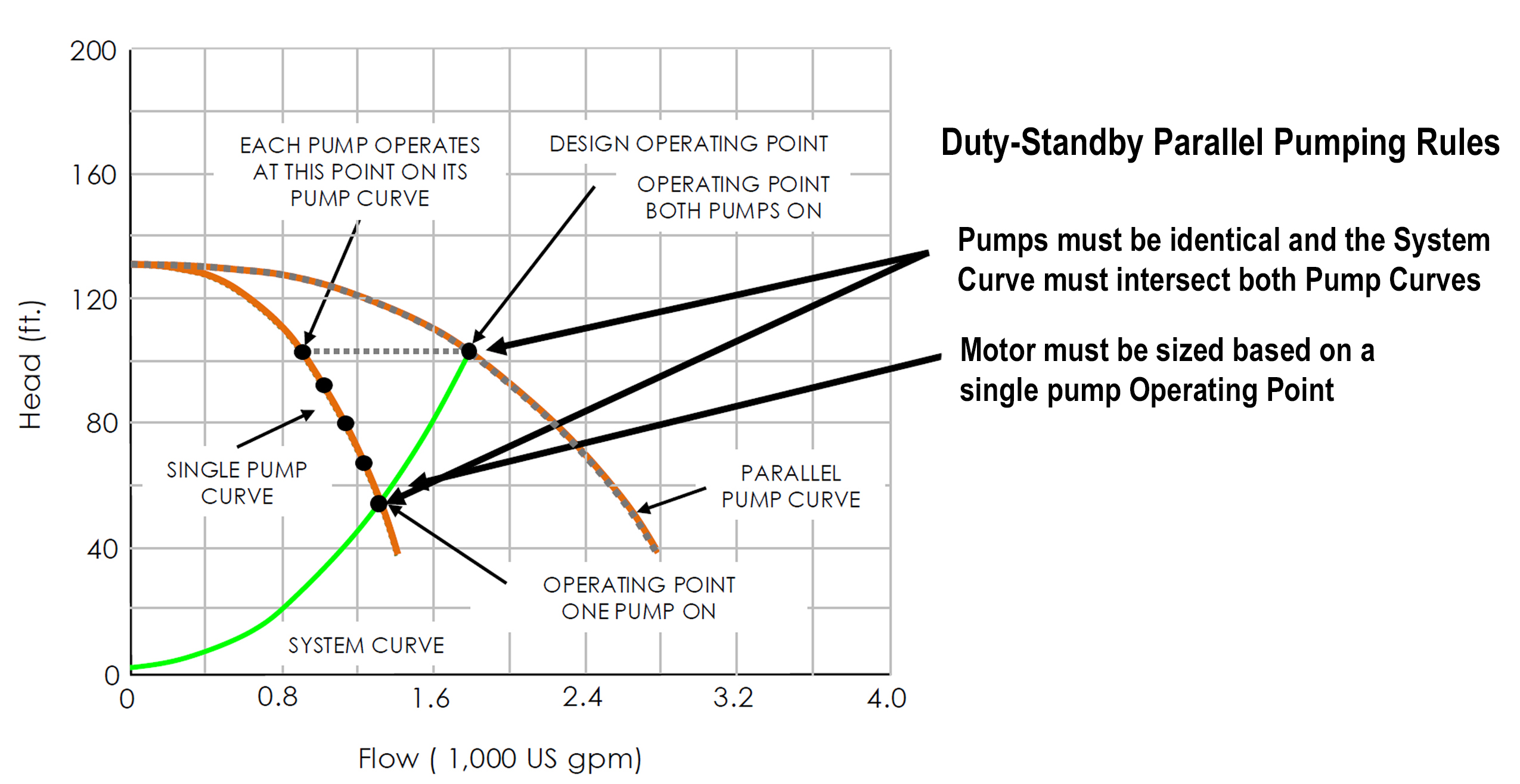
An alternative approach is to employ variable-speed, load-sharing pumps, each sized for a portion of the design load. This configuration allows both pumps to operate at partial load, improving wire-to-water efficiency, reducing oversizing and lowering overall pumping energy consumption.
Because GSHP systems operate primarily under partial load conditions, using smaller, high-efficiency variable speed pumps can reduce overall system cost, energy consumption, mechanical room footprint and design complexity. These pumps often include built-in control logic optimized for performance, pre-programmed and tested by the manufacturer.
Unlike many other systems, redundancy in pump systems is not solely determined by the number of pumps installed. For example, designing with two variable-speed pumps, each sized for 70% of the peak design flow, provides approximately 85% flow redundancy, which is adequate for most GHEX applications.
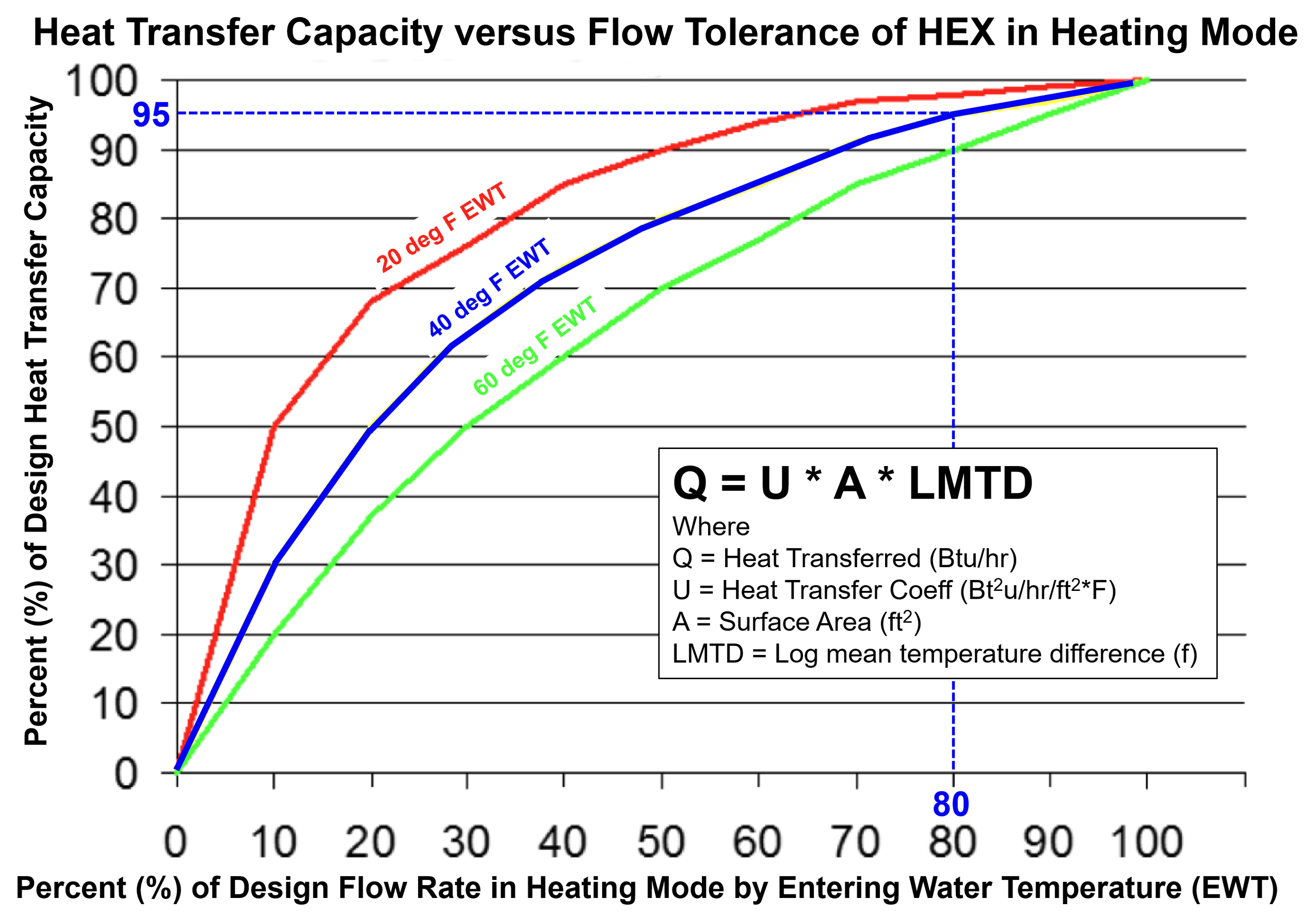
GSHPs operating in heating mode can deliver over 95% of rated coil capacity with only 80% of design flow when the entering water temperature is 40 F. This supports the use of reduced pump sizing without compromising heating performance. In cooling mode, capacity decreases only marginally — by a few percentage points — under similar flow reductions.
This approach is not suitable for mission-critical applications such as hospitals and data centers requiring dual pumps with 100% rated capacity for redundancy.
When evaluating the effect of pump speed on flow rate, system head and power demand, the centrifugal pump affinity laws apply.
Flow rate varies directly with pump speed — 80% pump speed is 80% flow
Head varies as the square of the speed — 80% pump speed is 64% of head
Power absorbed varies as the cube of the speed — 80% pump speed is 51% power
Reducing pump speed to 80% of maximum decreases power consumption to approximately 51% of full-speed demand, while still delivering 95% of the system’s heating output, as shown in Figure 3.
Preliminary design of the ground heat exchanger
Preliminary GHEX design is driven by available land area, site constraints and the building’s heating and cooling loads, following the selection of an appropriate GHEX type. Common closed-loop configurations include vertical boreholes, horizontal trenches and pond slinky loops. Open-loop systems draw from and return water to an aquifer or surface water body.
Among closed-loop options, vertical boreholes offer the greatest reliability due to stable subsurface temperatures, but they are typically the most expensive to install. Horizontal systems are generally less costly but require more land area and are subject to seasonal ground temperature variation. Pond slinky loops can be cost-effective and reliable if the pond is sufficiently large and deep — typically, a 5-ton system requires at least 1.25 acres of surface area and a minimum depth of 10 feet in moderate climates.
Examples of innovative GHEX configurations include using reverse flow on snowmelt patios, a heat exchanger with high volume potable water sources, rejected heat from ice rinks or dual process cooling with pool heating.
In projects with substantial cut-and-fill grading, such as a big-box store excavated into a hillside, a horizontal slinky GHEX can be installed beneath the fill section, often a parking lot, at minimal additional cost. This strategy avoids extra excavation by incorporating the GHEX into the planned fill area.
A pioneering method to enhance thermal performance involves placing a layer of tire-derived aggregate (TDA) directly over the GHEX piping prior to backfilling. TDA, which is otherwise difficult to recycle, increases the effective burial depth of the piping and improves moisture retention in the surrounding soil, both of which enhance heat transfer performance.
Open-loop systems can be viable in specific situations but are generally avoided due to higher pumping energy, greater power requirements and maintenance issues associated with untreated groundwater fouling heat exchangers.
The remainder of this article will be limited to vertical borehole GHEX design, with an emphasis on performance optimization and cost control. The design process is inherently iterative, incorporating evaluation of flow rates, flushing requirements and pipe and pump sizing for both full-load and part-load conditions, as well as considerations for long-term maintainability.
GHEX antifreeze options
For source entering water temperatures below 36 F, antifreeze is required and pressure drop calculations must be adjusted using correction factors specific to the antifreeze type and concentration. Propylene glycol (PPG) is commonly used in commercial systems due to its non-toxicity and low flammability, though its higher viscosity increases pumping energy. At concentrations below 25%, a corrosion inhibitor should be added unless specified otherwise by the manufacturer.
For residential applications ethanol or methanol is often preferred, as lower concentrations provide equivalent freeze protection compared to PPG. However, the toxicity of methanol significantly limits its appeal and any upfront cost savings are typically offset by increased handling and safety requirements.
Soil conductivity and diffusivity
For preliminary GHEX sizing, state well/drilling logs and site geotechnical reports are essential for characterizing subsurface conditions — especially soil thermal conductivity, the primary driver of borehole quantity and/or depth. Soil type and moisture largely control conductivity, which spans roughly 0.087 Btu/per foot per degree F (h·ft·F) for dry sand (worst case) to 1.39 Btu/(h·ft·F) for hard rock. Higher conductivity reduces the bore field size required for a given load profile.
For GHEX systems exceeding 20 tons, a thermal response test (TRT), or thermal conductivity (Tc) test is performed to refine sizing to reduce costs based on site-specific conditions.
TRT best practices include:
• Drilling a borehole to the proposed GHEX depth at the location of one of the wells to be used for the production GHEX, versus drilling and then abandoning the test well. After testing is complete, the production well becomes part of the larger GHEX network.
• Installing a U-bend pipe with the proposed circulating fluid.
• Grouting the borehole with bentonite grout and resting a minimum of five days before testing to revert to undisturbed conditions.
• Conducting the thermal response test. First inject calibrated heat to simulate operating conditions. The heat input required is 50 to 85 Btuh/Ft (15 to 25 watts/ft).
• After a 48-hour test using a minimum, constant clean power input, calculate in-situ thermal conductivity (k-value), borehole thermal resistance and thermal diffusivity from the test data once the slope of Tc temperature is constant (usually 12 hours).
Sizing the GHEX and performing the final GHEX design
Core inputs for GHEX modeling requires using software that accepts these parameters: hourly heating/cooling loads; in-situ ground thermal properties (conductivity, diffusivity); borefield geometry (spacing, depth, count); circulating fluid and antifreeze concentration; loop configuration (U-tube or coaxial) and pipe sizes; and grout thermal conductivity. Commercial tools that support these inputs include GLHEPro, GLD (Ground Loop Design), EnergyPlus, and TRNSYS.
An optimal GHEX design balances performance, cost and maintainability by:
• Sizing downhole and header piping to minimize friction while maintaining turbulent flow (target Re ≥ 2,500);
• Ensuring hydraulic balance across circuits and adequate flush/purge capability (including bore legs and supply/return headers) without specialized equipment beyond a standard flush cart or system pumps;
• Configuring components so routine service is straightforward, thereby reducing long-term operating cost and simplifying maintenance.
The following summarizes a baseline (initial) design versus an iteratively optimized design for a 30,000-square-foot office, focusing on GHEX/GSHP flow and flushing requirements.
• Baseline concept (single 60-ton field). Thirty vertical bores with 1.25 inch HDPE to 500 feet. Circulating 30% PPG at 6 GPM per bore yields Re = 2560 (turbulent). A 5 inch reverse-return header holds velocity less than 5 feet per second at the total 180 GPM. The GHEX circuit (excluding GSHP heat exchangers) requires ~180 GPM at ~23 feet of head (ft hd). Select a ~2 hp, 1750 rpm end-suction pump on a VFD to operate near the efficiency ridge.
• Flushing requirement (per full field). At 2 feet per second per bore, bore flow rises to ~9 GPM, so the header flow is ~270 GPM. With ~16 ft hd in the header and ~23 ft hd through the bores, total is ~270 GPM at ~39 ft hd, and typically needs a ~5 hp, 1800 rpm pump (commonly provided by a commercial flush cart/trailer).
• Optimized scheme (split headers). Use three 10-bore circuits with 3-inch supply/return headers terminating in the mechanical room. Per circuit: operation ~60 GPM at ~23 ft hd; flushing ~90 GPM at ~39 ft hd. Install two high-efficiency circulator pumps with onboard controls in parallel per circuit; they handle operating duty at about 70% output and can assist post-purge air removal (after an initial purge with a standard flush cart).
Benefits include indoor service (no exterior vaults/OSHA issues), multilevel redundancy, lower install/maintenance cost, and about 50% lower energy versus the baseline single-header concept.
Clear, properly formatted construction documents are essential for successful GHEX implementation. The GHEX layout should be overlaid on the surveyed site plan, with key details — dimensions, materials and installation notes — consolidated on a single sheet to streamline field use by contractors.
Essential components of construction documents include:
• A summary table of core GHEX parameters (Tc, diffusivity, grout type and Tc, pipe sizes, flow rate per bore, circuit flow rates, flushing flow rate and head, and distance to first and last bore);
• GHEX layout with header pairs (A,B,C,…) and bores (1,2,3,…) discreetly numbered as A1, A2, A3 … C1,C2, C3;
• Ground loop and header trench cross-section;
• TRT Test bore hole location as one of the production wells on the GHEX layout;
• Borehole spacing, down bore hole pipe and supply/return header pipe sizes;
• Subsurface manifold and mechanical room headers optimized for purging;
• Piping schematics with flow rates and pressure drops;
• Mechanical room piping (plan and elevation views);
• Building penetrations locations, spacing and sealing detail;
• Sequence of operations, control strategies and sensors placement;
• Drilling depth, casing specifications and intervals, grout type, thermal conductivity, mix and placement method, grout testing requirements, and in-situ test metrics;
• Pipe sealing during installation to prevent debris and building penetration details;
• Hydrostatically pressure-test each bore loop, each headered circuit, and the complete GHEX in accordance with ASTM F2164 (field leak testing of PE pressure piping).
• Flush and purge points on the system;
• Heat pump and circulator specifications;
• Call out trace wire, marking tape identification, and/or GPS tags for each bore hole.
Regular site visits are essential to verify that boreholes are drilled to the correct depth, grouting meets thermal requirements, and loop piping is properly purged and pressure-tested. Ensure permitting compliance by confirming that drillers are permitted by the authority having jurisdiction and have filed the as-built GHEX location and parameters reports.
After occupancy, monitor system performance during peak heating and cooling seasons to validate GHEX temperature stability and confirm heat pump COP and EER align with design expectations.
A well-designed ground heat exchanger is the foundation of any high-performance GSHP system. By following these best practices, engineers can ensure long-term efficiency, reduced operating costs, and seamless integration into the building’s HVAC strategy. With proper site assessment, data-driven design, and construction oversight, ground source systems can deliver unmatched energy savings and reliability.
Albert Wallace serves as president of Energy Environmental Corp. Visit www.energyhomes.org for information on specific features in this article contained in EEC patents or www.forgegeo.com for design assistance or obtaining geothermal skills certification.