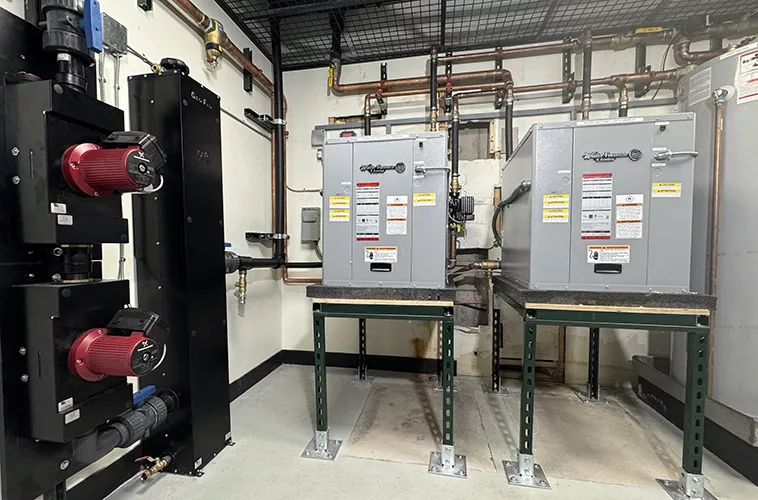
The ground heat exchanger (GHEX) is the defining element of a ground-source heat pump (GSHP) system, directly impacting cost, efficiency and reliability. Despite this, many GHEX designs still rely on outdated linear methods developed more than 50 years ago.
This two-part series outlines modern best practices for GHEX design, emphasizing modular approaches that reduce system complexity and cost. While example installations focus on radiant hydronic systems, these principles apply broadly to both hydronic and forced-air GSHP applications.
GSHP system efficiency is often evaluated based on heat pump Coefficient of Performance (COP) or Energy Efficiency Ratio (EER) under standard test conditions. However, true performance depends on broader factors, including partial load operation, GHEX pumping energy, auxiliary heating and cooling systems, and the building envelope. A best practice is to optimize total system efficiency year-round, accounting for heating, cooling, ventilation and domestic hot water (DHW) loads.
Unlike COP and EER, which reflect full-load performance under AHRI test conditions, the Seasonal Performance Factor measures real-world system efficiency over time, including part-load operation and auxiliary energy use. In this broader context, GHEX design plays a critical role in improving overall efficiency, reducing life cycle costs and enhancing long-term reliability.
Traditional GHEX design follows a linear design–bid–build process: engineers first calculate building loads, perform a thermal conductivity test in a representative borehole, estimate total loop length, analyze pressure drops across the GHEX and heat pump, and size pumps accordingly. The final design is then bid out — often determining whether a GSHP system proceeds.
Even the latest standard, the May 2025 CSA/ANSI/IGSHPA C448 Series, Design & Installation of Ground Source Heat Pump Systems, is focused on health, safety and public welfare, not optimized design.
Conventional GHEX and pump designs are frequently oversized compared to what an optimized system requires, resulting in inflated capital costs, higher maintenance burdens and diminished reliability. These inefficiencies often push total project costs beyond acceptable limits, leading to the rejection of many GSHP proposals.
Achieving an optimal GHEX design requires a collaborative, integrated team engaged in an iterative design process that balances geothermal field loads by refining key system parameters. The following steps outline this approach.
1. Define client goals and project scope
The first step is to clearly define the overall project goals, including establishing a proposed budget. This approach contrasts with traditional linear design methods, where the costs of HVAC and DHW systems are often unknown until after detailed designs are completed and bid by mechanical, electrical and plumbing (MEP) contractors.
Beyond capital and operating costs, client priorities may include occupant comfort, indoor air quality, energy efficiency, carbon footprint reduction, system simplicity and maintainability, and minimizing risk — particularly for projects with tight construction schedules. The design team should collaboratively identify, prioritize and formally document these requirements within the project’s contract documents.
Depending on the scope of the project, the ideal team includes the building owner, architect, general contractor, MEP and civil engineers, energy manager, landscape architect, geotechnical contractor, MEP contractor and maintenance personnel.
2. Conduct a site review with the integrated design team
Site conditions play a critical role in determining the feasibility of a GHEX, presenting both challenges and opportunities. A thorough site assessment, conducted with participation from all members of the design team, should evaluate the following:
Building(s) footprint, location and orientation;
Site access, particularly for drilling equipment;
Existing and proposed overhead and subsurface utilities;
Hazardous conditions or constraints (e.g., buried oil drums or overhead power lines);
Surface and subsurface geological conditions, including inspection of the drilling area and review of previous drilling logs, if available (typically maintained by the State Department of Water Resources);
Potential noise and weather-related constraints;
Identification of heating and cooling resources, as discussed in Step 3, that are accessible to the GHEX or MEP systems, which affect GHEX sizing.
The site visit is not merely for data collection. It also serves as a valuable opportunity for the project team to establish working relationships and set the tone for open collaboration throughout the project. The insights gained during this visit are essential to achieving an optimized GHEX design. If an on-site review is not possible, these parties should share preliminary design documents for comments in the conceptual design phase.
3. Perform hourly load calculations and assess offsetting thermal loads
Unlike annual energy models, which evaluate overall building efficiency, hourly room-by-room load calculations are critical for accurate GHEX sizing. Hourly bin data allows designers to assess peak loads throughout the year, heating and cooling load diversity, block loads for room-level equipment sizing, and simultaneous heating and cooling (symbiotic loads). Offsetting heating and cooling loads such as DHW, pool heating, snow melt or data center cooling can be used to shave peak thermal loads.
The most cost-effective GHEX design serves a building with well-balanced annual heating and cooling loads, as illustrated by the blue and green graphs in Figure 1.

In designing the GHEX for this load profile, the size balancing cost and performance is for 100% of the cooling load, which delivers 50% of the peak heating load or 97.5% of the total heating load. Using geothermal energy for this load profile leaves 50% of the peak heating load, or 2.5% of the annual energy use, to be handled by another heating source. Using auxiliary heating (or cooling with a hybrid system using cooling towers) is less expensive than installing a GHEX, which handles 100% of both heating and cooling loads.
For this example, the optimal GHEX size with auxiliary heat to handle the peak loads is 76% of the size and cost of a GHEX sized at 100% of peak heating load, representing only 2.5% of annual energy use (100 boreholes versus 76 boreholes). See Figure 2.

In residential and many commercial applications, GSHPs operate at partial load conditions approximately 85% of the time. Although design should not be based on rules of thumb, an observed 80/50 principle provides useful insight into these partial load conditions: the GHEX will meet 100% of real-time building loads 80% of the time accounting for 50% of the building’s total annual thermal energy demand.
The other 50% of energy use occurs during peak load conditions, which drive GHEX sizing and cost. This highlights the value of peak load reduction strategies, such as using simultaneous or offsetting heating and cooling demands.
4. Analyze geothermal properties and opportunities on site
Using data gathered during the site survey — along with drilling logs, geological surveys and input from civil, geotechnical and landscape team members — key metrics are established to support the initial sizing of the GHEX. These critical site characteristics include:
Average soil thermal conductivity;
Soil moisture content;
Depth and movement of the groundwater table;
Presence of surface water and underground aquifers.
This information is essential for estimating the thermal conductivity and diffusivity of the subsurface environment, which, in turn, is used to appropriately size the GHEX to meet the building’s heating and cooling loads.
The relevance and interpretation of this data will vary depending on the type of GHEX being proposed: whether it is a closed-loop or open-loop system, vertical, horizontal or submerged in a body of water. In some cases, more innovative approaches may be considered, such as thermal energy piers integrated into the building’s foundation, “pump and dump” systems which draw water from and return it to an aquifer, or hybrid systems that combine multiple GHEX configurations with and without thermal energy storage.
5. Allocate sufficient space for GHEX pumping and mechanical room equipment
Before sizing GSHP equipment, pumps or selecting GHEX locations, including remote vaults, it is essential to identify and confirm the availability of mechanical room space. In most projects, the space allocated for HVAC equipment is insufficient, highlighting the importance of addressing this issue early in the conceptual design phase in collaboration with the architect and building owner.
Waiting until after the final construction documents are issued often results in costly compromises or redesigns.
6. Separate GHEX flow from heat pump source flow
In commercial or large residential applications, designers often mistakenly apply design principles intended for small heat pump systems — using a single hydraulic circuit and shared pump(s) to circulate flow between the ground heat exchanger (GHEX) and the heat pump source side — based on the incorrect assumption that both sides require the same optimal flow rate. This typically results in oversized systems driven by peak load flow requirements. In practice, heat pump flow should be minimized to meet the current load efficiently, while GHEX flow should be optimized to maximize heat transfer per unit of pumping energy.
The preferred design hydraulically separates the GHEX and heat pump circuits, each served by dedicated variable-speed pumps. GHEX pump speed is controlled by source-side temperature differential to match real-time thermal loads.
On the building side, variable-speed distribution pumps and modulating valves — responsive to compressor speed or differential temperature — optimize flow to each heat pump. This strategy reduces pump sizing, lowers capital and operating costs, and improves overall system performance.
Although the concept is straightforward, successful implementation requires careful engineering and detailed system integration. While these elements are often lacking in customized solutions, using a proven systems architecture simplifies the design process while ensuring the resultant system exceeds client expectations.
Part 2 of this series will address this proven modular component architecture, including optimum pumping strategies, heat pump performance under partial flow conditions, iterative performance modeling for optimum GHEX design, and the required details for construction documents to ensure, cost-effective execution.
Albert Wallace serves as president of Energy Environmental Corp. He holds eight U.S. patents for integrated systems using geothermal heat pumps with variable-speed pumping and radiant heating and cooling for net zero buildings. He is a Certified Geoexchange Designer and Certified Energy Manager. He is a member of ASHRAE, an American Institute of Architects associate member, and a certified trainer and installer by the International Ground Source Heat Pump Association. Visit www.energyhomes.org and www.forgegeo.com for more information.