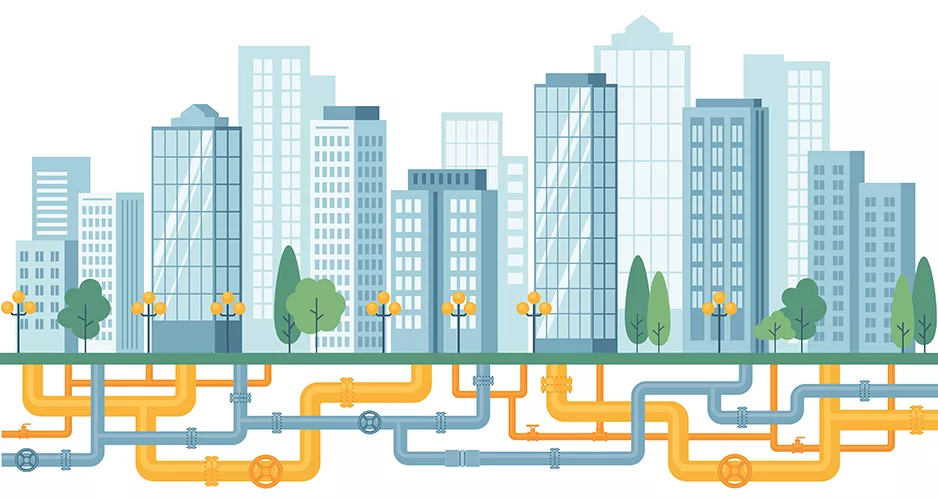
Water is the lifeblood of our environment and its utilization in buildings for energy reduction is finally getting well-deserved recognition. Climate change is effecting the way we design our systems, with consideration for droughts stressing our reservoirs, intense storms overwhelming infrastructure, and water supply rates that continue to fluctuate. Meanwhile, the built environment still swallows billions of gallons a day, creating a major opportunity for efficiency through leak mitigation and modern pipe sizing practices.
In my column, The Future Is Now, I’ve advocated that plumbing isn’t a passive backdrop, it’s a vital system for sustainable buildings. When designed right, plumbing systems not only deliver clean water and remove waste, but also manage energy, protect public health and adapt to a changing climate in any region.
From single family homes to district scale developments, here’s how the plumbing industry is rewriting the rules in 2025 and how we can leverage these tools for resilience, efficiency and long-term value.
Rainwater catchment: Turning stormwater into an asset
Rainwater harvesting has moved from a niche economical solution to becoming codified and leading the way through performance verified infrastructure pilots. The U.S. Environmental Protection Agency (EPA) frames rooftop capture and onsite storage as an essential green infrastructure strategy, delivering dual benefits such as reducing potable water use and mitigating peak stormwater flows that cause urban flooding and catastrophe.
Organizations such as the American Rainwater Catchment Systems Association (ARCSA) International state the importance of EPA compliance, noting that “well designed rainwater harvesting systems will make full on-site use of the rainwater, in most cases slowing it down until it is infiltrated on property, so it does not become problematic stormwater” (https://bit.ly/4lFUD5L).
A major step for the safe implementation of this new trend across the U.S. is the incorporation of ARCSA Design and Installation Standards into the International Association of Plumbing and Mechanical Officials’ (IAPMO) Green Plumbing and Mechanical Code Supplement of the Uniform Plumbing Code, and the International Green Construction Code of the International Plumbing Code.
Cities around America now require stormwater management for new construction to ensure resiliency by adhering to new codes and standards. On-site capture paired with non-potable reuse, drip irrigation and toilet flushing are often the most cost-effective path to designing a sustainable building.
New developments such as the Google Bay View campus in California integrate green roofs, bioswales and rainwater harvesting into a single system that channels filtered water to landscaping and other energy related systems.
In rural Montana, the Urban Frontier House uses rainwater for all non-potable needs, blending rustic ingenuity with modern filtration controls.
With the use of sensor operated cisterns and real-time weather forecasting, these systems can be monitored to automatically pre drain before a major storm, maximizing capture capacity and reducing flood risk.
Building water recycling: Closing the loop
Wastewater from showers, bathroom sinks and laundry represents a steady, relatively clean flow that can be reused throughout the built environment. Greywater is reused for drip irrigation, flushing or certain process applications after being treated and managed properly with accurate documentation through water management programs.
There are many tools available that provide state by state clarity on allowable end uses and local adopted codes should always be followed. While outdoor irrigation remains the most common approved application, indoor flushing is gaining traction when designed safely with proper ventilation and listed approved fixtures.
The Bullitt Center in Seattle treats greywater for toilet flushing, meeting stringent living building standards and reducing potable demand dramatically (https://bit.ly/460Cf2X). We even heard of a new type of recycling being done in the PAE Living Building in Portland, Oregon, where they utilized urine diversion from plumbing fixtures to process liquid and powder organic fertilizers, being one of the first buildings to ever do such a thing (https://bit.ly/41zZDSu).
For designing such unique systems, one should map the end uses first, then select treatment technologies that meet the quality requirements for each. Pairing rainwater harvesting and grey or black water reuse can reduce potable water demand by an estimated 40% to 60%, moving a project toward net-zero water goals in an expeditious way.
Ground source heat pumps and geothermal: Efficiency without the grid burden
Electrification has been dominating much of the heating and cooling conversation lately, but in my view, electrifying for electrification’s sake isn’t sustainable with today’s grid reality. Peak heating and cooling loads already strain transmission and generation capacity. Simply swapping out gas fired boilers for air source heat pumps can shift and, in most urban environments, worsen those peaks.
Ground source heat pumps (GSHPs) with geothermal loops offer a different equation by tapping the earth’s stable temperature for reliable always-on functionality. GSHPs can achieve coefficients of performance (COPs) between 3 and 6, which provides 300% to 600% efficiency in all seasons, according to the DOE’s Office of Energy Efficiency and Renewable Energy.
Because the ground loop is a renewable thermal reservoir, GSHPs provide heating, cooling and domestic hot water (DHW) with minimal energy use. They can reclaim waste heat from cooling mode to preheat DHW and often meet much of the load at no additional energy cost in cooling dominant months.
Heat rejection reuse is being taken to the next level as more heat generating buildings like data centers come online and the AI boom continues to need more power.
District systems like thermal energy networks (TENs) take it a step further. Instead of each building drilling its own independent wells, multiple buildings connect to a shared geothermal network. With TENs, cooling heavy buildings like data centers or grocery stores essentially “donate” waste heat into the loop, which heating dominant buildings like manufacturing facilities can use. This thermal sharing reduces peak grid demand, lowers operating costs and dramatically cuts greenhouse gas emissions at an astonishing rate.
In Framingham, Massachusetts, the utility service provider Eversource is piloting a neighborhood scale geothermal network for multiple buildings (https://bit.ly/4mAI9xJ). Early data shows heating and cooling bills dropping, peak electric loads flattening and resident comfort improving. This is becoming a reality for big cities like New York as well, as they continue to build out their campus style thermal energy network with a project called “Penn South campus,” which includes the U.S. post office (now Moynihan Station) and other surrounding buildings (https://bit.ly/4mtpfZG).
Much can be said about using hydronic systems when paired with GSHPs. With hydronic distribution through radiant walls and floors and the use of water to water heat exchangers, it allows high efficiency at lower operating temperatures. This synergy aligns directly with the hydronic principles I’ve covered in past columns along with the research done through the Radiant Professionals Alliance.
Water smart technology: Precision use monitoring
According to the EPA WaterSense program, U.S. households use nearly 8 billion gallons daily on landscape irrigation, with up to 50% lost to overwatering, poor scheduling or inefficient distribution; however, I know we can do better with modern tools (https://bit.ly/4lFX48y). Smart irrigation controllers respond to local weather data, soil moisture sensors and evapotranspiration rates, watering only when necessary.
Upgrading to IoT connected controllers can save a home or building a tremendous number of gallons per year, reducing cost while achieving sustainability goals. Pair this tech with drip irrigation and drought tolerant landscaping and you have a low maintenance, high impact water efficiency package. On a national scale, billions of gallons of water can be saved annually on supplied water with this small but impactful upgrade to outdoor landscaping (https://shorturl.at/HqyxH).
Household water leaks waste an average of 10,000 gallons annually, and one in ten homes leaks over 90 gallons per day, according to sources produced by EPA WaterSense (https://bit.ly/41getNX).
Commercial stakes are even higher; a hidden leak in a high rise mechanical room can run tens of thousands of gallons before anyone notices. IoT enabled leak detection systems monitor flow patterns in real time, alert operators within seconds and can shut off supply to prevent damage.
For example, a university in California used connected water meters to detect a slow dormitory leak, saving an estimated 1.4 million gallons annually (https://bit.ly/4m04fbY). Specifying mainline monitoring, submetering for high use areas, and leak sensors in mechanical spaces, riser chases and end use fixtures can really make an impact.
Integrating alerts from these devices into a building maintenance system serves as a single point of operational control, giving building owners real time data and remote access. This trend of digital monitoring via electronic technology is coming into play for many of our plumbing systems and for good reasons.
Building management systems (BMS) have long managed energy and lighting but water is finally getting equal treatment. A modern BMS platform can integrate submeters for domestic hot and cold water, irrigation controllers, rainwater and greywater storage levels, and leak detection alert technology.
A project at Singapore’s Marina Bay district manages rainwater and greywater holistically across multiple buildings, balancing supply and demand in real time — and the trend is catching on around the globe (https://shorturl.at/c1McA).
Federal facilities in America are moving in this direction too, as new regulations require water submetering in high use areas and encourage alternative water integration, sending a strong market signal and giving plumbers a whole new scope of work as it pertains to controls.
Health oriented design: Human consumption in the foreground
Oversized water distribution systems waste materials, increase loss and promote stagnation, which creates favorable conditions for Legionella or growth of other opportunistic waterborne pathogens. IAPMO’s Water Demand Calculator (WDC), developed through industry research and adopted in jurisdictions around the United States, sizes pipes based on actual fixture use probabilities instead of outdated, worst case assumptions.
For example, a multifamily project in Portland used the WDC to downsize piping, reducing the incoming supply from 3 inches to 1.5 inches. “Small diameter pipes allow shorter hot water wait times,” according to John Lansing, who worked on the project. “It’s an often overlooked aspect of where water waste happens” (https://shorturl.at/JNMB8). This new concept helps reduce construction costs, aids in shorter waiting times for hot water and improves water quality.
The Centers for Disease Control and Prevention estimates Legionella causes tens of thousands of illnesses annually in the United States. As new codes and standards evolve toward proactive designs, design guidance is becoming increasingly clear. It is said that maintaining hot water at greater than or equal to 120 F (storage is often hotter with the use of mixing valves for scald protection) gives these pathogens less of a chance of proliferation (https://bit.ly/4mpuIjY).
Keeping cold water below 77 F where possible with insulation, correct sizing and recirculation helps dramatically. Avoiding long periods of stagnation helps reduce the water age and lets old water flow. Lastly, implementing a flushing protocol with water management programs in higher risk buildings like hospitals have proved successful, resulting in far less outbreaks of waterborne illness.
In addition, plumbing designers can reduce risk by eliminating dead legs in potable water system design and renovations. Using thermostatic mixing valves helps keep system temperatures balanced and safe when paired with continuous recirculation in hot water systems. Right sizing the potable water with tools like the WDC can be a lifesaver for water quality, when all these design criteria are met and in sync.
Putting it together: A 2025 plumbing playbook for green buildings
This year’s green plumbing trends share a common thread: they’re all about system resilience. Rainwater and greywater reduce dependence on municipal supply. GSHPs and geothermal slash energy use and flatten peak demand. Smart irrigation, leak detection and integrated management systems maximize every drop. Right sizing and Legionella conscious designs protect both efficiency and public health.
The future is now, and I often advocate for the next leap in plumbing through connected resources. Buildings and neighborhoods sharing thermal and water infrastructure, using predictive analytics to adapt in real time and optimized by tools like AI, are seeing a boom in our industry.
We have the tools, the codes are evolving, and the demand from owners, regulators and communities is continuously rising. Whether you’re a contractor, designer or policymaker, this is the moment to get ahead of the mandate curve and build the future now with these green building trends.
John A. Mullen, a fourth-generation plumber, brings nearly two decades of experience and a passion for intelligent, sustainable systems to the plumbing and mechanical industry. From apprentice to executive, he has led many complex projects and driven industry-wide safety and compliance initiatives. Mullen’s dedication to the field continues to drive forward the tradition of ensuring safe and efficient plumbing systems for the public.



