Underfloor air distribution systems have been used in the United States for many decades. While overhead air distribution systems continue to be the predominant HVAC systems, UFAD systems see steady use, including on high-profile projects. This article is intended to quickly get designers and contractors up to speed with unique considerations to ensure successful implementation.
The scope of this article is UFAD systems serving office spaces for comfort cooling using a mixing approach. The system design values used in this article are typical, yet each project is unique. The proper approach to your project should be determined through engineering analysis and consultation with installing contractors and equipment manufacturers.
Underfloor air distribution systems use a plenum created under a raised floor to distribute conditioned air and outside air to the occupied space. The underfloor plenum is also used for routing electrical, data, and controls wiring. The ease of renovating offices by relocating underfloor air diffusers and electrical/data outlets is a primary benefit to UFAD systems. Furthermore, due to reduced ceiling space requirements, even with the raised floor, reduction of floor-to-floor height by up to 6 inches to 12 inches may be possible.
Comparing overhead systems to UFAD systems creates a good foundation for understanding UFAD design and installation considerations.
The mixing zone
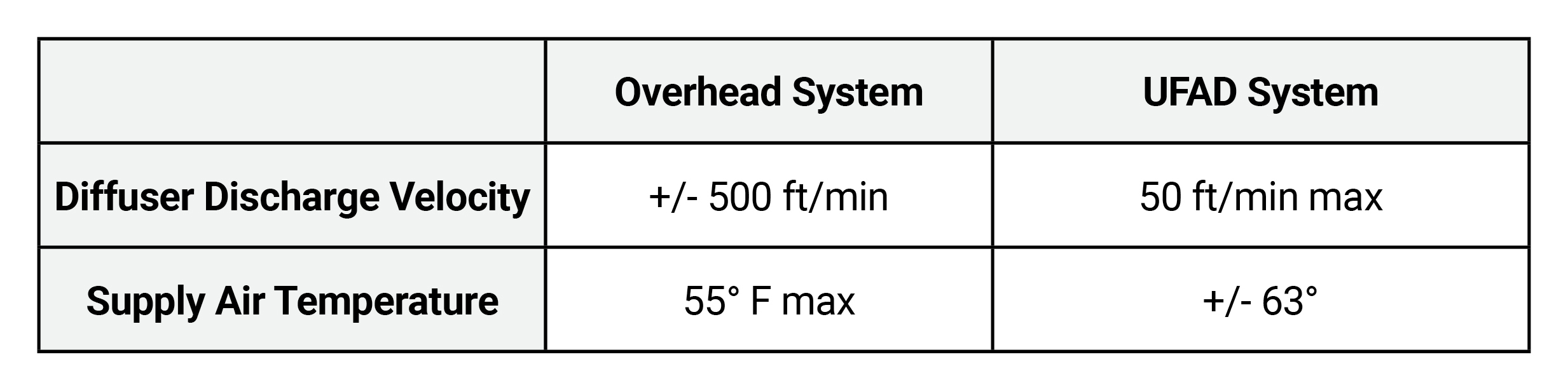
Overhead systems distribute air from diffusers at a high velocity above the occupied space. The mixing zone above the occupied space creates two benefits. First, the air can be introduced at much higher velocities than would be acceptable to occupants. The exit velocity from overhead grilles may be several hundred ft/min, with the objective that the velocity is slowed to 50 ft/min before it enters occupied space. Second, the air can be introduced at lower temperatures because it fully mixes before entering the occupied space.
UFAD systems introduce the air directly into the occupied space, requiring much lower exit velocities and warmer air to prevent cold drafts. The lower velocities may necessitate a higher quantity of diffusers with lower CFM. The warmer air creates a complication at the air handler to ensure that the air is still properly dehumidified.
Space stratification
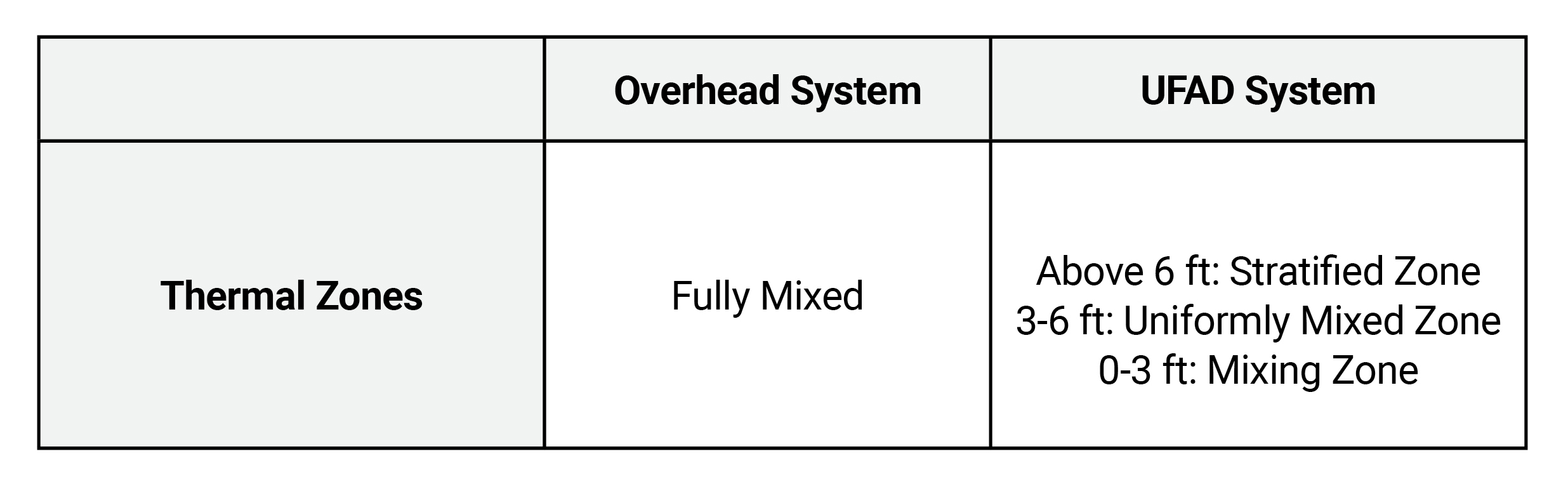
While stratification can play a role in overhead systems with high ceilings, fundamentally, overhead systems are designed to fully mix the space, creating uniform temperatures throughout.
Conversely, underfloor air systems have three distinct zones: the mixing zone, the uniformly mixed zone, and the stratified zone. From the floor level to 3 feet is the mixing zone. Next, from 3 feet to 6 feet, is the uniformly mixed zone where the space temperature is controlled, and the thermostats should be located. Above the uniformly mixed zone is the stratified zone. The stratified zone is characterized by higher temperatures. The diffuser layout and selection influence the precise elevation where these zones occur. A properly designed return air path can maintain this higher temperature all the way back to the air handling unit. Higher return air temperatures produce slightly higher AHU capacity and efficiency.
Air handler air path design
An air handler designed for an overhead system has one air stream that passes across the cooling coil. A maximum supply air temperature of 55° F is sufficiently cold for proper space cooling and cold enough to ensure moisture is condensed out of the air to properly dehumidify to typical space conditions of 75°F and 50% relative humidity.
With UFAD systems, a 63° F supply air temperature does not achieve a low enough dew point for space dehumidification to avoid mugginess and potential mold growth. The solution is to introduce a return air bypass mechanism where a portion of the return air passes across the cooling coil for dehumidification, and a portion of the return air bypasses the cooling coil to mix downstream of the coil to achieve the 63° F supply air discharge temperature. The cooling coil and bypass dampers are actively controlled to maintain space and discharge air temperatures. Depending on system design, the higher supply temperature can achieve higher system efficiency through increased economizer hour operation.
For UFAD systems, a dedicated outside air system to precondition outside air and provide space dehumidification is a best practice. In this scenario, the air handler provides sensible only cooling, but it is still important to equip the air handler with the ability to dehumidify during periods of high space latent load and transient conditions such as morning cool down. If unconditioned outside air is supplied directly to the air handler, the outside air should be configured to always pass over the cooling coil.
Air distribution
Overhead systems use ductwork designed to transport air at 1,000 to 2,500 ft/min. The ductwork is insulated and only constrained in size by coordination with other utilities. In UFAD systems, the entire underfloor air system is used as a plenum. Such a large area means that the air can be transported at very low velocities and very low pressure drops. Thus, air handlers serving UFAD systems can be designed at very low external static pressures, resulting in significant energy savings from reduced fan motor horsepower. However, the large uninsulated underfloor and raised floor surface areas create thermal decay of the supply air temperature that reduces cooling capacity. Later, we will review strategies to combat this.
Outside air effectiveness and indoor air quality
In overhead systems, short circuiting of the outside air can be produced through the outside air being introduced and returned high in the space. ASHRAE 62, which provides designers with guidance for calculating outside air rates, defines the concept of ventilation effectiveness and assigns a factor of 80% to derate the amount of outside air that enters the occupied space. ASHRAE 62 recognizes that outside air introduced at floor level and returned at the ceiling does not have this short-circuiting effect and is assigned a ventilation effectiveness factor of 100%. Furthermore, contaminates that are lighter than air are drawn up to the stratified layer and directed to the return rather than being mixed throughout the space, creating the potential for UFAD systems to result in increased indoor air quality.
Load calculations
Maintaining space temperature requires balancing the BTUs into the building with the BTUs out of the building. With the exception perhaps of the reduction of outside air load described above, UFAD systems need to remove the same BTUs. The overall capacity of the HVAC system does not change. However, due to the stratification layer in UFAD systems, the space load may be reduced by assigning a portion of the wall and lighting loads to the return air, thus influencing a decrease in space CFM. However, recall that the supply air temperature is higher, influencing an increase in space CFM. Therefore, these offsetting effects tend to counteract each other where the space CFM ends up in the same range as overhead systems.
Manual versus automatic diffusers
The ability for UFAD systems to have diffuser level control, either manual or automatic, provides potential for increased occupant comfort and LEED credits through controllability of thermal zones. Project cost pressure may make eliminating the cost of controlling actuated diffusers tempting. In practice, maintaining consistent space temperature requires reacting to changing thermal loads continually throughout the day. Occupants do not desire to make these consistent adjustments. Furthermore, unoccupied areas may contribute to overcooling or undercooling adjacent spaces.
Best practice is to serve occupied areas with automatic diffusers that react to changes in thermal load and provide energy savings by allowing AHU fans to ramp down during low load conditions.
Thermal decay of supply air temperature
In UFAD systems, the closer that supply air diffusers are located to the AHU, the better. The primary problem with remote grilles is not low pressure but thermal decay of the supply air temperature. As the air travels at low velocity under the raised floor, the air picks up energy through the underfloor and raised floor surfaces. This does provide cooling benefit to the adjacent spaces but may leave the supply air too warm to properly cool remote spaces.
There are several strategies to address thermal decay of supply air temperature:
• Air highways: Ducted partitions or fabric duct under the raised floor that transport the air to remote locations at higher velocity.
• Increased quantity of smaller AHUs: Modern designs often employ multiple Air Towers, vertical AHUs at lower CFM, distributed across the floor plate.
• Booster fans and supplemental cooling coils: In some instances, booster fans and underfloor cooling coils may be implemented to overcome the challenges of remote floor diffusers.
Air towers
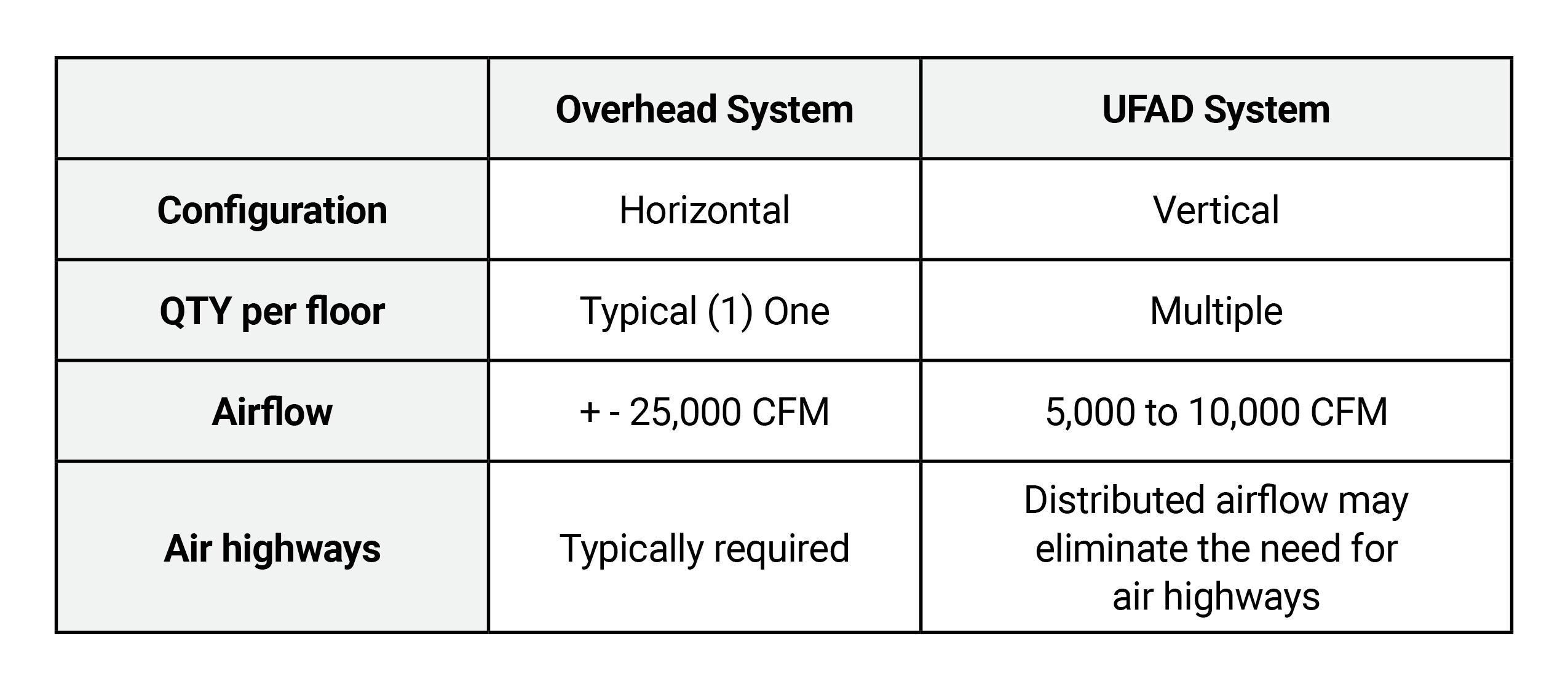
Many UFAD systems employ air towers rather than more conventional AHUs. A summary of differences between air towers and traditional AHUs is shown below:
Air towers use multiple small mechanical rooms or closets throughout the floor space as compared to a single, large mechanical room per floor. The vertical configuration of air towers has the potential to return usable space to the tenant. However, the author cautions against making the air tower mechanical rooms too small. These rooms require filter access on multiple sides, coil connections and valves, airflow measuring station, and smoke detectors.
Air Tower UFAD designs have enabled plenum depth in the 12” range as opposed to the 18” range of traditional air handler designs.
Exterior zones and areas of high loads
Exterior zones and areas of high load may require supplemental systems to properly condition the space. Exterior zones are commonly supplied by troughs with electric or hot water heat. Some trough manufacturers can draw in plenum air during cooling but recirculate space air during heating mode to reduce the potential for reheat. Conference rooms may employ underfloor fan powered boxes to boost local CFM. Consult with manufacturers for available options for perimeter and high thermal load zones.
Plenum leakage
Most people are aware of the importance of maintaining a tightly sealed supply plenum under the raised floor. The importance cannot be overstated. Strategies should be developed before construction begins, and inspections should be made throughout construction prior to and after the installation of the raised floor. Some projects may elect to have each trade responsible for sealing their own penetrations and to seal as they go. Other projects may hire a single contractor to seal all trades penetrations. Improperly sealed plenums can overcool the space with air leakage alone. Air leakage so severe that the building was not occupiable has also been observed.
Return air paths
Higher return air temperatures created by the stratified layer provide benefits for AHU capacity and efficiency. Maintaining the stratified layer requires locating transfers high in the ceiling space.
Additionally, the sizing of transfers and return air paths introduces a critical distinction between UFAD and overhead air systems. Overhead systems transport air through ducts that may be pressured to 1 inch to 3 inches of water gauge pressure. Underfloor air plenums are only pressured to 0.05 inch to 0.1 inch of water gauge pressure. In overhead systems, enough pressure is created to push the air through the transfers. In UFAD systems, an undersized return will raise the room pressure such that supply air to the room is prevented because the raised floor is not pressurized sufficiently to push the air through the transfer. Due to this, transfer air components are significantly larger on a UFAD project and need to be understood early in design for proper coordination. The chart below depicts typical transfer and return air velocities.
From a stratification perspective, a ceiling that acts as a return air plenum is beneficial in creating upward flow and maintaining the stratification layer. However, there is correlation with UFAD and the desire to have an open exposed structure overhead. This is particularly true when wanting to showcase the aesthetic of mass timber construction.

Cost considerations
It is the author’s experience that when comparing UFAD systems to overhead systems directly, UFAD systems have a first cost premium. A thorough ROI analysis must consider energy efficiency, decreased space reconfiguration expenses, and reduction in façade and envelope costs when floor-to-floor heights are reduced. Furthermore, a properly designed UFAD system has the potential to increase occupant comfort, which is correlated to higher worker productivity.
To summarize, overhead air distribution systems are the predominant market solution and have highly refined design procedures and tools. Designers have extensive experience and intuition with overhead systems. Contractors have established quality control procedures and well-developed cost models. UFAD systems can be a market differentiator providing energy efficiency, thermal comfort, and tenant flexibility. UFAD systems have the potential to provide more rentable square footage for a given floor plate and reduce floor-to-floor heights. UFAD systems can create a clean, open ceiling environment and showcase overhead structures and ceilings.
The author has witnessed several projects that required post-construction fixes that could have been prevented with a better understanding of how UFAD systems differ from overhead systems. Understanding the differences equips the project team with the areas that traditional paradigms do not apply such the increased focus on return air path pressure drop.
Designers and contractors who are new to underfloor air distribution systems are encouraged to study the resources available online and through the American Society of Heating, Refrigerating and Air Conditioning Engineers, where factors unique to UFAD are documented. Manufacturers are an invaluable resource to provide input during design and construction. I hope this information helps point you in the right direction for a successful underfloor air distribution project!
Senior Vice President Justin Bowker, P.E., has been part of the TDIndustries engineering team since 2001. Under his leadership, the team challenges itself to harness technical approaches to provide focused value to the owner on design/assist and design/build projects.