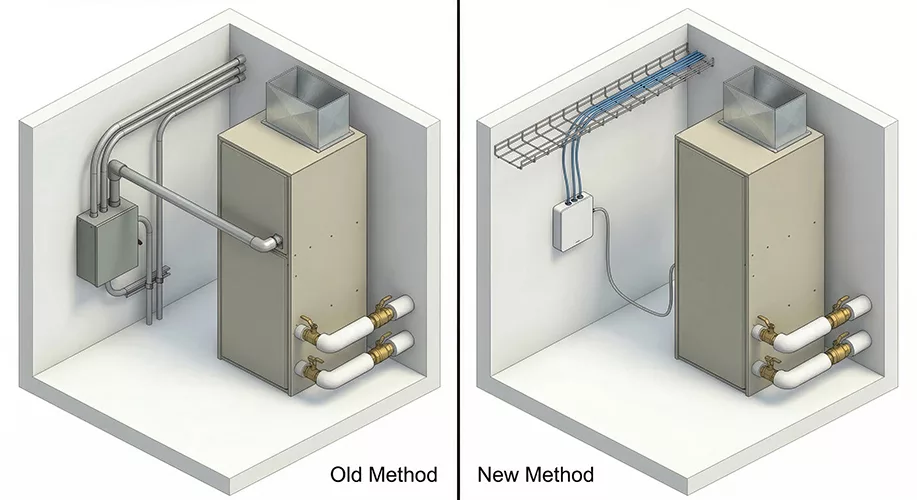
In the world of geothermal consulting and thermal energy networks (TENs), we naturally spend the majority of our time focused on the hydronic and mechanical sides of the equation — high-density polyethylene pipe, boreholes, flow rates, compressors and BTUs. However, as we embark on the massive, unprecedented undertaking of retrofitting our existing building stock to meet 2030 and 2050 decarbonization mandates, a significant and often crippling bottleneck has emerged.
It isn’t the thermal infrastructure; it’s the electrical infrastructure.
Traditionally, upgrading an existing building from legacy fossil-fuel boilers to high-efficiency electric heat pumps requires a massive, often cost-prohibitive overhaul of the building’s electrical service. To put it simply, the “E” in HVAC has become a formidable barrier to entry.
However, a revolutionary development formalized in the 2023 National Electrical Code (NEC) — the introduction of Class 4 Fault-Managed Power Systems (FMP) — is fundamentally changing the game.
It is time for the mechanical and electrical trades to work in closer harmony than ever before. Class 4 wiring is the “piping” of the electrical world, and it is the key to unlocking affordable, large-scale building decarbonization.
The bottleneck: Labor shortages, supply chains and the copper wall
To understand why Class 4 power is so critical, we must first look at the logistical realities of traditional electrical upgrades. A recent white paper published by Southland Industries analyzing electrical distribution highlights a perfect storm currently battering the construction sector.
First is the skilled labor shortage. Data from the National Electrical Contractors Association reveals a sobering statistic: 10,000 licensed electricians are retiring for every 7,000 that enter the workforce.
Second is the supply chain crisis. The unprecedented pressure from artificial intelligence (AI) data centers, electric vehicle (EV) charging infrastructure and nationwide building electrification has pushed lead times for traditional power distribution components — such as heavy transformers and switchgear — to upwards of 100 weeks.
In an existing 50-year-old high-rise, individual dwelling units often have 40-amp or 60-amp electrical panels already maxed out. Ripping open walls to pull heavy-gauge copper wire through archaic, rigid steel conduits to upgrade these services is a nightmare for labor and a massive drain on capital expenditure. It displaces tenants, adds months to project timelines and, in many cases, the cost of the electrical upgrade far exceeds that of the mechanical HVAC equipment itself.
We simply cannot achieve our aggressive decarbonization mandates if we are forced to rebuild the electrical grid of every legacy building from the ground up using 20th-century methods.
What is Class 4 wiring? The physics of packet energy transfer
For decades, the electrical and HVAC trades have operated primarily with Class 1, 2 and 3 circuits. Class 2 is well-known to most HVAC professionals; it is the low-voltage, power-limited wiring used for thermostats, sensors and Power over Ethernet (PoE). It is inherently safe because the power is hard-limited (typically under 100 volt-amperes and 60V DC).
On the other end of the spectrum is Class 1: the “meat and potatoes” high-voltage, high-current AC power requiring heavy, rigid steel conduit; expensive junction boxes; complicated and costly installation practices; and significant physical space to mitigate the severe risks of arc flash, fire and lethal shock.
Class 4, as defined in NEC Article 726 and regulated by UL 1400 safety standards, bridges this divide. Often referred to commercially as Digital Electricity (a patented technology pioneered by VoltServer), it enables industrial-level power — up to 450V DC — to be delivered safely over thin, flexible, communication-style cables (such as 16 or 18 AWG), without the need for steel conduit.
How is this possible? The system uses a centralized transmitter and a distributed receiver that communicate constantly. Traditional analog power (AC or DC) enters the transmitter and is converted into packetized digital electricity. Power is sent in discrete packets, typically 500 times per second. Interspersed between these energy packets are data packets that perform a microsecond safety check.
If the transmitter detects any fault — such as a person touching a bare wire, a short circuit or improper grounding — it halts power transmission within 20 milliseconds or less. This is a fraction of the time it takes for a human heart to register a shock. It is intelligent power that delivers the high-energy output of line voltage with the touch-safe simplicity of low-voltage data cables.
The retrofit advantage: Electricity’s PEX piping moment
For plumbers and pipefitters, think of the transition from threading heavy, rigid steel pipe to running flexible PEX tubing. Class 4 does exactly this for electrical distribution, offering distinct, transformative benefits for retrofits:
• Simplified, conduit-free installation. Because Class 4 is actively fault-managed and touch-safe, it does not require the rigid steel conduit, heavy copper or strict physical separation rules of Class 1 AC wiring. It can be pulled through tight mechanical spaces, existing riser shafts and above drop ceilings with the ease of data cable.
• Reduced installation labor costs. Because FMP is inherently touch-safe, it allows for simplified, limited-energy installation practices. Within the union ranks, a large, enthusiastic subsector of limited-energy electricians is trained specifically for this infrastructure.
By shifting the workload to these specialized professionals and eliminating the need for heavy steel conduit, developers can dramatically reduce overall installation labor costs and accelerate project timelines while continuing to support highly skilled, licensed union labor.
• Long-distance power delivery. Unlike Class 2 PoE systems, which suffer from severe voltage drop over 100 meters (328 feet), FMP can safely deliver kilowatts of power over massive distances — up to 2 kilometers (1.25 miles). This makes it the perfect backbone for powering edge nodes, water-source heat pumps and rooftop ventilation units across sprawling TENs.
• DC-native efficiency. The power grid operates on alternating current (AC), but modern electronics, LED lighting and the variable-frequency drives in heat pumps operate natively on direct current (DC). Converting AC to DC at every single appliance results in a conversion penalty that wastes between 5% and 20% of a building’s energy as heat. FMP delivers DC power natively, slashing these conversion losses.
Real-world proof: Decarbonizing historic landmarks and mega-resorts
This isn’t theoretical laboratory science; the technology is already commercially mature and actively disrupting the market in more than 1,000 high-profile locations globally.
1. The historic retrofit: Sinclair Hotel (Fort Worth, Texas)
Real estate developer Farukh Aslam purchased the 1929 Sinclair Building, an Art Deco masterpiece, with plans to convert it into a 164-room luxury Marriott Autograph hotel. Upgrading the electrical infrastructure using traditional AC methods would have required destroying historical plaster and expanding structural pathways.
Instead, the team used VoltServer’s Digital Electricity to power 24-port Cisco UPoE switches. Centralized FMP transmitters in the basement safely delivered up to 2,000 watts of power over simple 18/2 speaker cable to the upper floors.
Today, the Sinclair powers more than 2,000 connected devices via this method, yielding a massive 30% to 40% reduction in total energy consumption while preserving the building’s historic integrity.
2. The mega-scale new build: Circa Resort & Casino (Las Vegas)
In ground-up mega-projects, the savings scale exponentially. The 35-floor, 1.25 million-square-foot Circa Resort was the first ground-up casino built in downtown Las Vegas in 40 years. By using FMP as the backbone power distribution infrastructure for its advanced building automation, lighting and climate controls, the project achieved massive logistical victories.
Working alongside Belden’s REVConnect cabling system, the deployment enabled low-voltage technicians to rapidly install the power backbone. The result? The project was completed two months ahead of schedule and yielded $2 million to $3 million in construction cost savings directly attributed to bypassing dedicated AC power infrastructure.
3. Data centers and industrial scale
The advantages of Class 4 power extend far beyond hospitality. Southland Industries recently conducted a rigorous comparative analysis of high-performance data centers facing massive AI loads. It found that replacing traditional AC distribution with FMP reduced overall installed costs by 33%. It saved more than 14,000 labor hours by eliminating overhead busways, massive output switchboards and floor power distribution units.
For context, Southland was able to safely run 32 flexible FMP cables, each carrying a massive 200kW of power, inside a single 6-inch-by-12-inch data tray.
Similarly, in the industrial agriculture sector, the 30,000-square-foot GreenSeal Cannabis cultivation center in Ontario, Canada, deployed this technology to eliminate the need for thousands of pounds of copper and steel conduit. Removing step-down transformers and localized AC electrical panels in high-humidity environments radically reduced HVAC cooling loads while dramatically improving facility safety.
Pioneering the future: NYC’s St. George Tower
At Egg Geo, we are taking this technology to the frontlines of grid reliability and building decarbonization. We recently executed a highly strategic “Infrastructure Handshake” submission for Con Edison’s Non-Emitting Reliability Solutions RFI in New York City’s Zone J.
In NYC, thousands of pre-war high-rises cannot be electrified because their electrical panels and the local utility transmission grids are maxed out. To address this, we are spearheading a fully funded Field Evaluation Pilot at the historic St. George Tower in Brooklyn.
Our intent for the St. George prototype is to install Class 4 FMP directly in the first apartment, providing the NYC Department of Buildings and the Fire Department of New York a real-world Living Lab sandbox to physically verify the 20-millisecond pulse-power safety shut-off capabilities and shape the 2026 NYC Building Code updates.
To guarantee the project is not delayed by regulatory timelines, we have engineered a dual-pathway fallback: If the building department process lags, we can immediately use current, code-compliant Class 2 standards to electrify the heat pumps. This ensures we establish the digital backbone and gather the millisecond-level telemetry data required to trigger a full Class 4 regulatory exemption without delay.
To guarantee verifiable impact, this pilot will be independently overseen by the City College of New York’s Smart Grid Interphase Lab.
Crucially, this pilot tests the integration of Ephoca DC-native heat pumps (similar to the “Cozy” window units). By using FMP to deliver DC power directly to a DC-native heat pump, we eliminate the need for complex, heat-generating AC-to-DC inverters at the appliance level. This slashes hardware costs, achieves higher efficiency and creates $10,000-per-unit savings from avoided electrical upgrades alone.
It transforms a building retrofit into a localized non-wires alternative. Utilities are staring down the barrel of multibillion-dollar grid upgrades if every building switches to heat pumps simultaneously. FMP’s inherently digital telemetry guarantees Con Edison absolute visibility and control, ensuring zero incremental load on the distribution grid during the critical 12 p.m. to 9 p.m. summer peak window.
Bridging the gap to TENs
Decarbonization is not only about the source of energy; it is about how we safely and affordably deliver it to the people who need it. Moving BTUs hydronically through TENs is the most efficient way to heat and cool a city. However, we must be realistic about the final hurdle: powering the mechanical edge nodes.
By integrating TENs with Class 4 FMP, we provide the necessary electrical capacity for heat pumps at the edge of our thermal grids without the sticker shock of a total building rewiring. FMP provides real-time energy consumption data, automates load balancing and allows facility managers to identify potential issues before they become catastrophic outages.
We are entering a new era of infrastructure. The plumber, the pipefitter, the mechanical engineer and the electrician can no longer work in silos. Class 4 wiring is flexible, safe, touch-friendly and ready to meet the massive density demands of a decarbonized future. It’s time we started treating our electrical grids with the same fluid innovation we apply to our hydronic loops.