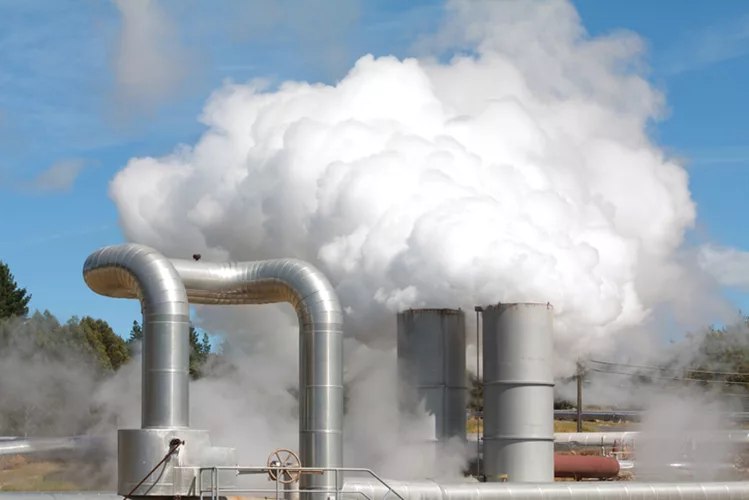
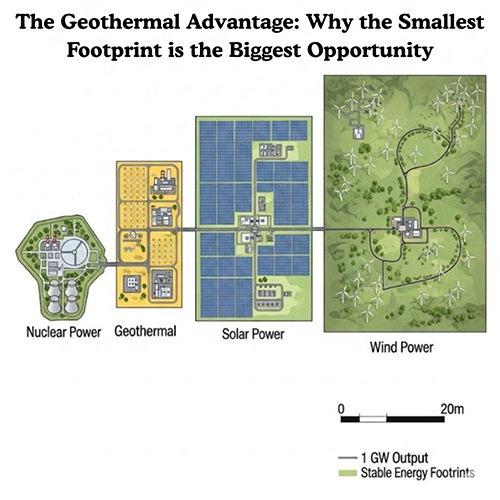
For a sustainable energy future, we must not only look at where our power comes from, but critically, how much land it consumes. On this metric, geothermal energy has a definitive advantage, boasting one of the smallest land footprints of any renewable power source. While technologies such as solar and wind require vast areas to capture diffuse, intermittent energy, geothermal taps into a constant, concentrated heat source beneath the Earth. This gives it an extremely high power density, putting its surface impact in a class with nuclear power when measured by stable energy output.
The cohesive nature of renewables
Geothermal energy provides the crucial element that solar and wind often lack: clean, firm power that runs 24 hours a day, 7 days a week. This makes it the ideal anchor for a grid that is increasingly dependent on weather-driven sources.
We know that when the sun sets or the wind dies down, a geothermal plant continues to deliver power, preventing reliance on fossil fuels to balance the grid. This constant nature allows it to integrate seamlessly with other renewables, elevating them instead of replacing them.
Beyond providing continuous baseload power, geothermal systems can be designed to work directly in concert with other technologies. Some geothermal systems can adjust their output to meet demand, making them flexible resources that can ramp up when solar production drops off in the evening.
It’s important to remember that geothermal can be paired with solar and wind to increase the overall reliability of above-ground renewable power, and this integrated approach maximizes the value of every renewable resource on the grid.
The numbers: Land required per gigawatt
The true value of geothermal is revealed when comparing the land area needed to generate stable, utility-scale power. Most studies show utility-scale geothermal power plants use between 1 and 8 acres per megawatt (MW). To generate 1 gigawatt (1,000 MW) of stable, continuous electricity, a geothermal plant requires approximately 5,000 acres, or just under eight square miles.
This makes geothermal an exceptionally efficient user of land compared to its competitors:
| Power Source |
Land Required for 1 GW (approximate) |
|
Nuclear |
1.3 square miles |
|
Geothermal |
Nearly 8 square miles |
|
Solar |
45 to 75 square miles |
|
Wind |
260 to 3,360 square miles |
The why: High capacity factor
The reason for this small footprint lies in geothermal’s operational consistency. Like nuclear, geothermal is a baseload power source, meaning it runs consistently, 24 hours a day, 7 days a week. Its capacity factor often exceeds 90%.
This is the critical difference: The amount of usable energy produced per acre over a year is massive compared to intermittent sources dependent on weather and time of day. A solar farm requires a massive land area to compensate for nighttime, cloudy days and seasonal drops in efficiency. Conversely, a geothermal plant draws stable power from a small plot of land around the clock, optimizing land use.
A solution for dense urban environments
Geothermal’s unique advantages — its high power density and minimal surface impact — make it an indispensable resource for navigating the global energy transition. Unlike the spacious fields required by solar and wind farms, a utility-scale geothermal system requires little surface land because the majority of its infrastructure is located deep underground.
The visible components are typically limited to relatively compact power plant buildings. They dramatically minimize surface-level environmental disruption and avoid the land-use conflicts that tend to slow large-scale renewable projects.
This delivers a crucial feature to the grid: a reliable and consistent supply that is entirely independent of volatile weather patterns. It produces power around the clock, offering a stable, predictable and resilient source of energy that is vital for stabilizing the grid against increasing threats such as extreme weather and cyberattacks.
The benefits of this minimal footprint are perhaps most critical when applied to decarbonizing dense urban environments. The same principle of high power density translates directly to thermal energy networks (TENs), which are the future of heating and cooling in cities.
These geothermal heating and cooling networks have an even smaller impact than power plants; their boreholes can be sited directly beneath existing structures, such as buildings, parking lots or athletic fields. This flexibility makes geothermal TENs the ideal solution for complex, space-constrained urban areas and large campuses, where tearing up streets or dedicating large tracts of land is not feasible.
Ultimately, geothermal’s ability to provide continuous, high-density power with a tiny physical footprint positions it as an essential cornerstone for the energy system. It is one of the few clean energy solutions that can be deployed unobtrusively in densely populated, high-demand areas to meet the world’s rapidly growing energy needs while simultaneously freeing up valuable land for other uses.
Much credit for this article goes to our colleague and good friend, Val Usle, who prompted this entire line of inquiry.