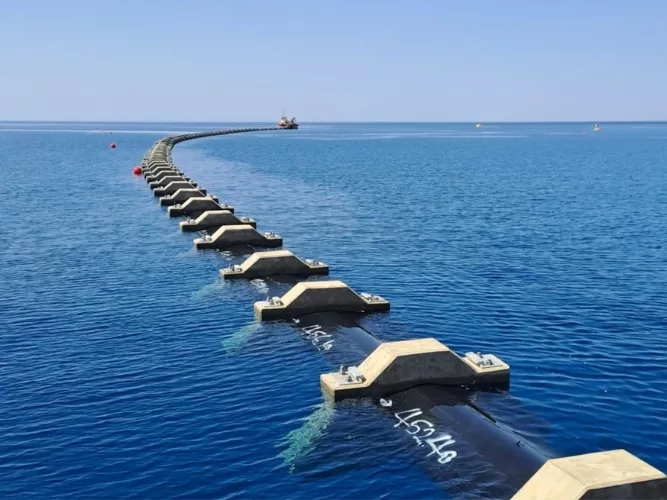
The Marine Installations chapter of the Plastics Pipe Institute’s Handbook of Polyethylene Pipe has been updated to include more technical information and guidance for the use of high-density polyethylene (HDPE) pipe. Chapter 10 as well as the entire 600-page handbook is available at https://www.plasticpipe.org/PE-Handbook.
“This handbook has always been the keystone for anyone involved in water and wastewater systems,” said Camille George Rubeiz, P.E., F.ASCE, co-chair of PPI’s HDPE Municipal Advisory Board (MAB) and vice president of the Municipal & Industrial Division. “We continually revise and update it to keep users current on the latest technical information and installation methods. Revising Chapter 10 is a prime example of PPI members volunteering their time and expertise to benefit the industry.”
The MAB serves as an independent, noncommercial adviser to PPI’s Municipal & Industrial Division, the leading North American trade association representing the plastic pipe industry.
“This revision significantly expands the technical depth and practical guidance for marine HDPE pipeline projects,” said Alex LeBon, P.E., marine pipelines division manager for Makai Ocean Engineering in Hawaii. LeBon served as the chapter’s primary author.
“Our group made several key additions, including survey and shoreline guidance, viscoelasticity considerations during installation, expanded ballast weight design guidance, updated bend limits, and new visuals and photos showcasing real-world projects,” LeBon explained. “Our goal was to provide clearer design guidance, practical field insight and applied engineering experience to support safer and more reliable marine installations.”
Rubeiz said he and PPI members Gerry Groen of Infra Pipe Solutions Ltd., Matt Haun of Performance Pipe, and Greg Rocheleau of Makai collaborated with LeBon on the update.
“Polyethylene pipe is increasingly popular with owners and contractors due to its long life, lower cost and ease of installation,” LeBon said. “For marine applications, polyethylene pipe is now the standard material of choice because of its resistance to corrosion and its light weight and flexibility, which allows installation using the float-and-sink method. This method is fast and requires minimal heavy equipment, resulting in significant cost savings. The flexibility and ductility of PE allow it to adapt to varied conditions, including unconsolidated river and sea bottoms, unsupported spans, and forces from strong currents and waves. Chapter 10 covers all major considerations for marine PE pipe design and provides necessary recommendations and formulas.”