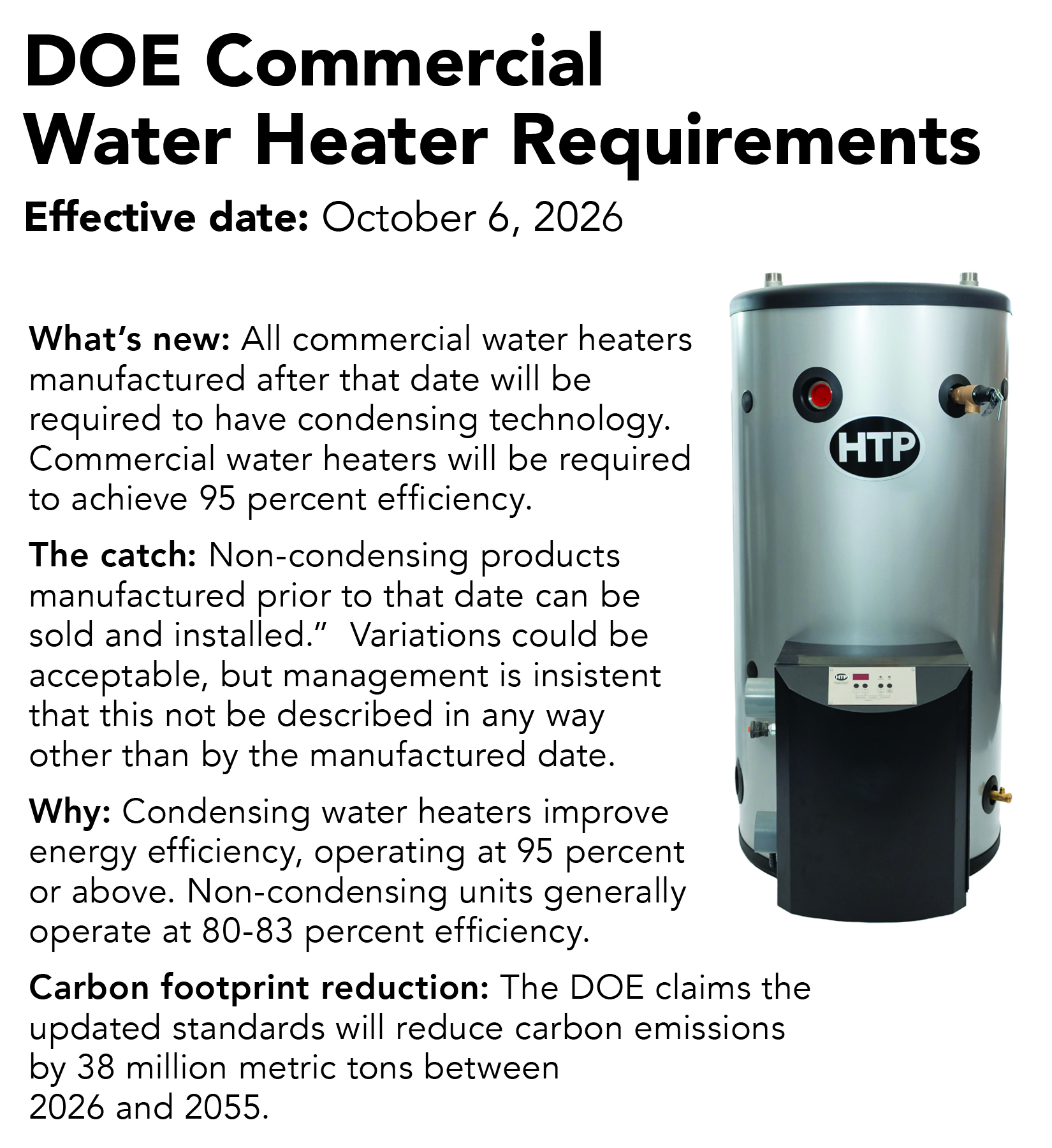
Time is growing short for manufacturers, distributors and contractors who install commercial water heaters to adapt to a game-changing directive from the Department of Energy. All commercial gas storage water heaters manufactured after Oct. 6, 2026, will be required to meet stringent new energy efficiency metrics that can only be met with condensing technology. (Non-condensing products manufactured before that date can still be sold and installed.)
The DOE rule is aimed at improving efficiency and reducing the nation’s carbon footprint. The DOE claims the updated standards will save businesses $140 million a year in operating costs and reduce carbon emissions by 38 million metric tons between 2026 and 2055.
Condensing technology is well-developed — HTP introduced its first condensing gas storage water heater, a predecessor of the popular Phoenix line, more than 30 years ago. However, the majority of commercial gas water heaters in use remain lower-efficiency, non-condensing products.
The domino effect of the rule will impact installers and building owners for decades as non-condensing water heaters are retrofitted with condensing ones. Government-mandated change is never easy to accept, but unless there is a last-minute intervention by the current administration and/or a successful legal challenge, there is no turning back. It is only a matter of time before all commercial gas storage water heaters in the United States will be condensing types.
Non-condensing vs. condensing
At the heart of the transition is the conversion from non-condensing water heaters to condensing water heaters.
Atmospheric gas storage water heaters burn fuel, such as natural gas, to heat water stored in a tank. The unit exhausts hot combustion gases upward through the flue and out of the building. The buoyancy of the hot exhaust gases drives a natural draft that in turn draws fresh air into the water heater. This air is mixed with fuel for combustion.
After the air/fuel mixture is burned in a combustion chamber, the combustion gases exit the water heater through a heat exchanger, where heat from the combustion gases is transferred through the wall of the heat exchanger into the stored water around it. The exhaust then continues up and out of the building through the flue, completing the cycle.
The design of basic atmospheric, non-condensing water heaters is uncomplicated, which makes them affordable and simple to install. Units that do not require electricity have the benefit of enabling users to heat water even during a power outage. There are some variations of non-condensing water heaters that have fans (as seen in mechanically vented units) or powered dampers (common in commercial models over 105,000 Btu/hr).
The key disadvantage of atmospheric gas water heaters is that they need the exhaust to be hot for buoyancy. That heat for buoyancy is essentially wasted energy. Because of this, atmospheric units generally operate at 80-83% efficiency.
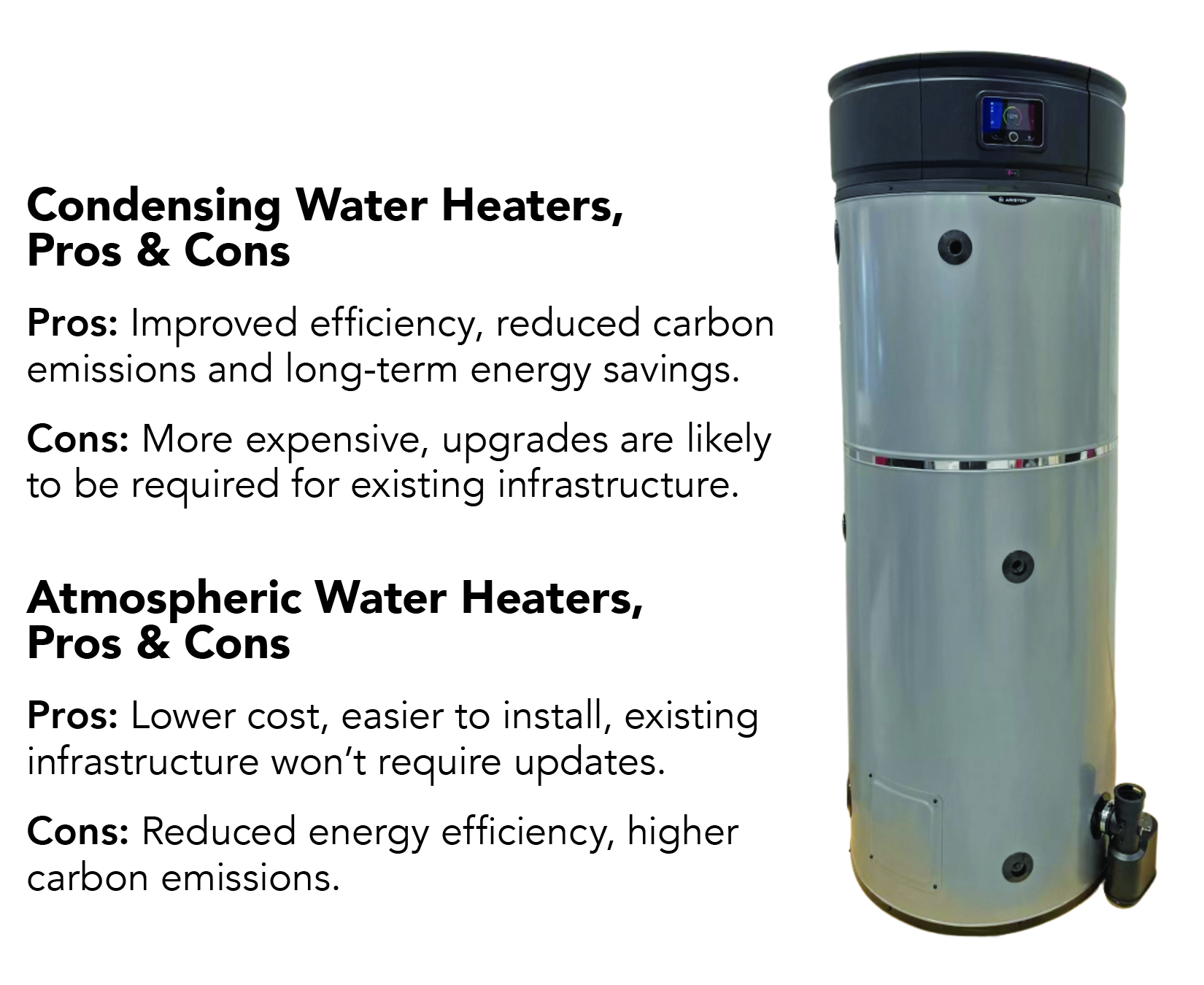
Contrast this efficiency with condensing water heaters, which are engineered for maximum efficiency, capturing and utilizing heat from exhaust gases that would otherwise be lost. Condensing commercial water heaters commonly produce efficiency ratings of 95% or higher, a significant increase compared to atmospheric water heaters.
What enables the efficiency gains seen in condensing water heaters? The heat exchangers in condensing water heaters can transfer enough energy from the combustion gases to the water that under the right operating conditions, water vapor in the combustion gases will condense into liquid water, hence, the “condensing” terminology.
This condensed water vapor, or condensate, needs to be managed and disposed of. Because of the efficiency of the heat exchanger, and resultant heat taken out of the exhaust gases, the exhaust gases lack the buoyancy required to vent naturally. This is why condensing water heaters need a blower or fan to force the exhaust gases up and out of the flue.
The more technologically advanced condensing water heaters commonly bring with them a bevy of beneficial additional features. With advanced electronic controls, many can be connected to the cloud and accessed remotely to monitor energy usage or diagnose faults should one occur. If so equipped, MODBUS and/or BACNET capability can enable them to be integrated into building management systems, which can curb energy consumption and further reduce emissions without sacrificing comfort. Look for a model with a powered anode for superior resistance to corrosion.
Manufacturers adapt
The tip of the transition spear falls on manufacturers, who have to walk a delicate line between developing and launching products that meet the new standards while also building today’s models.
Some manufacturers already offer condensing units, and new models are expected to hit the market. But like the veteran at the Las Vegas casino, most manufacturers are not showing their hands just yet. Over the next few months, manufacturers could introduce more condensing models.
Developing new products is serious business. Once internal testing is complete, safety and efficiency certification needs to be completed. Sourcing new parts through the supply chain is another obstacle. Assembly lines need to be retooled. Condensing units are more complex and need more time to assemble, requiring assembly line rebalancing. It is a lengthy, protracted process, and the impending deadline adds to the pressure.
Contractors’ corner
The transition may pose challenges for contractors who have yet to install a condensing water heater. The basics still apply, such as checking the physical space and ensuring the new unit fits. Here are a few key points to watch for when preparing to install a condensing water heater:
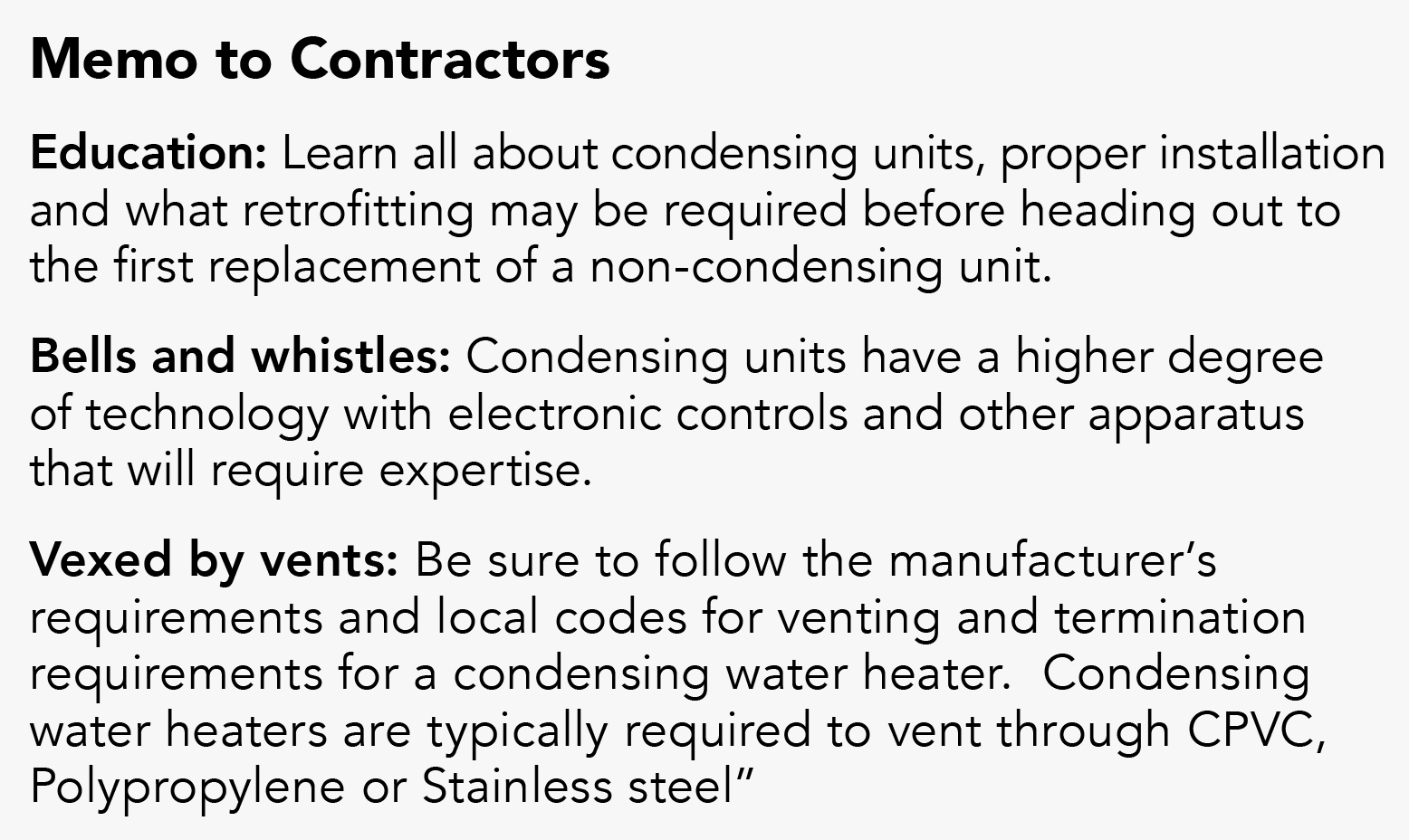
• Venting matters: While atmospheric, non-condensing water heaters often exhaust through a traditional chimney constructed of brick or cement, condensing units will need flues constructed of polypropylene, CPVC or stainless steel. Venting codes vary between regions; therefore, installers should check with their Authority Having Jurisdiction and always follow the manufacturer’s instructions. Pay attention to required vent diameters, total allowable vent lengths and terminations.
• Electrical circuit availability: Condensing units require electricity. If the unit being replaced is power/mechanically vented or is equipped with a powered damper, power should already be there. If there is not an outlet in easy reach, one will have to be installed.
• Condensate disposal: Installers will need to find ways to dispose of condensate. If there is not a suitable drain nearby, a condensate pump may be needed. The condensate is mildly acidic. Installations will likely need a condensate neutralizer and they are required in many places. Some condensing water heaters, like the soon-to-be-released Ariston commercial condensing water heaters, include a condensate neutralizer from the factory. The neutralizer may not be filled with media from the factory. Be prepared to add the media, if/as needed. The media typically used is calcium carbonate.
With all the differences between non-condensing and condensing units, it is beneficial for contractors to educate themselves before they are on site for their first install. Savvy installers may benefit from seeking out learning opportunities. Manufacturers often offer training on the products and how to install them. Ariston, for example, has a live-fire training facility in Massachusetts where installers can work with physical units. Alternatively, trainers will often travel to distributors and installers at their request and perform training at their facility.
In the weeks, and even months following the transition deadline, installers may face a dilemma of whether to recommend condensing units or seek out a new non-condensing unit remaining in inventory. The fear for contractors should be offering a higher-cost condensing unit when a competitor is offering a lower-cost non-condensing unit.
Barriers to entry
Most gas storage water heaters sold today remain the non-condensing types, though the split is much less pronounced among the commercial and residential duty commercial models. The primary barrier to more widespread adoption of condensing water heaters relates to the total “first” cost, which is the total of the purchase and the installation costs, both of which are likely to be higher for a condensing model.
Contributing to the higher installation cost is the possibility of required infrastructure upgrades for venting, electrical and condensate management.
Though users will benefit from reduced operating costs, the initial investment can be substantial and could be a deterrent for owners who may be unconvinced that the energy savings justify installing a condensing unit, especially ones who may be planning to sell in the near future.
No business owners want to close, or reduce operational time for equipment installation, and for many businesses, hot water is something without which they cannot operate. Even half a day of additional down time for infrastructure upgrades may not be tenable for a building owner.
For these reasons, property owners and installers may be inclined to stay with a non-condensing unit. Some may search out and purchase a non-condensing unit from existing stock after the deadline. It is likely that we will only see sales of condensing water heaters continue to increase at a modest rate until after the deadline.
Time for change
It is time to act and be prepared for the standard that will go into effect later this year. The window for installers to learn condensing technology, distributors to place their last orders of non-condensing products and manufacturers to adjust their production schedules is quickly closing. Expect a flurry of activity as everyone adapts to the new commercial water heater landscape.
Soon there will be no alternatives to a condensing unit when installing a commercial water heater. With all the benefits of condensing water heaters, their already solid adoption rate and proven track record, there is little reason not to embrace the change.
Brian Pickett is the regulatory affairs manager at Ariston USA. He has more than 14 years of experience in product development, project management and regulatory affairs management at Ariston, which offers water heaters under the Ariston, American Standard Water Heaters and HTP brands in the U.S.