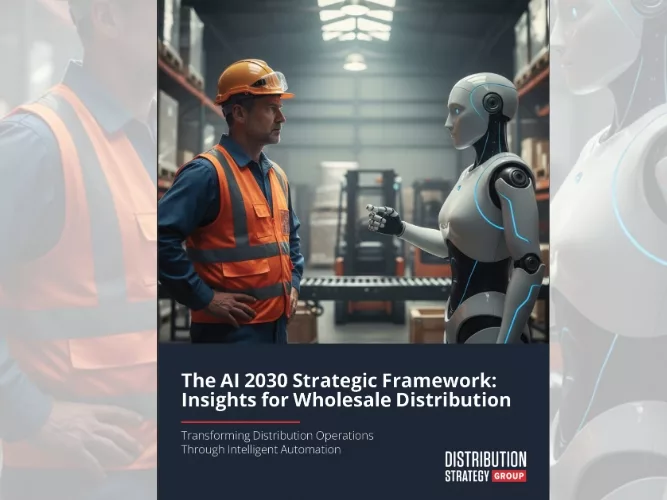
Artificial intelligence is now viewed as essential to the future of wholesale distribution by 97% of companies, yet most distributors are still in the early stages of adoption, creating a widening competitive gap between AI leaders and laggards, according to a new report from Distribution Strategy Group (DSG).
The report, The AI 2030 Strategic Framework: Insights for Wholesale Distribution, is based on findings from DSG’s 2025 State of AI in Distribution survey and presents a practical roadmap for distributors to move from experimentation to measurable business impact.
Key findings include:
- Early adopters report 40% to 70% productivity gains and multimillion-dollar sales improvements from AI-enabled tools.
- Human barriers outweigh technical ones: skills gaps (33%) and resistance to change (19%) rank higher than budget or data constraints.
- Mid-market distributors are using AI to narrow competitive gaps with larger rivals.
The framework outlines a phased path through 2030, beginning with low-friction pilots such as email order automation and predictive analytics, and extending to more advanced capabilities including autonomous AI agents, generative AI, digital twins, and robotics.
“AI has moved from future concept to present competitive factor for distributors,” said Brian Hopkins, partner at Distribution Strategy Group. “Organizations that begin building AI maturity now will be positioned to lead the industry over the next decade. This framework provides a clear starting point and a path to scale.”
The report recommends that distributors:
- Build AI literacy across the workforce.
- Activate AI capabilities already embedded in existing customer relationship management (CRM) and enterprise resource planning (ERP) platforms.
- Prioritize high-ROI pilot projects that deliver immediate operational benefits.