While some construction markets are slowing, the rapid expansion of data centers across the globe is creating new opportunities and demands for manufacturers and wholesalers alike. From materials and specifications to training and technical expertise, the sector is quickly emerging as a critical growth area for the PHCP-PVF supply chain.
A LinkedIn post by Porter Pipe & Supply, a PVF distributor headquartered in Addison, Illinois, highlighted one of the company’s training sessions focused on data center construction. That conversation prompted a deeper look at how the industry is preparing for this evolving market. We sat down with Stephanie Porter-Bodziach,executive director of marketing, eCommerce and customer experience at Porter Pipe & Supply, along with Kevin Coulas, vice president of production at Weldbend, a sponsor of the training event held at a Porter Pipe location in Madison, Wisconsin, to discuss what distributors and manufacturers should be doing now — and how they can position themselves for the future of data center development.
The Wholesaler: Porter Pipe has hosted training sessions on data centers. Can you give us a snapshot of what the training covered?
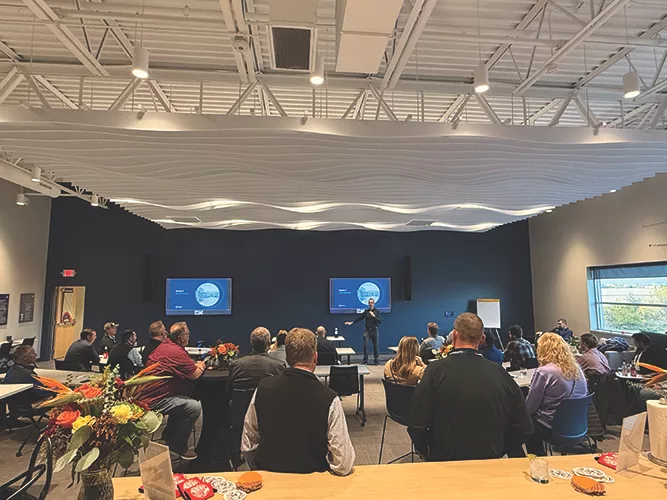
Stephanie Porter-Bodziach: Rather than traditional trainings, we recently hosted a series of curated industry events titled “Drinks & Data Centers.” The goal was to bring the right people into the room for meaningful conversations around the data center boom and what it truly requires from the construction supply chain. The event was relaxed, fun, yet very informative!
Each event partnered with a different manufacturer, and featured Bill Kleyman, CEO of Apolo.us, which enables organizations to harness the power of AI in a fully controlled, compliant environment. As a recognized data center expert, he shared insights from his 2025 State of the Data Center Report. The discussion focused on market growth drivers, emerging trends, and what those shifts mean specifically for contractors supporting these projects. Open Q&A sessions encouraged candid dialogue and addressed real-world challenges attendees are facing or will potentially face as this data center boom continues.
At the core, data center work isn’t about learning brand-new systems. It’s proven mechanical and cooling infrastructure applied at a much larger scale, with tighter timelines and far less tolerance for error.
Each event hosted approximately 100 industry professionals, including general contractors, mechanical, plumbing, and HVAC contractors, along with key vendor partners. Attendees ranged from seasoned data center professionals to those looking to expand their involvement in this space. We plan to continue hosting these events into 2026.
TW: Data centers are becoming major drivers of PVF demand. What elements of their cooling and mechanical systems are creating the biggest need for pipe?
SPB: Data centers are rapidly becoming significant drivers of PVF demand, primarily due to their scale and complexity. These facilities rely heavily on chilled water and condenser water systems to support continuous operations, which translates to substantial volumes of pipe, often in large diameters.
As computing density increases, designs incorporate more advanced cooling strategies and higher levels of redundancy. That means longer pipe runs, additional loops, and more material overall. Reliability is also critical. Data centers are expected to operate 24/7 with no room for failure, so material selection and system design prioritize durability, consistency, and long-term performance.
That combination of volume, redundancy, and reliability is what’s fueling PVF demand in this space, often with specific materials, joining methods, and brands dictated by engineering specifications.
TW: How are you training your sales and technical teams on the piping systems most common in data centers, such as large-diameter chilled water or liquid-cooling loops?
SPB: Data center work is not new to Porter Pipe & Supply! We’ve been supporting this sector for over 20 years, though the scale, speed, and complexity of today’s projects have certainly increased.
To support that evolution, we are establishing a national project support team dedicated to mega projects, which are predominantly data center work. From a training standpoint, staying aligned with current systems, applications, and best practices through our vendor relationships is embedded into how we operate.
We’ve further reinforced this focus by appointing Kevin Roche as vice president of strategic partnerships and national projects. His role is centered on aligning internal teams and vendor relationships to ensure we execute reliably on our customers’ large-scale, schedule-driven work.
TW: How is the company helping team members understand the material selection for data centers—carbon steel vs. stainless, HDPE vs. copper, grooved vs. welded systems?
SPB: Material selection for data centers is driven primarily by engineering and design specifications. Our role is to understand the intent behind those designs and ensure they’re executed correctly.
Across the industry, we’re seeing designs that emphasize system integrity, redundancy, and risk mitigation. That often translates to minimizing potential leak paths and selecting materials and joining methods that support long-term reliability.
Our teams work closely with engineers, contractors, and manufacturers to support those decisions, whether the application calls for carbon steel, stainless, HDPE, or copper. The focus is always on sourcing the right material, understanding why it was specified, and delivering it in a way that supports both construction efficiency and long-term performance.
TW: Data-center jobs demand strict traceability. How are you preparing your teams to manage MTRs, heat numbers, and compliance paperwork accurately?
SPB: Traceability is non-negotiable on data center projects, and it’s something we take seriously. To support this level of rigor, we’ve built a dedicated project support team focused on large-scale and data center work to ensure documentation is handled accurately from start to finish.
Material Test Reports (MTR’s) are managed seamlessly through both printed and digital formats, and customers have 24/7 access to our exclusive online MTR database. This level of documentation support is not limited to mega projects; it’s a standard service offering we’re committed to providing across our customer base.
We also offer reporting and documentation support tailored to each project’s requirements, along with invoice transparency to support audits and closeout. The goal is to make documentation predictable, accessible, and reliable, so it never becomes a bottleneck on the project.
TW: Are you partnering with pipe manufacturers or joining-system experts to train your team on installation practices, pressure ratings, and system compatibility?
SPB: Absolutely! Successful data center projects hinge on close coordination across the supply chain.
Our strategic partnerships with vendors and manufacturers allow us to stay aligned with evolving system designs and technologies, as well as staying ahead of any shifts in production or supply chain lead times.
As data center construction continues to advance, strong partnerships with manufacturers help us support our customers with proven solutions and practical, real-world guidance. That collaboration ensures materials are aligned with project requirements and available when needed, helping reduce risk and keep complex projects moving forward.
Ensuring a consistent cadence of lunch and learns and product specific trainings with our team is something we see as best practice, regardless of project type!
TW: Data centers run on tight construction timelines. How is the company training its operations and logistics teams to handle staging, kitting, JIT delivery, and jobsite sequencing for large pipe packages?
SPB: In the world of data centers, execution is critical, particularly given the aggressive schedules where delays are costly. This is where suppliers must really leverage the strength and strategy of their team’s organization, expertise, and strategic partnership! Not to mention, be stocked up with inventory or in lockstep with manufacturer partners.
At Porter Pipe & Supply, as our slogan reflects “Partnership with Purpose”, we already tailor our logistics strategy for each project, incorporating staged deliveries and kitting (or what we call ‘F.A.S.T.-Pak) when appropriate, just-in-time logistics coordination, and precise jobsite sequencing.
Our dedicated project support team is committed to ensuring that materials arrive seamlessly as planned, enhancing crew productivity and maintaining project schedules. Instead of a “one-size-fits-all” approach, we adapt our logistics to the specific needs of each project, helping to minimize risk and maximize efficiency. By handling logistics effectively on the front end, we keep projects on track and reduce the likelihood of costly delays.
Weldbend
LOCATED IN ARGO, ILLINOIS, WELDBEND has been producing domestically manufactured carbon steel fittings and flanges for more than 60 years. The company recently partnered and sponsored a Drinks & Data Centers event at Porter Pipe’s location in Madison, Wisconsin. We asked Kevin Coulas to guide us from a manufacturers perspective on what is taking place in the sector.
THE WHOLESALER: How is the rapid expansion of data centers reshaping demand for PVF products?
KEVIN COULAS: Data centers and the AI revolution have significantly impacted demand for PVF products. One of the challenges of data centers is the speed at which they are being fabricated and built. Because of this, PVF availability has become a key concern for data center companies. With technology companies putting pressure on meeting construction completion dates, delays in PVF materials cannot be tolerated.
Furthermore, these data centers require large amounts of supporting infrastructure, specifically in the areas of power and water, resulting in increased demand from these sectors. We see this trend continuing into 2026 and 2027 as demand from these data centers continues to rise.
TW: With data centers increasingly focusing on sustainability and environmental awareness, how are your PVF solutions supporting these goals?
KC: Steel has historically been one of the most recycled products and has become a key component in the steelmaking industry, as it is more efficient to remelt steel than to produce steel from iron ore. We also realize that our products may be filled with chemicals that can be hazardous to the environment. This is why we have an onsite, state-of-the-art lab that is third-party operated to conduct our mechanical and chemical testing, ensuring the products comply with applicable standards. We conduct our testing on sacrificial pieces rather than coupons, and we believe this provides the best representation of the actual mechanical properties of our products being installed.
TW: What trends do you see ahead for the PVF market as data center development accelerates, and how are you preparing for long-term growth?
KC: Weldbend continuously reinvests in new equipment to keep up with the latest technology. Just recently, we submitted a purchase order for new equipment that is set to deliver in about one year. Over the course of the past several years, we have invested in new Computer Numerical Control (CNC) equipment and forming presses, and we have engineered ways to utilize robotics and automation to keep up with customer demand while also improving our high standards of quality. Our equipment lends itself to the high-volume and quality requirements that these data centers demand from their fitting and flange suppliers.
TW: Many hyperscale operators require full traceability for all PVF components. How does your manufacturing process ensure documentation integrity—from MTRs and heat numbers—throughout the fitting and flange lifecycle?
KC: Weldbend prides itself on maintaining traceability from the melting of the steel all the way to the customer. We maintain product identification from incoming raw material through the manufacturing process and in the warehouse. When our customers order our fittings and flanges, not only are MTRs shipped with the product, but they are also automatically emailed to the customer prior to shipping. We maintain an electronic material traceability system that allows us to view data on our products, as well as generate MTRs. In addition, we have added a QR code on our MTRs that, when scanned, pulls up the Weldbend MTR on traceability.weldbend.com to help ensure the integrity of our products.