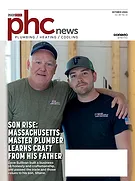
One thing’s for sure. Chris Hronek doesn’t like talking about himself. Even after spending four years leading Tweet/Garot Mechanical Inc., De Pere, Wisconsin, one of the country’s premier contractors licensed in more than 35 states, through a comprehensive digital transformation building real-time documentation into every stage of fabrication and installation, and earning SMACNA’s Innovator of the Year in 2024 for those efforts, he deflects responsibility right at the top of our conversation.
“It’s a company award,” says Hronek, Tweet/Garot’s construction technology manager. “It might be my name on it, but everything we’re doing is built on the culture here. None of this happens without leadership support and a team that wants to push boundaries.”
These efforts were critical in the company’s adoption of Stratus, a web-based construction procurement, manufacturing and logistics platform.
“We were able to take what used to be paper drawings, and now our shop teams are using monitors to view drawings in a digital format so they are always the most current. And we don’t have to worry about rips and coffee spills either,” Hronek explains. “By going digital, the teams are able to get the most accurate, up-to-date information, and they can pull measurements and add their own data with productivity timestamps along the way.”
Thanks to Stratus and other automations, the contractor can make quick adaptations to schedule changes, notify the shop throughout the process and automate material cut lists to eliminate errors. Field teams use QR codes for on-site package tracking, providing live project productivity insights. Connecting the same digital content through the entire project also allows cost comparisons between model production and estimates at any stage of a project.
As a result of digitizing workflows and streamlining processes throughout the company, Tweet/Garot increased its efficiency to consistently deliver projects to customers on time and within budget.
Home base
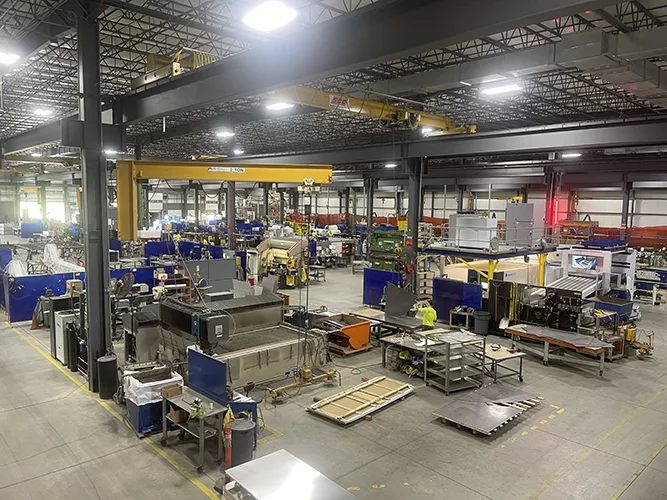
We interviewed Hronek at Tweet/Garot’s 108,000-square-foot manufacturing facility in Wrightstown, Wisconsin, a 20-minute drive from company headquarters. While we met Hronek at the company’s flagship manufacturing site, Tweet/Garot operates a total of 155,000 square feet of manufacturing space in all.
Hronek’s story is different from many construction technology specialists we’ve met. Hronek didn’t enter the industry with a computer science degree. No, his foundation is purely hands-on since his high school days doing a work/study program in residential HVAC.
“My dad’s a union machinist and my mom worked at the paper mill,” Hronek adds. “And I’m a sheet metal worker by trade.”
After high school graduation, Hronek drove to Tweet/Garot’s former headquarters in Green Bay, Wisconsin to interview for a pre-apprentice sheet metal position in 2001. (His job interview was on 9/11, no less.) He’s been with the company ever since.
After joining the company, Hronek progressed through the traditional skilled trades career path: pre-apprentice, apprentice, journeyman and foreman. But even during these early years, he was drawn to the connection between hands-on work and emerging technology.
“I attribute a lot of my interest in the tech side to the fact that smart phones we’re just starting to come out when I was coming into this industry,” he adds. “I went the Google Android route and knew how to work around some of the limitations to the operating system. Word got around and people were saying, ‘Oh, Chris can do that.’ ”

His affinity for technology led to opportunities within Tweet/Garot that gradually pulled Hronek away from fieldwork and into increasingly technical roles. For example, he helped implement the company’s coil line, worked on input roles when the company transitioned from Trimble’s Pipe Designer and Duct Designer to Autodesk Fabrication software, and eventually became the fabrication database manager, the first person in the department with field experience.
His initial work in the field is exactly what gave Hronek an invaluable perspective as he moved through these different roles.
“Early in my career, it was easy to put blame on problems the next step up,” Hronek explains. “When you’re in the field, it’s the shop’s problem. When you’re in the shop, it’s the office’s problem. When you’re in the office, it’s the owner’s and architect’s problem. Through my journey, I think it’s been interesting to kind of move into that next step up, myself, and figure out nobody wants to give anybody a bad product. I think I’ve been able to provide value by living it and that has allowed me to kind of talk through and understand what the problems are upstream, downstream and then try to find the best solution for it.”
Tweet/Garot agreed. By 2020, the company formalized a Construction Technology Department with Hronek as the manager. His team now develops digital workflows, supports VDC and estimating, manages fabrication databases, pilots new technologies, and always looks for ways to automate and improve workflows.
The digital pivot
Eventually, Hronek led Tweet/Garot though a critical evaluation of productivity tracking and fabrication management software systems. The company had been using Autodesk Fabrication software since the late-2000s, which provided a unified database across estimating, design, and installation. But as the industry shifted toward Revit for multi-trade collaboration, new challenges emerged.
“When we switched to Revit as a fabrication user, we couldn’t estimate in Revit and we couldn’t spool in Revit natively,” Hronek recalls.
The company initially used add-in software for spooling, but Hronek recognized the need for a more comprehensive solution that could digitize not just design work, but the entire workflow from coordination through fabrication and installation.
“Estimating, VDC, project management and the shop were all doing the right things, but in silos,” he says. “We realized we needed a role that connected everything. That’s where construction technology comes in.”
After spending a year evaluating multiple platforms, Tweet/Garot selected Stratus as the answer. What started as a spooling solution has evolved into something far more powerful. Additionally, the company’s growth spanning five Wisconsin prefab locations meant any new system had to work at scale.
“We wanted everything coming into the shop digitally,” Hronek says. “That’s the only way to sustainably track our work.”
Tweet/Garot’s prefab strategy needed modernization on two fronts:
Prefab, where BIM-based modeling drives spooling and shop production.
Non-modeled work, where field-fabricated connections and modifications often rely on hand-drawn sketches.
Stratus became the digital backbone of Tweet/Garot’s prefab operations, replacing manual spooling workflows and delivering an end-to-end digital connection from design to shop fabrication to field installation.
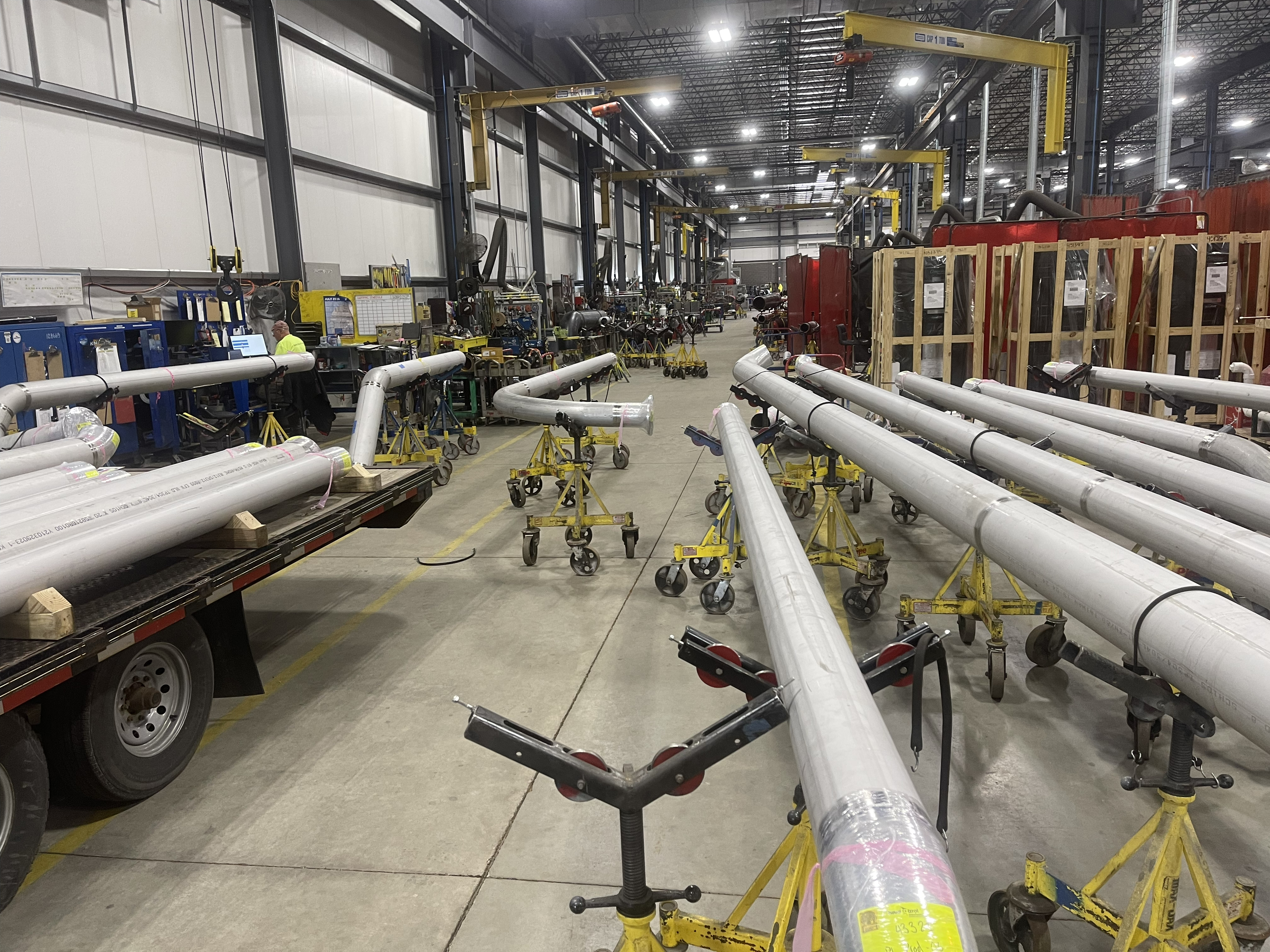
When visitors tour the Wrightstown facility, they see a shop that helped earn Hronek (and everyone else) that SMACNA innovation award. Computer screens are integrated into workstations. Automated cut lists are sent directly to equipment operators. As shop personnel complete each stage—marked, for example, as “issued to fabrication” and “fabrication in progress,”—bills of material are generated automatically, which go directly to purchasing. As everyone completes each stage, they update the status, creating a real-time view that easily tracks every package’s location and progress.
“There might be 25 different jobs going on,” Hronek explains, “but everyone can quickly see what’s being done and when the work will be completed.”
But there was a gap in this technology.
Stratus works perfectly for modeled work. But many projects, such as plumbing tie-ins, small retrofits and field-fabricated connections, are not modeled. Those field-order drawings remained stubbornly analog, typically hand sketches scanned or texted back to the shop.
“We live in a modeled world,” Hronek explains, “but the field doesn’t always get that luxury. So we also needed a way to digitize the non-modeled stuff, too.”
One of the most innovative aspects of Tweet/Garot’s digital transformation was their early adoption of Field Orderz, a Stratus add-on designed to handle the non-modeled side of fabrication work. Field Orderz features “smart sketching” capability that can transform paper sketches into digital drawings complete with dimensions, labels and material specs. Material orders can be created directly and then submitted for purchase.
“Field Orderz eliminated the old workflow of paper sketches getting lost in trucks, emails with blurry photos, shop calls asking, ‘What exactly is this?’” Hronek adds. “Now it’s clean, digital and trackable.”
Years before Field Order and digital transformation, Hronek also developed standardized order sheets, for example, featuring the 10 most commonly used sheet metal pieces, allowing field foremen to quickly specify what they need digitally rather than hand-drawing sketches.
Tweet/Garot began piloting the software with plumbing teams, processing a few hundred drawings in the first test period. Adoption spread quickly.
“It’s still one of the most important steps we ever took,” Hronek says. “It pulled the last piece of the workflow—non-modeled work—into the digital chain.”
Beyond workflow improvements, the digital ecosystem approach has given Tweet/Garot something even more valuable: real-time data about productivity, bottlenecks, and actual versus estimated performance.
The tracking capabilities built into Stratus allow Tweet/Garot to analyze productivity with precision. Project managers can see exactly how much material has been installed versus what remains to be done. Estimators can compare their projections against actual performance. Shop managers can identify chokepoints in the fabrication process.
This data-driven approach extends to dashboard development. The construction technology team is currently working with Tweet/Garot’s projects team to create a dashboard that pulls information from both Stratus and Vista (the company’s ERP system), providing visibility into project status, billing and productivity metrics.
A new blueprint
For many mechanical contractors, “innovation” is synonymous with buying new software. For Hronek, it’s about building a digital ecosystem without forgetting about the human touch.
For example, implementing Stratus required Tweet/Garot to overcome significant cultural and technical challenges. The company had to convince shop floor workers—many of whom had spent entire careers working from paper—to embrace computer screens and digital workflows.
Or did it?

“Giving these guys computers and screens was a concern,” Hronek admits. “But as it turned out nothing could be further from the truth. I would say everyone liked the new way once they got comfortable with it. When you understand the work, you understand the pain points. Technology is just the tool. Innovation is fixing the problems our people deal with every day.”
The key, as Hronek notes, was ensuring the digital solution actually solved real problems these workers faced. That belief and the results it produced have positioned Tweet/Garot and its construction technology manager into national leaders in digital prefab. Hronek has already made a presentation on Tweet/Garot’s transformation at Stratus user conferences and other SMACNA events.
“I’ve lived all sides of this,” he says. “I know the field frustrations. I know the shop headaches. I know what VDC needs to coordinate and what estimating needs to price. That’s what makes our Construction Technology Department so effective—we sit in the middle and help everybody see the bigger picture.”
So instead of pushing technology top-down, he uses a collaborative approach:
Estimators understand how digital prefab improves bid accuracy.
Project managers see real-time progress and cost impacts.
VDC teams work with content that matches how the shop actually builds.
Field leaders appreciate faster turnarounds on field-fabricated connections.
Shop foremen get consistent, readable data and fewer production stalls.
“Construction tech roles didn’t exist 10 years ago,” he says. “Now they’re becoming central to operations. We’re not trying to be a tech company. We’re a construction company using technology the right way. And if what we’re doing helps the industry move forward, then we’re doing our job.”