Tesla’s Cybertruck has sparked a lively debate about its classification, with some viewing it as a work of art, others as a daring mechanical and architectural statement. Love it or not – it’s certainly unique. There’s a mostly steel and glass home in the wooded hills of Bethesda, Maryland that stirs similar reactions on a first encounter.
Regardless of your viewpoint toward modern architecture, world-class architect David Jameson’s own home is singular and distinctive. First-time observers are moved toward intense curiosity, regardless of their view.
For those with an inclination toward modern art, it’s phenomenal. But for those who wonder how it works, say, mechanically – especially when snow is piled high outside, or when the midsummer sun is high – the brilliance of this home’s design and aesthetics is tied to mechanical mastermind, Dan Foley.
Foley, owns Lorton, Virginia-based Foley Mechanical, Inc., a 21-person full-service mechanical systems firm. Foley’s skills, like Jameson’s, have taken him to the summit of his profession.
David Jameson, FAIA, is the owner of David Jameson Architect, Inc., based in Bethesda, a suburb of Washington DC. Jameson now ranks as one of the nation’s finest contemporary residential architects based in the USA, though his projects can now also be found in Europe and Asia.
It helps that Foley and Jameson work their craft in one of the world’s wealthiest metro areas, Washington DC. It’s no surprise that they found each other and have worked closely together for many years.
“What I’ve seen all too often is a disconnect between architecture and mechanical systems,” Jameson says. “With Dan, I saw an opportunity to bridge that gap, and to promote the importance of collaboration so that, as a team, we could offer a total systems or holistic approach.”
Foley adds: “For his own home, a construction project that took several years to complete, we worked closely with David and the structural engineer. The results were easy to see. Very few architects actually care about comfort. That’s not the case with David.”

Habitable art
The home Jameson designed for himself and his family became a bold expression of his architectural skills, and character. The house is now widely recognized as a fine example of residential fine art and function.
“I call it ‘habitable art,’” Jameson adds.
For years, Foley’s crew called the residence “home base,” since the installation team spent a lot of time there. Chief among them, mechanical pro Brian Golden, Foley’s “Top Gun,” became very familiar with the home and Jameson’s family.
The 9,500 square-foot residence, which Jameson built as well as designed, offers two distinct personalities: one public, one private.
Jameson refers to the home as the “Vapor House.” With plentiful glass, and soaring panels of reflective, rippled black stainless steel, the house is formed by an arrangement of large windows framed by giant burnished and iridescent “liquid bricks.” The house wraps around a lap pool.
The architect invested considerably to develop his “laboratory of ideas.” Sporting a Darth Vader vibe, “The home is rather dark and mysterious,” Jameson explains. “It also captures certain qualities of water – like steam coming off a pond.”
Foley’s relationship with Jameson began in 2004. Jameson appreciated Foley’s demand for perfection – or as close to it as humanly possible. They began with collaborations on several projects and then, in 2010, Jameson unveiled blueprints for his own home, inviting Foley to do all of the mechanical systems work, beginning with concrete-embedded radiant floor heat and cooling, including a snowmelt skirt around the outdoor pool. The bulk of Foley’s work happened between 2012 and 2016, though various loose-end work continued through 2020.
Resembling a contemporary museum or art gallery, the home has big, open rooms with 25-foot ceilings, giant windows and massive glass doors that open electronically. The metal-and-stone kitchen is virtually black. Inside, light changes the appearance of each room throughout the day.
The house surrounds the lap pool on two sides, though a detached “west wing” – a two-level pavilion or guest quarters – also radiantly heated – completes what at first appears to be an extension of the home. The home’s below-grade level includes a spacious movie theater.
The large two-story living area incorporates the dining zone, flanking the kitchen; upstairs are five bedrooms. Dark wood covers structural pillars, while raw cedar was used for many internal walls. Gray stone slabs adorn the floors; all are radiantly heated and cooled. And so, as a visitor steps into the Vapor House – preferably in winter with bare feet – it’s the surreal warmth that begs the question: How’s this possible?
Mechanical Mystery Tour
Foley is quick to point out that the goal of floor cooling was to wick-away (or, in winter, to utilize) floor heat from solar gain through geo-exchange. Through clever thermal energy transfer – smartly monitored and controlled by tekmar controls and floor sensors for the home’s 14 radiant zones – year-round circulation of geothermally cooled (or heated) fluid serves as the home’s key source of comfort.
“In the winter, we capture and circulate solar gain heat to reduce the need for geothermal energy and heat,” Foley explains. “In the summer, the opposite happens: solar gain is reduced to the point where we circulate fluid temps in the floors of 60 to 70 degrees to cool the home – never less than 60 degrees. It’s an amazingly efficient system.”
“Dan’s expertise results in ‘curated mechanical art,’” Jameson adds. “I appreciate his mastery at delivering ‘the art of comfort.’”
In a nutshell, there are no t-stats in the home; control is achieved entirely via mobile device, linked to sophisticated controls connected to hidden temperature sensors. Though there’s a back-up boiler, the geothermal heating and cooling provides the great majority of mechanical temperature control.
Initial work on the home involved the drilling and grouting of 16 300-foot geothermal boreholes to serve 12 separate geothermal systems for a total of 36 tons: heating and cooling.
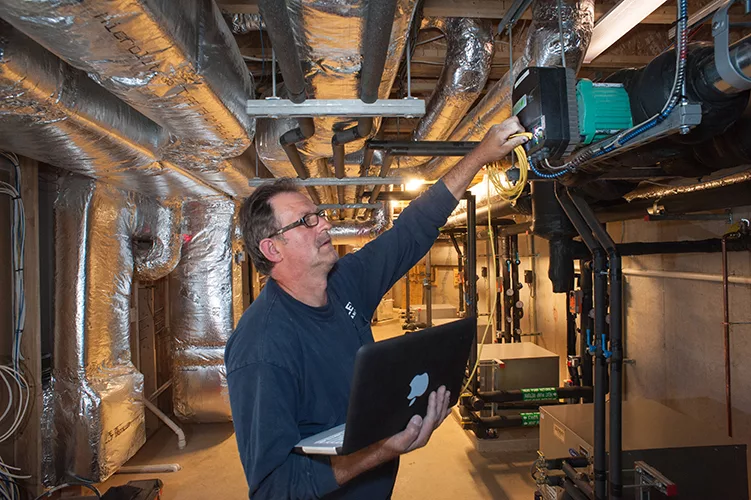
All mechanical systems and sensors are hidden, yet readily accessible. Foley also assured that he could provide full integration of air ventilation, heating, cooling, filtration and humidification. Humidity and enthalpy sensors were incorporated into the design.
Foley chose to use direct expansion cooling for ducted filtration, ventilation and dehumidification during the summer months, and steam humidification during the dry winter season. IAQ is addressed through media cartridge air cleaners, steam humidifiers, de-humidifiers, UV-C lamps, ERVs, exhaust and ventilation/make-up air.
“We must be able to control all of those factors to achieve a high level of indoor air quality for the Jamesons,” Foley says. “If not, we’re not delivering sufficient air quality or comfort. This is one of the reasons, learned from early experience, that when a client doesn’t want to give me the entire job – say, all hydronics but none of the HVAC – we won’t accept it because we lose control and can’t assure the customer the comfort they want.”
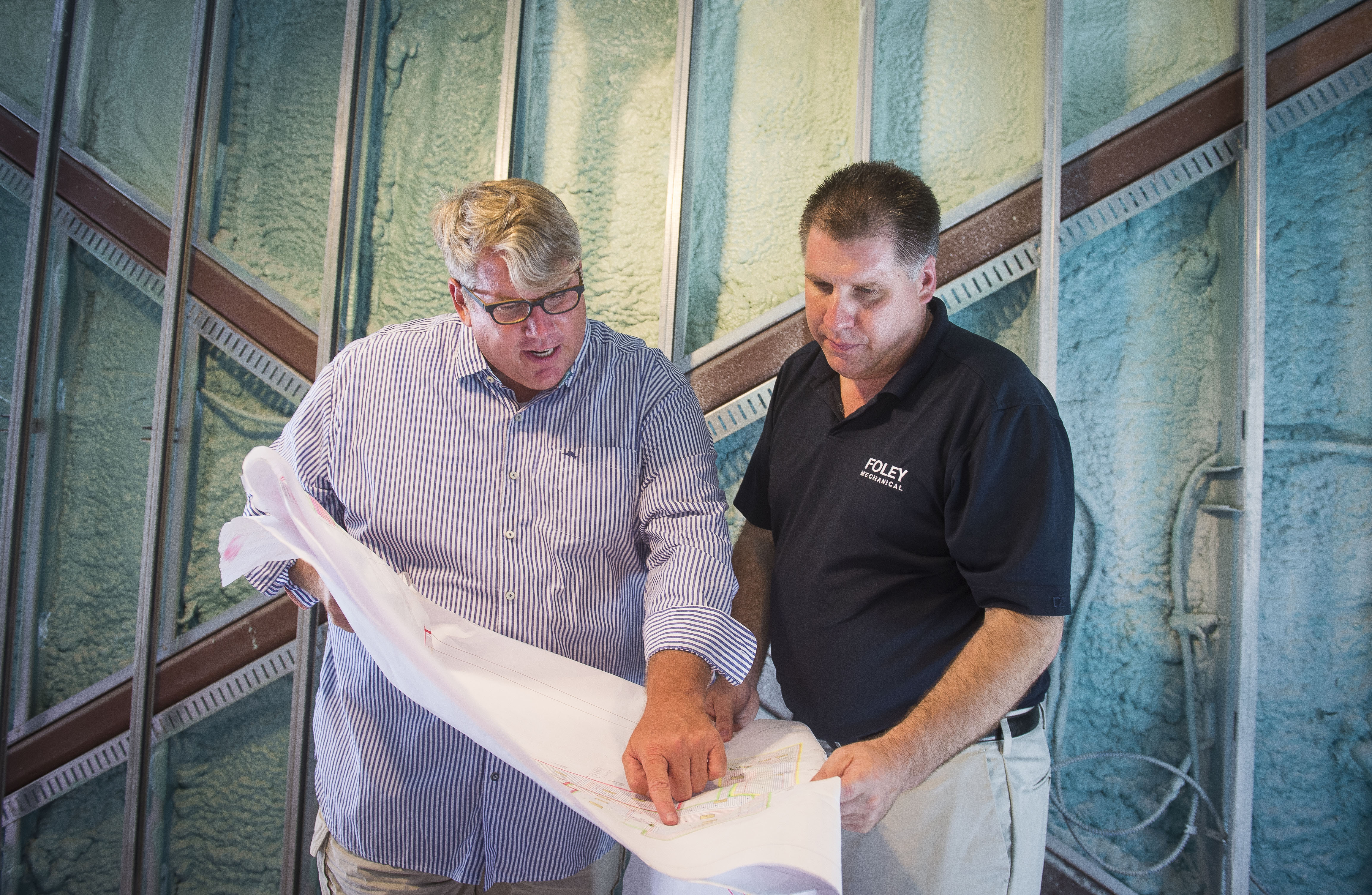 Foley at Jameson House
Foley’s installers began their work inside the home attaching miles of bright orange Watts RadiantPEX+ tubing to subfloor surfaces prior to concrete pours: high mass for the basement level, or lightweight gypsum-crete for upper levels. All loops made homeruns to and from Watts stainless steel radiant manifolds.
Foley chose a wide variety of Taco technologies, including HotLink-Plus hot water recirculation, expansion tanks, a three-inch 4900 Series hydro-separator to separate geothermal loop and system flow, a 4900 Series air separator, a combination of zone ¾-inch valves and ECM circulators for hydronic circulation, paired with either ZVC or SR relay zone controls.
A 1HP Taco ECM VR30 pump manages geothermal system circulation, while a VR20 governs circulation to and from the geothermal split systems. Two VR15 pumps manage flow to and from the geo (or gas backup boiler) heat exchangers, paired to radiant loops. Foley also used Taco triple-duty valves (one 1.5-inch, one 2-inch, and one 2.5-inch) for check valves, and for the larger pumps for flow control, flow measuring and balancing.
A 2-inch Watts backflow device was used at the water main, and incoming municipal water is treated by Watts OneFlow salt-free scale prevention and point-of-use reverse osmosis.
Foley’s suppliers for mechanical systems and components are RE Michel, Thos. Somerville Co. (with reliable assistance by George Howell) and Washington Winnelson.
Expertise on tap
So, how is it that a mechanical systems contractor can match wits, wisdom and intellect with one of the brightest architects on Planet Earth? Through a strong relationship that lives up to or exceeds expectations, and delivers on a promise every time.
To see the two of them on jobsites, at home or while dining, is to see genuine, mutual friendship. Both admire and appreciate each other’s skills.
“David creates works of art, and I do too,” Foley says. “We complement each other in that way. Our skills and talents aren’t exclusive, they interrelate. Our mix of skills become the heart of a collaboration that works. That’s the key.”
Architect David Jameson is recognized for his award-winning residential designs, national and international media features, and inclusion in prominent architectural listings like the AD100 list and The Wall Street Journal’s top architects. His work has been featured in more than 200 publications and earned him more than 175 design awards.
Foley’s no stranger to professional accomplishment and accolades either. He entered the trade two years before completing his bachelor’s degree in business management at Virginia Tech in 1988. His superb mechanical systems quickly won him recognition. In 2002, following 15 years of service with Arlington Heating & Air, concluding as vice president and general manager, he founded Foley Mechanical.
Foley was also a charter member of the Radiant Panel Association (now IAPMO’s Radiant Professionals Alliance), and has been a long-time member of ACCA. He served as RPA president in 2003. Foley was named NAPHCC’s National Association Contractor of the Year in 2016, and he was the recipient of the Holohan-Carlson Award for excellence in 2025.

“The world of mechanical systems isn’t one that a lot of people naturally gravitate to,” Foley says. “Yet it’s a perfect match for my interests and aptitude. But my goal, lately, is to enable and empower others in the trade – especially now for the guys who work at FMI.”
Brian Golden, for example, has been with Dan for 20 years and is now FMI’s overall jobsite manager.
“I’m not afraid to say that his mechanical talents exceed mine,” Foley says. “He and our other guys are the very best in their field. I want to give back, not just within the company, but within the industry that’s been so good to me.”
Foley’s emphasis is on comfort.
“There’s no mechanical systems recipe that can be applied to multiple homes or buildings,” Foley explains. “Each application of our talents, skills and technology must be examined individually if a robust, lasting total comfort solution is to be provided.
“This philosophy worked well at David Jameson’s home – a jobsite that exceeded the demands of most complex commercial systems,” he concludes. “And if it served us well there, we know that we’re on the right path.”