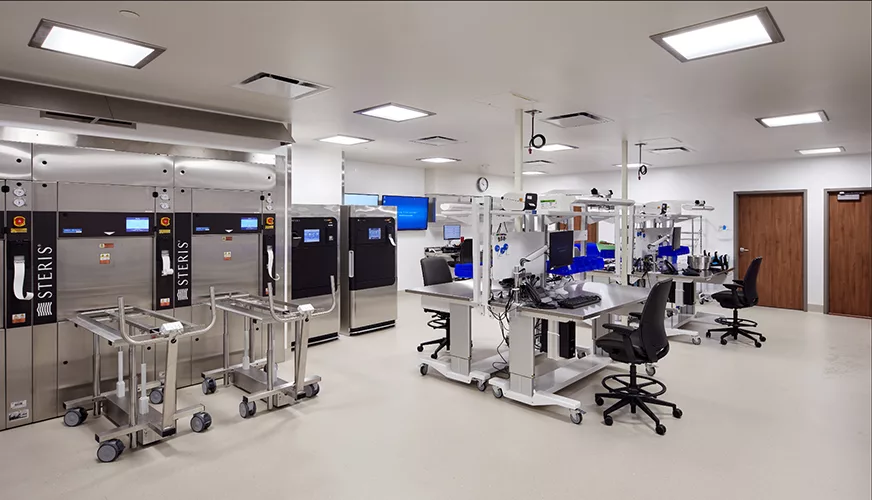
In 2023, the Association for the Advancement of Medical Instrumentation (AAMI) and the American National Standards Institute (ANSI) developed and approved ANSI/AAMI ST108:2023 Water For The Processing Of Medical Devices. This standard supersedes the previous AAMI technical information report on the same subject, known as AAMI TIR 34. The standard aims to establish minimum requirements for the water and steam quality used in the processing of medical devices. It’s meant to assist medical device processing professionals within hospital sterile processing departments (SPDs).
The Joint Commission, in alignment with the Centers for Medicare & Medicaid Services (CMS), is using ANSI/AAMI ST108:2023 as a benchmark and reference point during its accreditation surveys. Like with other AAMI standards, The Joint Commission references ST108 as a metric for best practices. AAMI and the standards it produces are authoritative industry sources that surveyors can rely on.
This means ST108 has become a de facto enforceable standard even though it is not explicitly mandated. SPDs need to comply with the standard or risk citations during their triennial accreditation survey.
Plumbing engineers working on designs for healthcare facilities, specifically SPDs, need to know how their designs can affect water quality and the ability to meet and maintain the requirements of ST108. Reading and understanding ST108 is imperative. To fully understand the requirements of the standard, it’s important to purchase it and become familiar with it for use in design. Becoming well-versed in it will enable an engineer to provide value to clients.
Here is a high-level overview of the sections included in the standard and the guidance it provides.
ST108 overview
1. Roles and Responsibilities. ANSI/AAMI ST108:2023 outlines the roles and responsibilities of a multidisciplinary team responsible for water quality and the water management program. This team includes:
Senior organizational leadership (those with authority to make large-scale decisions);
Facilities engineering staff;
Infection prevention staff;
Representation from the SPD;
Clinical engineering representative;
Surgery/procedure room personnel;
Water treatment specialist.
2. Risk analysis. The standard encourages the multidisciplinary team to complete a risk analysis prior to water system installation. This is in alignment with The Joint Commission water management standard (EC.02.05.02, Eps 1 through 4), which requires healthcare facilities to have a water management program and an implementation team responsible for a risk assessment.
3. Categories of water quality. Three categories of water quality are identified as follows:
• Utility water. This water is used for flushing, washing and intermediate rinsing. The typical domestic water supply is usually sufficient, although some minimal processing or further treatment may be needed, depending on the incoming water characteristics.
• Critical water. This water is used for the final rinse after high-level disinfection, for the final rinse of critical devices prior to sterilization and feedwater for process steam production. This water requires extensive multistep treatment.
• Steam. This is vaporized water used for the sterilization of medical instrument packs. The steam source could be central plant steam or locally generated steam.
4. Water quality selection and requirements. Guidance is given for determining the appropriate water quality categories to be used at various stages of medical device processing. It includes recommendations for cleaning through manual operation, as well as the use of washers, washer-disinfectors and ultrasonic cleaners. Disinfection and sterilization processes are also given guidance.
5. Water treatment systems installation and operation qualification. The standard offers information on water treatment systems designed to produce utility water and critical water. It also discusses important considerations for the piping distribution, water storage and general configuration of the treatment system.
6. Water treatment systems performance qualification, routine monitoring and continuous quality improvement. These sections lay out the validation of water quality through appropriate sampling methods. They also establish routine monitoring criteria to ensure the water maintains the quality requirements.
7. Treatment systems maintenance and special considerations. The standard addresses the maintenance and serviceability of treatment systems. It also provides guidance on what to do in special cases, such as extended shutdowns, boil water alerts and system repair/modification.
8. Annex information. Multiple sections dedicated to annex material complement the main body of the standard. Much of it is directly applicable to the implementation of the recommendations outlined in the standard.
Design tips
It’s common to work with a water treatment specialist to design the critical and utility water systems serving an SPD. A wide range of available water treatment strategies and different equipment configurations are available, depending on the characteristics of the available feed water. It’s a very specialized field of expertise; one that is difficult for a plumbing engineer to master when he or she is responsible for the rest of the plumbing design at the facility.
Relying on a water treatment specialist is perfectly acceptable and a good idea. However, the engineer’s job is to promote the best finished product for the client. The engineer needs to be competent enough to question the specialist when things don’t look right or step in if they’re wrong.
To do that, the engineer needs to understand some basic components of the system and how certain decisions may affect the ability to comply with ST108. Being prepared to discuss certain aspects of the system design with the water treatment specialist and providing necessary input can be the difference maker the client needs.
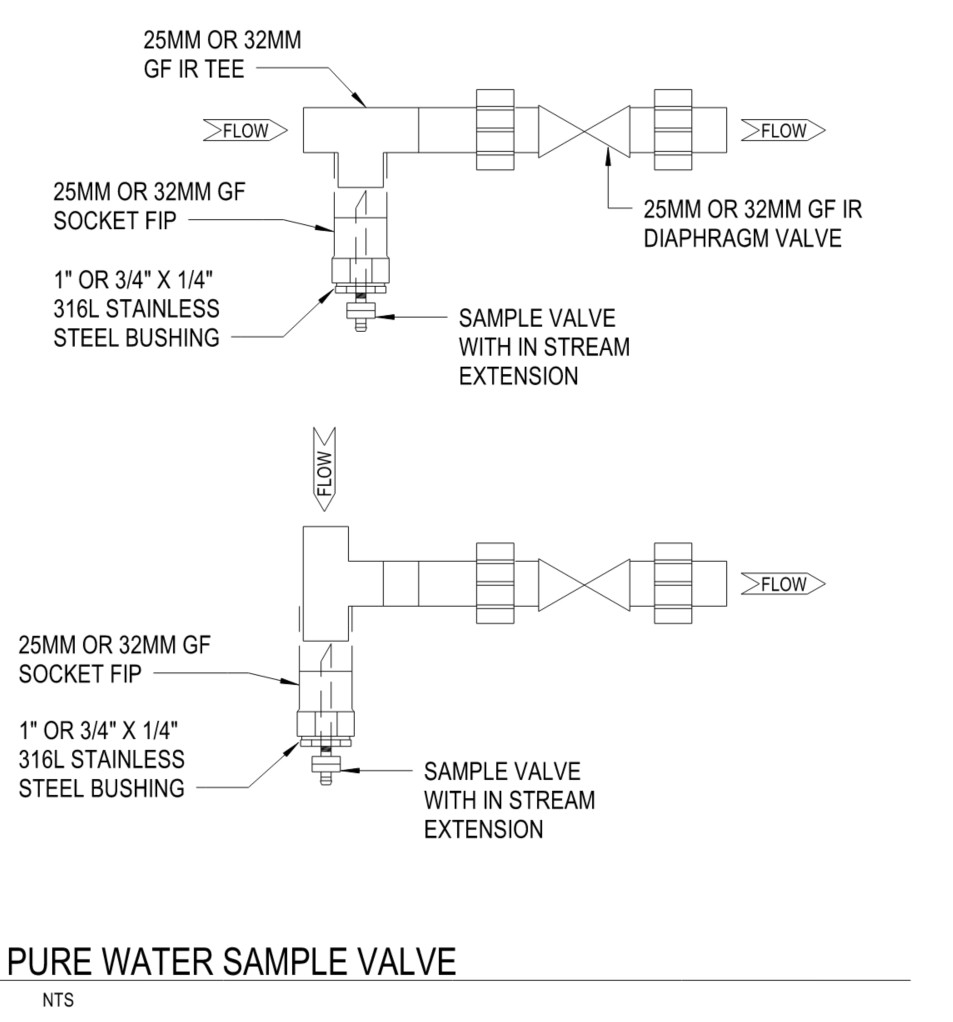
ST108 spells out some unambiguous requirements that can be directly incorporated into a plumbing design for an SPD. These are very black and white and should definitely be included. Other recommendations exist that stem from the standard and can help ensure the system design meets and maintains compliance. Still other considerations for local jurisdictional requirements should be given thought and addressed to support both compliance with plumbing code and the standard.
1. Sampling requirements. After a water treatment system is installed, it must undergo a validation program. This involves daily sampling and testing at post water treatment system test points and at point-of-water-use locations for a defined period. These samples are tested against the performance qualification levels listed in the standard. Once the validation stage is complete, the requirements for routine monitoring with minimum frequencies are listed.
The sampling locations given in the standard include:
a. The incoming water;
b. Following each treatment step;
c. At the point-of-water-use, including:
• Utility water to washers and decontamination sinks or
nearby contiguous plumbing;
• Critical water at point-of-use or as close as possible;
• Steam condensate collected at the sterilizer/steam filter.
The plumbing engineer must ensure that these sampling ports are installed in all the required locations. Whether at the treatment equipment or in the distribution piping systems, there are likely several locations.
2. Piping requirements. ANSI/AAMI ST108:2023 calls for the critical water loop to be circulated at a velocity of 3 to 5 feet per second to minimize potential biofilm, bacterial growth and endotoxin. The plumbing engineer should understand the hours of operation of the SPD based on the type of facility. It’s crucial to understand that even though the facility may shut down for the weekend, it doesn’t mean the water treatment system should shut down as well. The water should be continuously circulated to minimize bacterial growth.
The system design should avoid dead legs. ST108 defines a dead leg as a length of uncirculated piping between the circulation loop and the water point-of-use exceeding 3 to 5 times the piping internal diameter. As much piping as physically possible should be under constant circulation. The plumbing engineer should ensure that there are no dead legs in any part of the system, including at the equipment.
3. Material recommendations. The standard indicates that the distribution piping material should be compatible with high-purity water and identifies schedule 80 PVC, polypropylene (PP) and high-density polyethylene (HDPE) as potential options.
PVC is a solvent-weld system and poses a few problems. The solvent cement contains volatile organic compounds that can leach into the water. The PVC itself has plasticizers that can also migrate into the water. This leads to increased total organic compound levels that may push it out of the specification in the standard. Additionally, the nature of the piping joints creates crevices in the piping system, leading to entrapment areas for bacterial growth.
HDPE and PP piping have some similarities, but PP piping is recommended for critical water distribution. Both are typically a butt fusion piping system; this eliminates the gaps that can trap bacteria and become a problem. PP is superior due to its lower tendency to leach organics, its ability to handle higher continuous temperatures, and its resistance to biofilm and scaling, thanks to its smooth inner surface. Additionally, it resists oxidizing disinfectants better than HDPE.
In addition to the piping in the distribution system, using diaphragm valves in lieu of ball valves is desired. They have less likelihood of trapping water and bacteria with no pockets or cavities when in the open position.
4. AHJ considerations. One significant challenge to the design of a quality critical water distribution loop occurs when the plumbing code or local authority having jurisdiction (AHJ) requires individual isolation of equipment with high-hazard backflow preventers at each location. It’s virtually impossible to place high-hazard backflow preventers, such as reduced-pressure zone assemblies (RPZs), close enough to the equipment to avoid a dead leg as defined in the standard.
Typically, they’re placed on an adjacent wall or in a dedicated closet stacked with the rest of the backflow preventers. This means a large length of uncirculated piping exists between the backflow preventer and the equipment.
In Wisconsin, where I design a large portion of my projects, it has adopted an alternate approval for the use of an ASSE 1024 dual check valve made by Vista Water Group called VersaCheck. The approval includes the generalized use of the device, but critically, it was approved as a high-hazard assembly. Because of their small size, we can typically get them close enough to the equipment to drastically minimize the dead leg over the use of RPZs.
5. Redundancy. Redundancy in the critical water generation equipment is important. Just as building redundancy into the design of water heaters or other plumbing equipment can make all the difference, having two distribution pumps ensures that the entire process isn’t stopped when one fails. If using deionization tanks, being able to swap them out without shutting the system down is important. General redundancy in the system should be considered where it’s feasible and appropriate.
6. SPD and lab. Sometimes there are situations where an SPD requires critical water, and the lab within the hospital could benefit from the pure water generated as well. As nice as it may seem to feed both areas from the same equipment, it isn’t recommended. If the equipment feeds the lab water as well as SPD, when the system needs disinfection, the SPD and the lab are both down for the several-hour process. This could be quite costly for the facility.
Keep it separate if possible. The lab typically doesn’t require large amounts of pure water and can use point-of-use purification equipment as needed.
ANSI/AAMI ST108:2023 is an important standard that medical device processing professionals must adhere to. It’s essential for a plumbing engineer to read and understand the standard. Their job is to create the appropriate systems, in conjunction with a water treatment specialist where necessary, that conform to the requirements of the standard.
Aside from the explicit requirements in the standard, there are some best practices to incorporate as well that will help create the best systems possible to meet and maintain the requirements outlined in ST108.
Ray Schwalbe, PE, ASSE 6060, is a mechanical engineer at HGA in Milwaukee. He has more than 10 years of experience specializing in plumbing, medical gas and specialty gas design for multiple market sectors.