The latest technical document from the Municipal Advisory Board details the required wall thickness for a high-density polyethylene water main pipeline subject to fault crossing seismic hazards.
The 38-page MAB-10 2025, “Design of HDPE Water Mains for Crossing Seismic Hazard,” includes formulas, calculations and charts, as well as information about pipeline response to strike-slip events. It partners with the previously published MAB-9, “Design of HDPE Water Mains for the Lateral Spread Seismic Hazard.” Both are available free on the group’s website at www.plasticpipe.org/MABpubs.
“As requested by multiple owners and consultants, the Municipal Advisory Board developed this document to assist in the design of HDPE for the expected fault crossing seismic event,” said Camille George Rubeiz, P.E., FASCE, co-chair of the HDPE Municipal Advisory Board and vice president of the Municipal & Industrial Division of the Plastics Pipe Institute.
The MAB serves as an independent, noncommercial adviser to the Municipal & Industrial Division of PPI, the major North American trade association representing the plastic pipe industry.
“In MAB-10 2025, simple relations are developed for the required wall thickness for an HDPE water main subject to the fault crossing seismic hazard,” Rubeiz said.
“The two primary seismic hazards to buried pipelines are wave propagation and permanent ground deformation. For the fault crossing hazard as described in MAB-10, the required wall thickness is a function of site conditions — burial depth and soil unit weight — the acceptable pipe strain, and geometric characteristics of the hazard, specifically the amount of fault offset and the pipeline’s fault crossing angle.”
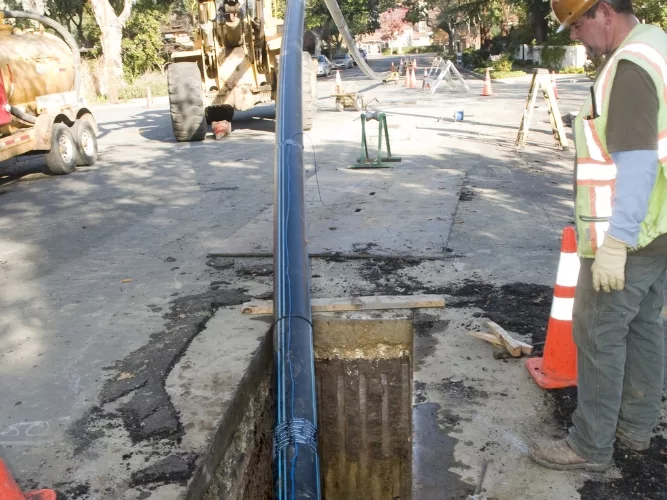
Heat-fused HDPE pipe sections create a leak-free joint and a monolithic pipeline. The ductility and flexibility of HDPE pipe provide high resistance to earthquakes and are also important factors in ease of installation. HDPE pipe also resists corrosion and is not subject to tuberculation, helping maintain and maximize water flow capacity. It can be installed using a variety of trenchless and open-cut methods.
The MAB-10 volunteer task force consisted of engineers, utility professionals, industry experts and contractors. The project was led by Michael O’Rourke, professor emeritus of civil engineering at Rensselaer Polytechnic Institute.