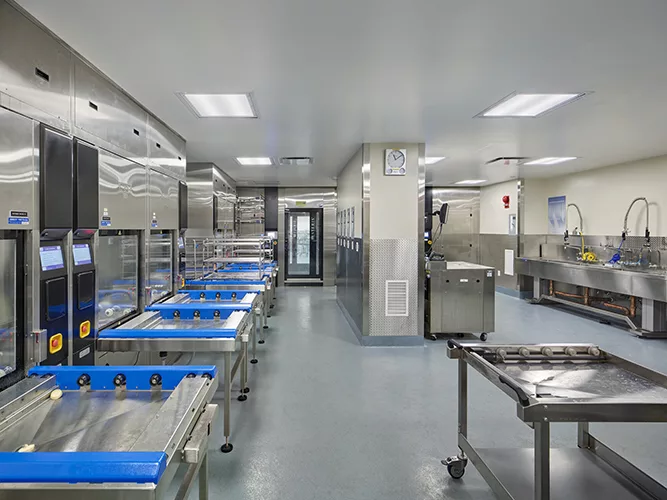
The sterile processing department (SPD) is one of the most critically important areas of a hospital, as it provides tools and instruments for operating room procedures. Surgeries and other procedures in operating rooms are often the largest revenue generators for hospitals, and even short disruptions can cause huge financial losses. Worse, operating room delays affect patients needing immediate lifesaving treatment.
SPDs are also among the most challenging for plumbing engineers, particularly water systems. SPDs contain many different plumbing systems on their own, but they also contain complex equipment with strict requirements around water temperatures, pressures and purity that are unforgiving if designed incorrectly. Given their critical role, SPD plumbing systems must be designed with precision, redundancy and resiliency.
Staff, spaces and workflows
As with many other hospital and healthcare spaces, it helps to understand how SPD staff work and the environment they work in. While it’s not required to have a healthcare degree to work in an SPD, those who do are still highly trained in surgical equipment and instruments, sterilization techniques, working in hazardous conditions and infection control.
They are often required to obtain Certified Registered Central Service Technician certification, which involves 400 hours of hands-on experience and passing a 150-question exam. All this training prepares them to work in conditions and with materials that are unsafe to the public while keeping patient safety and infection control at the forefront.
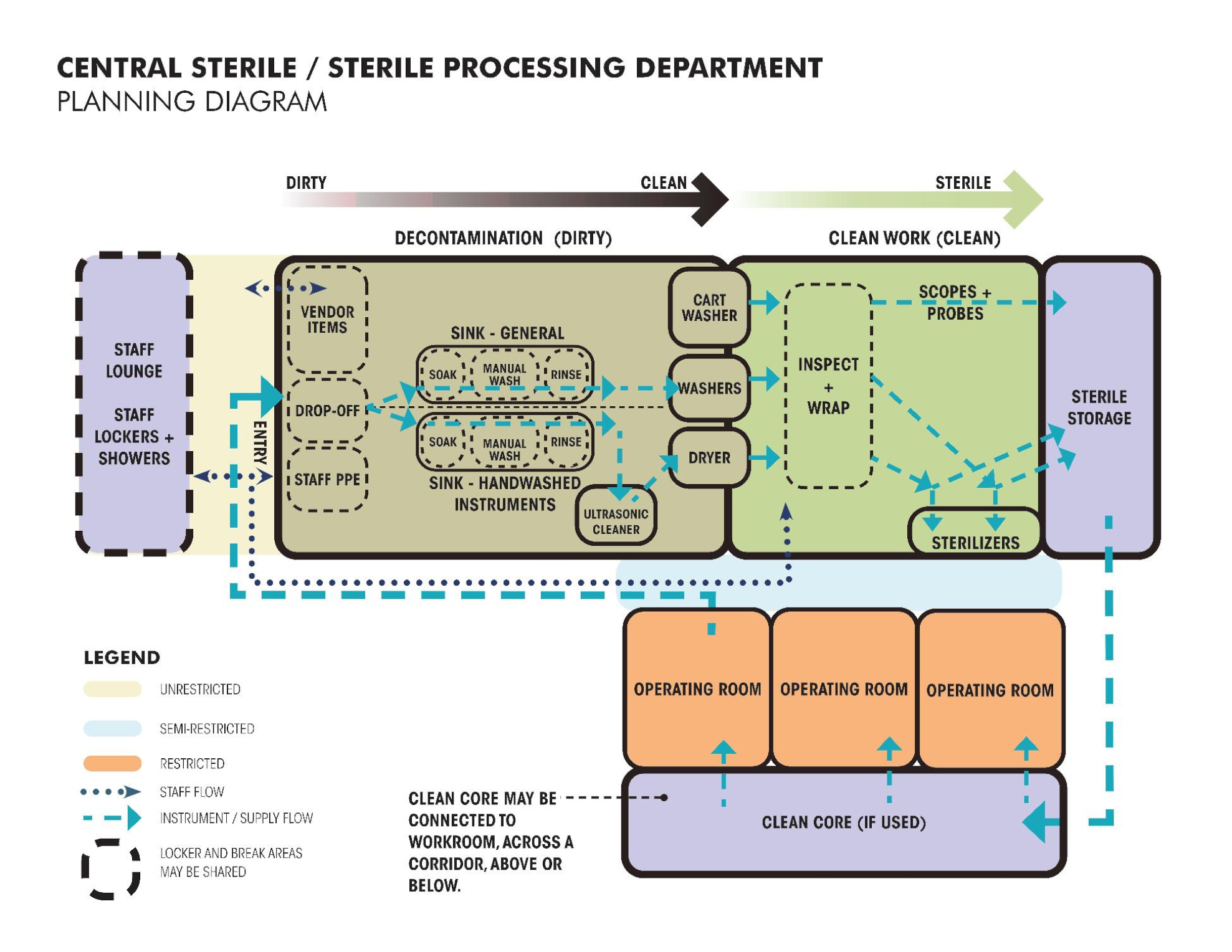
SPDs include several work areas, but past naming conventions were inconsistent. For example, the area for unloading sterilizers and packing instruments was once called the clean area, preparation area or prep and pack. Today, healthcare code bodies such as the Facility Guidelines Institute (FGI) standardize these titles to reduce confusion among design and healthcare professionals (see Figure 1).

When architects plan SPD layouts, they consider required work areas and staff workflows, usually driven by healthcare codes such as FGI. Most importantly, codes mandate one-way workflow — dirty instruments move to clean and then sterile states without crossing paths, minimizing infection control risks.
After surgeries, instruments arrive at the SPD and are dropped off in the decontamination (dirty) area, where they are first cleaned by hand in processing sinks. Afterward, the more resilient instruments are placed in mechanical washers that clean them further, but do not sterilize them (see Figure 2).
More delicate instruments, such as imaging probes, endoscopes and others with internal electronics, are sensitive to high water temperatures and aggressive sanitizers and cannot be cleaned in washers like other equipment. Instead, these instruments are cleaned in ultrasonic cleaners that do not damage them, then placed in dryers.
After instruments are cleaned in the decontamination area, they are moved to the clean workroom. These two areas are separated by a sealed barrier for infection control. Instruments move between them through pass-throughs in the barrier that are often integral to the washers and dryers — they enter the equipment in the decontamination area on one side and then exit into the clean area on the other.
In the clean area, the resilient instruments are inspected and then wrapped in packaging designed for sterilization. They are then put into machines that use steam and vacuum to sterilize them and then put into storage for use in surgeries. Less resilient instruments that cannot withstand steam sterilization may be inspected and stored, or they may be sterilized with chemicals.
All SPD cleaning and sterilization processes require specialized equipment with strict water and other plumbing system requirements. It is critical to read the equipment cutsheets and specifications so you understand them (see Figure 3).

Since the SPD equipment requirements can be challenging for plumbing systems, you need to plan early and thoroughly. Push your clients and architects to get you equipment information as early as possible, even if it is only preliminary. This helps identify needed systems, source equipment, backflow prevention and other piping accessories.
Backflow prevention
Planning for backflow prevention is often one of the most challenging aspects of designing plumbing systems for SPDs. You can expect to need a reduced-pressure zone (ASSE 1013-type) backflow preventer for nearly every piece of equipment with a water connection. Backflow preventers occupy significant wall space, require access for routine maintenance and testing, and quickly add cost.
How you incorporate backflow preventers into your design depends on code requirements and client preferences; you should consult both before developing a strategy. Many plumbing codes allow one backflow preventer per water system to isolate the entire SPD area. However, some states (such as Wisconsin) require each piece of equipment to be isolated from the rest, meaning that you need one backflow preventer per system per piece of equipment.
Your clients may also have opinions about backflow prevention strategies, as each one carries yearly maintenance and testing requirements, which add to operating budgets. Additionally, backflow preventers eventually fail and need replacement, running the risk of shutting down a piece of equipment or an entire area, depending on how you arrange them. Early in the design process, ask your clients about their risk tolerance for equipment or area shutdowns — this will guide your design.
Most clients consider a complete shutdown of the SPD unacceptable. Therefore, I always recommend some level of redundancy in SPD systems so that no single point of failure can shut down the entire department. When the codes mandate that each piece of equipment be isolated from the rest, some redundancy is already built in, as one backflow preventer failure only shuts down one unit.
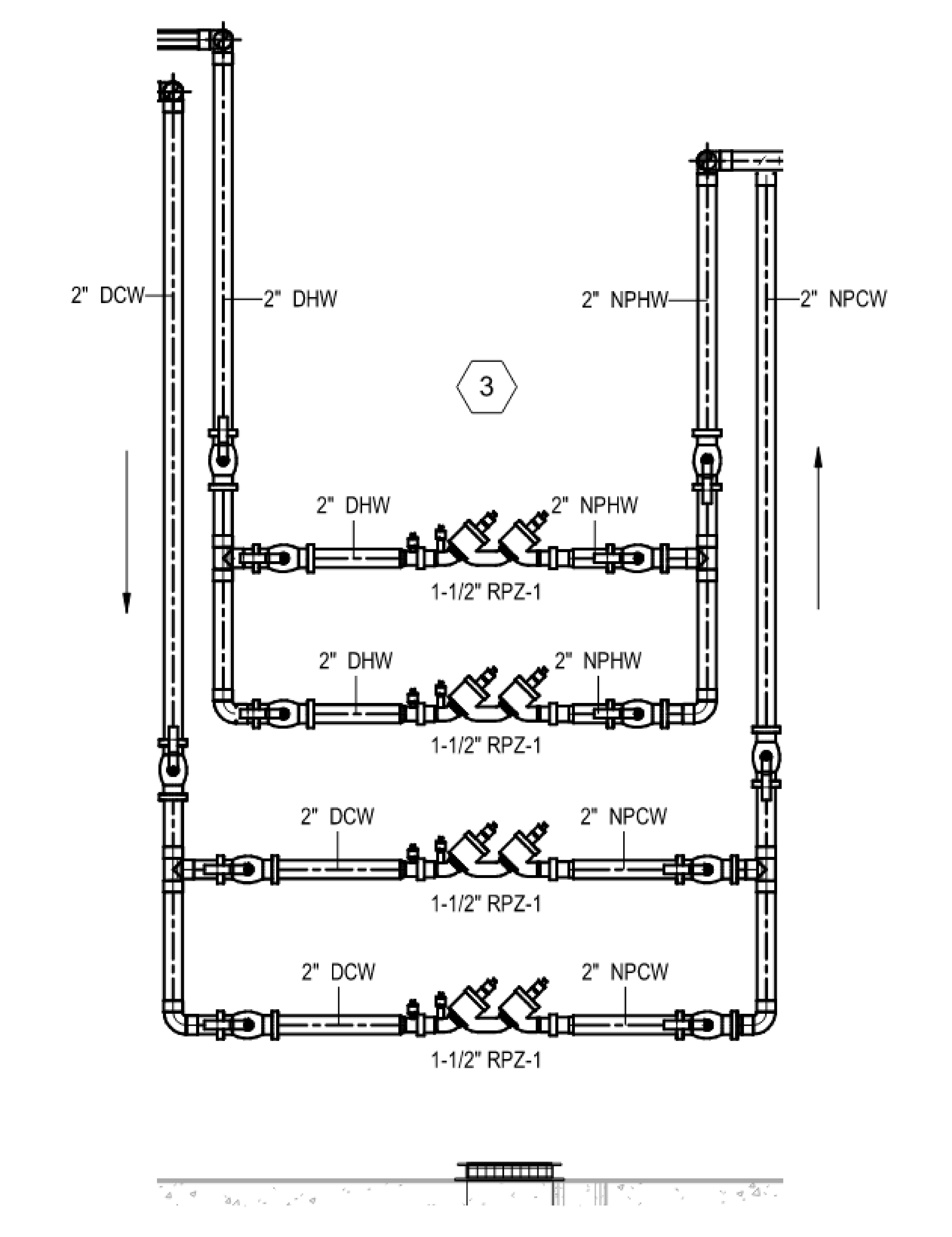
Most clients I’ve worked with have been accepting of this. If codes do not require individual isolation, then a more cost- and maintenance-effective solution is to isolate each water system entering the SPD space with backflow preventers in parallel. This way, one parallel unit can keep the department running if the other unit fails.
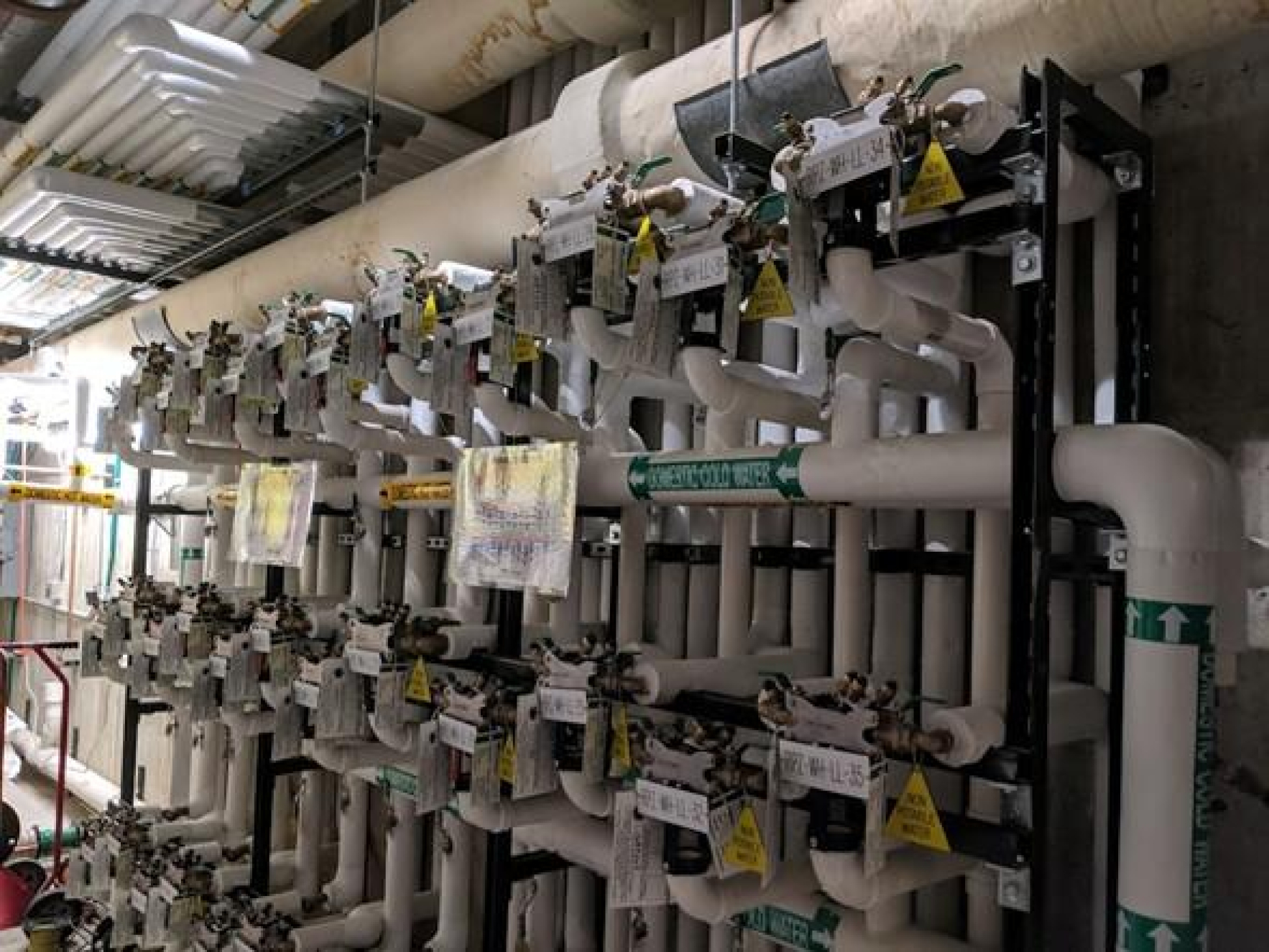
Locating backflow preventers is usually more challenging than choosing an arrangement. Healthcare codes rarely allow backflow preventers and other plumbing system accessories in clean and sterile spaces. While placing them in decontamination areas may be allowed, it is often problematic due to limited wall space. Backflow preventers are best located in nearby back-of-house spaces where testing and maintenance can be done outside the SPD.
It’s also best to have this space very near the equipment it serves, as equipment often has strict temperature requirements and triggers alarms when these are not met. When these spaces are located nearby, it is not usually necessary to run circulated hot water into the SPD space. While equipment may have strict temperature requirements, most units are also programmed with flush cycles that allow uncirculated water to reach the required temperature (see Figures 4 and 5).
 |
 |
Flush cycle durations and flows are often detailed in the equipment information, which can be used to determine how far to run an uncirculated branch without triggering an alarm. Furthermore, while you should understand an SPD’s workflows and operating hours before designing it, most run continuously enough that uncirculated hot water has little chance to cool. Even in ambulatory surgery centers that only perform elective procedures, it is not uncommon for SPDs to run constantly for 20 hours a day.
Water temperatures and pressures
To address waterborne pathogen and infection control concerns, some healthcare codes require that hot water be delivered to an SPD at 140 F. Absent any code requirements, good design practice is to keep hot water temperatures above 125 F, as cooler water promotes Legionella and other waterborne pathogen growth. Most decontamination and sterilization equipment prefers these higher temperatures, reducing strain on integral booster heaters.
Equipment and fixtures needing lower temperatures, such as endoscope cleaners and hand sinks, can be equipped with thermostatic mixing valves to temper hot water. Hand sinks should meet the temperature requirements of the respective plumbing code (105 F is common), but decontamination and processing sinks can be kept at the system temperature. Higher water temperatures are often better for manual instrument washing; SPD staff are trained to deal with them.
Different pieces of equipment may also require varying water pressures. Building water pressure is sometimes adequate for the range the equipment can tolerate, but in other cases, you will have to equip the supplies with pressure-reducing valves. Faucets and water guns on processing sinks, particularly, may want lower pressures to prevent overspray and spread of waterborne pathogens.
Water purity
SPDs have followed several different water quality standards (though not requirements) in the past. The newest standard gaining traction in healthcare is the 2023 version of ANSI/AAMI ST108 — Water for the Processing of Medical Devices. While this standard is not yet a code requirement, many engineers in the industry expect it to become one at some point and design for it regardless.
ST108 has three classifications for water purity used in SPDs, each with a different application (see Figure 6). The first, utility water, is used for manual washing and rinsing in processing sinks. Most untreated tap water will meet the quality requirements for utility water, but it’s still important to confirm this with a sample analysis.
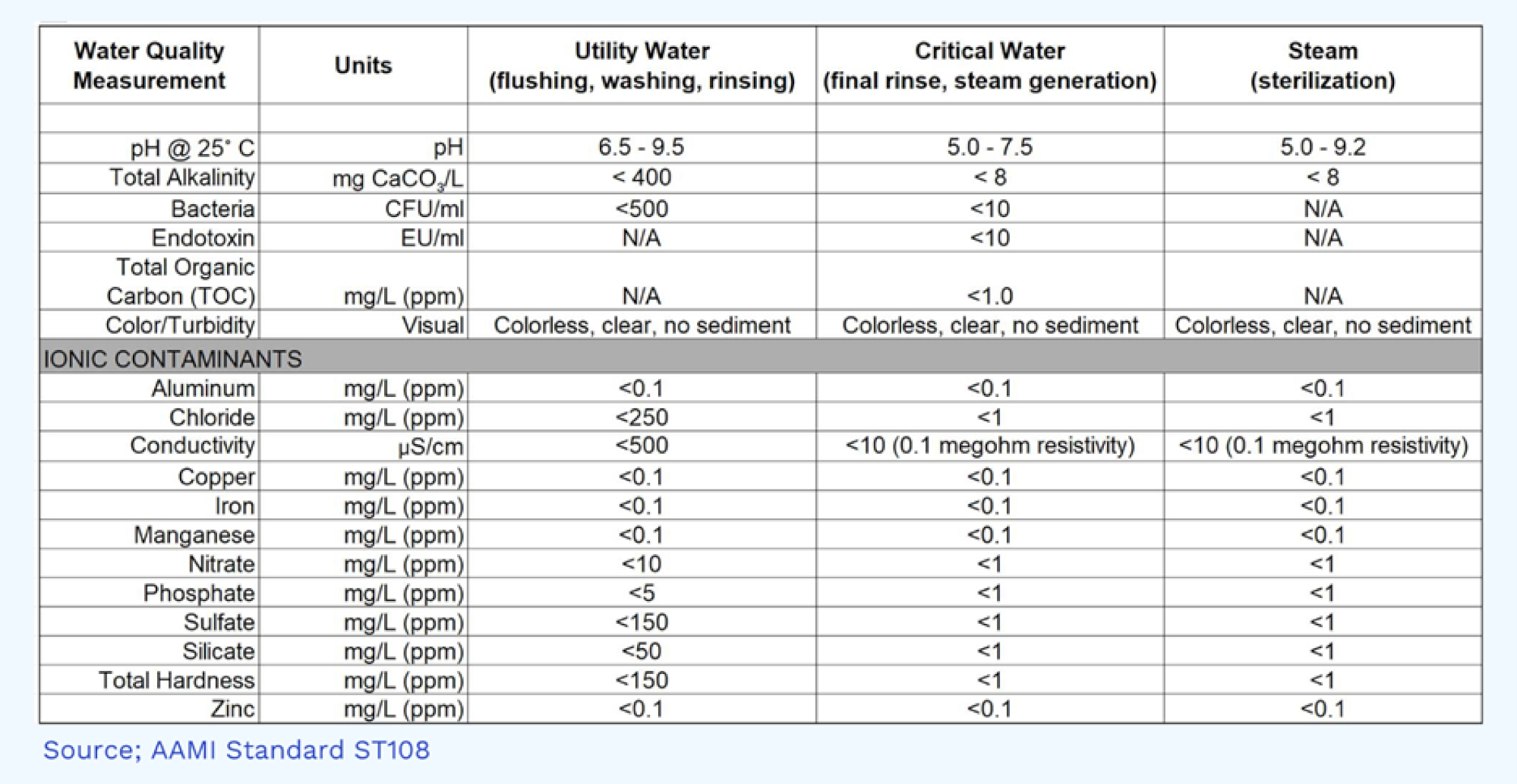
Critical water is for use with instrument washers and sterilizers and has more stringent quality requirements. If sterilizers have their own internal steam generators, this water can also be used to feed them. If house steam will be used for sterilization instead, that water must meet the steam category requirements.
While house steam can be used for sterilization if the building has it, it’s not always preferred. Steam systems are often expensive, difficult to design and maintenance-heavy, so most mechanical engineers I’ve worked with prefer to avoid them. Therefore, it’s often easier and less risky to equip sterilizers with their own steam generators. Provided that building steam isn’t used, water delivered to the SPD only needs to meet critical water requirements, and this can be used for all equipment in the space.
While the ST108 standard provides guidelines for water quality in different SPD applications, it is not a substitute for understanding equipment manufacturer requirements. Some equipment may have higher water quality requirements than those in the standard; if so, those should govern your design.
Source equipment
Understanding SPD equipment requirements is critical, but sizing source equipment requires more data from facility operators and SPD staff. Determining the SPD water load on water heaters and water purification equipment is key to sizing both, and understanding how an SPD will operate is key to calculating this. At a minimum, you should have your client provide the following information:
• Anticipated average and peak operating room caseload per day;
• Number of hours per day that the SPD will operate, and when in the day these hours are;
• Anytime of day when there are anticipated surges in operating room procedures.
This information, combined with water usage and cycle time data from the SPD equipment, is all used to calculate water loads. Plumbing engineers can use this to size water heating equipment, but water purification equipment is usually selected by a vendor. When working with a vendor, provide them with all this information, along with all SPD equipment cutsheets and specifications and have them determine what water purification equipment is needed.
Sterile processing departments are often the most challenging areas of a hospital to design plumbing systems for. Even seasoned engineers must carefully plan for them. Early planning, detailed equipment information, equipment research and coordination with clients, staff, architects and vendors are all critical. Hospitals rely on functioning, resilient SPDs to keep revenue streams intact. Engineers involved in them need to keep this in mind during design and treat them with the care they deserve.