Last month, I talked about my work with Rotary International’s water missions — in particular, our trip to Ghana last October (bit.ly/3KAT2So). This month, I’ll focus on schools, economic development, and women and children’s health in these Ghanian villages.
Basic education and literacy
Rotary promotes basic education and literacy by providing scholarships, tutoring and educational programs, and by building schools when officials assure Rotary that the buildings will be staffed and maintained. Sustainable projects are important.
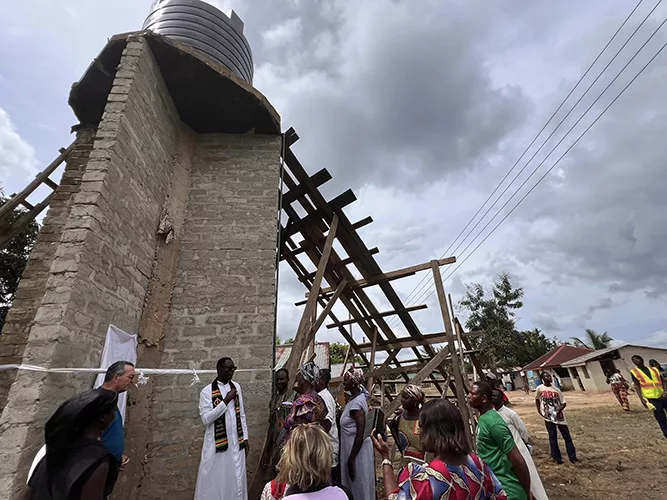
When we visited the village of Esaman in October 2025, its school looked like a cattle barn. Village elders pleaded with us to build a new school because the politicians would not send teachers to its four-room school.
Rotary District 6400 Governor-elect Kim Spirou, our team leader, and Father Stephen said it did not look like the village would get a school for two reasons. The contractors would have a day’s drive from Accra to reach the construction site, and they did not want to stay and work deep in the jungle without extra pay for the logistics of shipping in the materials, building temporary worker shelters, etc.
The second reason was that the politicians did not want to send government-paid teachers. The only way they will get a school is if there is a generous donor.
I have been on several Rotary mission trips and worked on at least four school construction and renovation projects over the years. Rotary International has mission trips to countries around the world. In our mission trips for the school projects, we provide a new or renovated school building, new school uniforms, new schoolbooks, soccer team uniforms, soccer balls, backpacks, clothes, reading storybooks, school workbooks, class photos, toys and school supplies.
We built a new school in the village of Assin-Sybinso and a new medical clinic in the village of Ekukrum in Ghana. The mission trip work is documented in dozens of posts with photos on my Facebook site (www.facebook.com/ronald.george.CPD).
On my last mission trip, between the day we took school photos and the day we returned with the prints and had the ceremony to distribute the photos and new school supplies, we had a book bag and a photo left over. When we inquired with a teacher about the student, the teacher informed us that the student had died of malaria during the week. Saddened by the thought of what had happened, I realized his family would probably appreciate his photo.
I asked if his parents were around; a student was sent into the village to summon the mother to the school, where we presented her with her son’s picture and his book bag. When she saw his photo, she dropped to her knees, tears streaming down her face as she clutched it. She did not know we had taken school photos, and she had never had a photo of her son. She told me she was grateful that we had taken his picture so that she could remember him. It was a very moving experience.
Economic development opportunities
Rotary works to strengthen local economies by supporting entrepreneurs, particularly women, and providing access to financial resources and jobs. Spirou has been our team leader on these Ghana mission trips since 2012. She began purchasing sewing machines for young girls who drop out of school, and this has become one of our mission trip goals: economic opportunities for young women in Ghana.
The Rotary mission team has called this project Sewing Seeds of Hope; I learned a similar program was inspired by women displaced by war, where they formed a seamstress program to help their families succeed by creating and selling hand-sewn products. During the 2015 mission trip to Ghana, our host, Father Stephen Amoah Gyasi told Spirou about a young girl in his parish who needed assistance with earning a living. He introduced her to the young girl, Esther, a 15-year-old.
Esther had recently become a young mother, and her life was turned upside down. She was forced to leave school due to her situation, stay home and take care of her child. Esther was eventually disowned by her family and she was forced to leave her home, so she turned to her church and Father Stephen for help.
Father Stephen was fortunate to have Rotary’s Spirou visiting, so he asked her if she could help Esther. Spirou decided to purchase a sewing machine for Esther so she could earn a living and stay off the streets.
Esther was thankful for the new sewing machine, so she made a dress for Spirou before she left for home. After seeing Esther respond so well, Spirou decided to start a program for future mission trips to provide kits for girls who were in similar situations.
Spirou learned that many other young girls in Ghana have to drop out of school when they reach puberty and start menstruation. Many young girls don’t know what is happening to their bodies when they reach puberty, so they stay home from school. Eventually, they fall behind in schoolwork and many drop out of school.
To align with Rotary’s goals of economic development, health and wellbeing, and maternal and child health, Rotary mission trips have included kits with reusable, washable pads to help girls stay in school during menstruation. Spirou started raising funds to buy sewing machines for these young girls to help them earn a living. She worked with the Days for Girls program to keep them in school.
In 2016, I accompanied Spirou on a prior mission trip. Before that trip, she organized fundraisers to purchase sewing machines. She worked with the Sewing Seeds of Hope foundation to buy 10 electric sewing machines and about 65 nonelectric sewing machines for areas with no power so young girls could learn the seamstress trade.
We presented the sewing machines to the girls at a church in a ceremony in the Assin-Bereku Region. Father Stephen had identified girls in the area he was aware of through his parish who had dropped out of school and were struggling. He invited the girls to the ceremony to receive sewing machines, and Spirou arranged for a local seamstress to teach them to use their machines and become seamstresses.
To help kickstart the program, the Rotary team hired the seamstresses to measure us for shirts, dresses, aprons, placemats, potholders and other items to be made with colorful Ghanaian fabrics we purchased at a local fabric store. We gave the materials to the girls to make the items we ordered.
On our recent trip, the girls held a fashion and hair show that rivaled the major shows. The fashion industry has featured Ghanaian fashion designers in its publications, with some recent designs from Ghanaian seamstresses. Recently, Spirou began adding hair dryers and other hairdressing equipment for girls who want to expand into other areas and pursue another career option.
Protecting the environment and promoting peace
Rotary also focuses on environmental sustainability and protection by building rainwater collection facilities, stormwater/erosion control projects, landfills, waste treatment and septic disposal facilities, and leachate field facilities rather than direct waste discharge into waterways.
The organization works to foster peace and understanding through projects and training programs, promoting diplomatic resolutions to conflicts, and aiding in medical and food support and assistance to minimize suffering in regions of conflict.
Health and well-being, maternal and child health
On the last two mission trips, we built medical clinics in the remote villages of Assin-Kyinaso and Ekukrum. We purchased and delivered medical supplies to the Mankessim Women’s Hospital & Fistula Center in the Central Region of Ghana and to St. Francis Xavier Hospital in Fosu, Ghana.
For health and well-being, our mission trips have raised funds for the construction of a new public restroom/sanitation building with community toilets, showers and lavatories in remote villages. The mission focused on improving the health and well-being of the entire community; this is especially important for mothers and young children.
In addition, Rotary International helps with another education and health program spearheaded by one of our team members (Penny Joy). The program, called Days for Girls (www.daysforgirls.org), provides kits containing reusable sanitary pads for girls.
Joy met with government health and education officials; during the meeting, they mentioned that during another mission trip, they distributed reusable kits and packages of disposable products. Most of the girls wanted the reusable kits because they will last for years; the disposable ones are a one-time use, and then they have nothing.
The reusable/washable pads were for young girls who often drop out of school when they reach puberty, stay home and fall behind in school studies. We heard that the girls often did not know what was going on with their bodies and lacked health education. The Days for Girls program provides kits with reusable materials and health education literature for young girls, in an effort to keep them from dropping out of school and to help them get an education. The program was designed to provide small purses or bags with personal hygiene supplies for girls.
Community and youth programs
Rotary engages in a wide range of community and international projects, including building community facilities, providing disaster relief and running leadership programs for young people (Interact and Rotaract clubs at high schools).
Another mission trip to Ghana is tentatively scheduled for Feb. 6-15, 2026. We plan on commissioning 10 water wells on this trip. If you are interested in making a monetary contribution to one of these projects or in going on the trip, contact me as soon as possible, as space is limited ([email protected], 734-755-1908 (cell)). It is the trip of a lifetime!