Many years ago, I went to a Rotary International meeting as a guest. Later, I joined Rotary and started attending meetings in Monroe, Michigan. Rotary is an international membership organization of business and community leaders who perform community service on local projects such as civic projects, parks, schools and humanitarian projects worldwide.
Rotary members are volunteers who use their time, money and talents to make a difference in their local communities and globally, with a focus on seven key areas:
Promoting peace;
Fighting disease (safe drinking water, polio vaccines and mosquito netting);
Providing water and sanitation (for drinking, bathing/hygiene, cooking and laundry);
Supporting maternal and child health (through health education and hospital/medical clinic construction);
Basic education and literacy (school supplies, school construction and education on how water and sanitation improve health);
Growing local economies;
Protecting the environment (waste system design and treatment).
In 1932, Rotarian Herbert Taylor created a four-way test for Rotary that can be applied to any project to determine whether it is ethical and beneficial to all. The test is a nonpartisan and nonsectarian ethical guide for Rotarians or anyone to use for their personal and professional relationships. It has been translated into more than 100 languages, and Rotarians recite it at the completion of every Rotary club meeting.
“Of the things we think, say or do:
“Is it the truth?
“Is it fair to all concerned?
“Will it build goodwill and better friendships?
“Will it be beneficial to all concerned?”
Rotary’s seven key service areas for service work check all boxes on the four-way test. Five of the seven key areas rely on plumbing to help achieve the service goals: fighting disease, water and sanitation, education, maternal and child health, and protecting the environment. We’ll go through the first two this month.
Fighting disease
Rotary has addressed disease in several ways. One significant way is through providing clean water for bathing, washing and drinking. This helps improve hygiene for people in undeveloped parts of the world who gather water from contaminated streams, rivers, lakes or other surface water. Drilling water wells for clean water helps prevent waterborne diseases.
The organization also helps fight disease by building medical facilities and supporting hospitals and medical facilities with supplies. It provides volunteers to staff the facilities and to train medical facility staff in developing nations.
Another notable way Rotary fights disease is through its efforts to eradicate polio. For more than 35 years Rotary has been distributing polio vaccines worldwide and its goal is in sight. Rotary launched the Polio Campaign in 1979, vaccinating 6 million children in the Philippines. Today, Afghanistan and Pakistan are the only countries in the world where polio regularly occurs. Through the Rotary Polio Vaccination Program, Rotary has almost eliminated polio worldwide.
On each Rotary mission trip to areas with malaria or other mosquito-borne illnesses, volunteers distribute hundreds of mosquito nets to mothers with small children in remote villages. During our October 2025 trip to Ghana, we distributed almost 1,000 mosquito nets.
These are some of the ways Rotary works to address health issues and fight or prevent disease.
Providing water and sanitation
Rotary provides access to clean water and sanitation in developing and underserved communities. Over the last 10 years, our Rotary mission teams from District 6400 have provided more than 80 water wells in remote villages and communities of Central Ghana. We have 10 more water wells planned for another mission trip planned for February 2026.
The water wells come in three types:
1. Electric submersible well pumps can only be in locations with electricity. If the electricity is intermittent as it seems to be in many developing countries, an elevated tank can provide water even if the electricity goes off.
2. Hand pumps are used in areas with no electricity. When hand-pump water wells are used, there is generally no elevated water tank. The user places a bucket or pan under the well spout and pumps until the bucket is filled to the desired level.
3. Windmills can be used in open areas where the wind can blow and spin the blades, which drives a pump shaft similar to that of a hand pump, but the wind provides the motive force. Windmills are a little more difficult to purchase, install and maintain and they must be taller than the trees in the jungle canopy to be in the wind. For this reason, not many windmills are installed in Ghana to pump water.
In open areas, windmills can be used to pump the water up to an elevated tank where a well pump discharge pipe brings a squirt of water up to the tank with each pumping motion. Then, a somewhat larger gravity feed line comes down from the tank to nearby yard hydrants for villagers to draw water with a concrete splash pad centrally located in the community. The pressure at the tap depends on the elevation of the water storage tank.
Generally, electric and wind-driven wells will have elevated water storage tanks; hand pumps will not have a tank. The height of the tower or elevated platform and the size of the water tank are based on the well’s capacity and the number of people served by it. The pressure at the yard hydrant outlet and the volume of water stored in the tank should be considered. The larger the community, the larger the tank, within reason.
Water wells have limitations; the water table can be drawn down and the well can periodically run dry. Sometimes a well may need to be deeper or more than one well may be needed, as well as proper well spacing, to serve a community. The water tanks are generally plastic tanks that range in size from 50 gallons to 3,000 gallons. A good rule of thumb is to store about 5 to 10 gallons for every person served by the well and tank in a community.
The tank platform designs are typically based on available materials. If there is a hillside, piping up to a tank higher on the hill works well. In flat areas, reinforced concrete or concrete block platforms are generally used because steel is expensive and not readily available. Wind bracing or diagonal supports are essential to prevent the tower from toppling or collapsing.
In years past, I saw a water tower that was quickly built with no diagonal supports or cables, resting on four concrete posts about 12 inches square and 50 feet high. Before the concrete was cured properly, the tank on top was filled, causing the tower to lean over to one side. In our most recent trip, the villagers built a wooden ramp and used long ropes to pull the plastic tank up onto the platform.
Newer designs use concrete blocks where, in plain view, the base looks like a plus sign. Then, a reinforced concrete platform is poured at the top to hold a plastic tank. This design is easy to build and provides a solid foundation for the water tower.
Mission to Ghana, 2025
On our mission trip in October, our Rotary mission team visited eight remote villages in Ghana and installed either a hand-pump well or, if electricity was available, a submersible electric well pump and a water tower. Each village had a piping distribution network and a yard hydrant in a concrete splash pad. We had the chief from each village select several people to serve on a Water and Sanitation Committee.
We stayed in a guest house with 12 bedrooms and 12 1/2 bathrooms. The guest house was built with a commercial kitchen and dining area that can accommodate up to 40 people for family gatherings and to host Rotary mission teams when they come to the region. There were also support buildings for staff, an on-site water well and a 2000-gallon water tank.
The fixtures were imported from Europe and were very nice. During our stay, the well quit working numerous times. They called the plumber who does all their plumbing and water wells. When I inquired, he said the submersible well pump was cavitating and needed to be shut off to let the air trapped in the pump escape, which reprimed the pump. Apparently, when our entire team took showers in the morning, the well kicked on for a long time, drawing down the water table to the point where air was drawn into the pump.
Once air gets into the pump, it stays in the impeller until it is shut off. I looked at the showerheads and the sink faucets and noticed they all had very high flow rates, close to 8 gallons/minute (gpm) each. I suggested flow restrictors on the showerheads and sink faucets to reduce flow to 2 to 2 1/2 gpm, saving water and preventing drawdown of the water table at the well site during our peak morning showering periods.
He needed to do some research to find flow restrictors for the fixture fittings. In the interim, we staggered our showers to morning and evening showers and asked everyone to limit their shower time. One team member said she had a head full of shampoo when the water quit working. She used bottled water to rinse that morning. The power would go out from time to time, leaving the tankless water heaters in each suite inoperable. Eventually, the tank runs dry when the power is off for extended periods.
Once, while I was in the shower, the lights went off. I had about 30 seconds of warm water to rinse off as the gravity flow from the tower continued to drain out my shower before the hot water left in the pipe from the water heater, mounted high on the other side of the bathroom, was used up. After that, I would fill several empty water bottles and leave them in the corner of the shower for such emergencies.
They came in handy one morning when we woke up with no power. The staff had installed a large emergency generator for power outages, but each time, the staff had to become aware that the power was out, start the generator, then turn off the power grid breaker and switch to the emergency generator power.
One day, I was working at the medical clinic we had built, and there was a portable generator for emergency power. The building maintenance person would disconnect the power from the electric meter and connect the cables for the emergency generator. He was connecting to the lugs on the utility side of the meter. I pointed out that when he does that, the meter is charging him for his emergency power. I suggested installing a plug for the emergency generator on the building side of the meter and not manually changing the wires.
Ideally, a permanent emergency generator with an automatic transfer switch would be installed. We are very fortunate to have a reliable source of clean water and sewers and the availability of dependable electricity.
Our Rotary mission teams have also built numerous sanitation buildings in remote villages with a men’s side and a women’s side. The buildings typically have four water closets, four showers and four lavatories on each side. This facility allows villagers to have access to clean water, toilets, showers and lavatory fixtures.
To get to one remote village, we had to ride in the bus down a narrow one-lane dirt road with cocoa trees, banana trees, palm trees and other vegetation occasionally scraping down the side of the bus for about an hour and a half. We could have reached out and picked some bananas, plantains, coconuts, cocoa pods or mangos off the trees as we slipped through the trees. We could hear an occasional thump on the bus when an occasional mango was hit by our bus as it lumbered down the narrow dirt lane, squeezing through the trees in a few places.
At the end of this long jungle road, watching all kinds of tropical fruit in the trees pass by the bus windows, we reached a tiny village where many of the villagers had probably never seen or experienced the outside world. There was no electricity or water in the village. There were only two vehicles; both were three-wheel motorcycles.
One was a flat-bed trike used as a village utility vehicle and school bus. We witnessed the bus leave the village after our well dedication ceremony, taking the children down the long road to their family farms. There were maybe 25 children piled in the bed of the tiny three-wheeled vehicle. They were holding on to each other as it pulled away. The children in this village had to walk almost a half mile down the one-lane road to where a creek crossed to collect water in pans or plastic buckets and bring back to the village.
We were told of this village because of the outbreak of waterborne disease that had sickened and killed a lot of villagers. When Father Stephen heard about the village, he put it on the list for a future water well. We raised funds year-round for these projects and sent the money ahead to fund construction of a school, a medical clinic and eight water wells. We went there to help with the final painting and preparation for the commissioning of these projects.
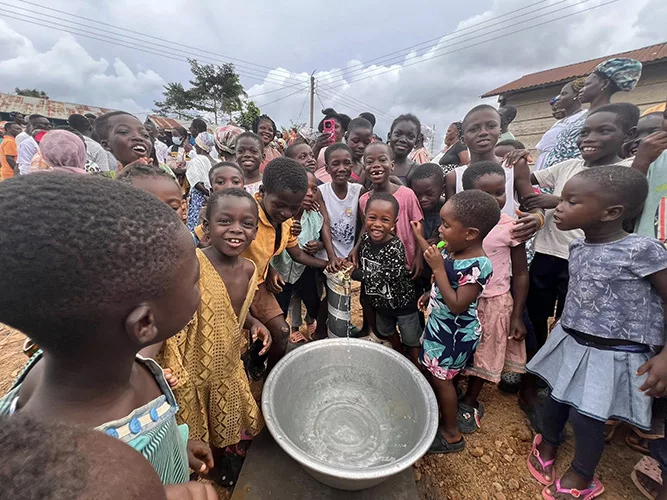
The children are always happy at a well dedication ceremony because they no longer have to carry water long distances. I would estimate the most remote village we visited was close to 40 miles away from a paved road and electricity. The water wells in these remote villages had to be hand pumps because there was no electricity.
Father Stephen had to bribe the driver of the water-well drilling rig to come to one remote village because the road was so poor and narrow. The driver did not want to take his big well-drilling rig that far down a muddy dirt road. He was concerned about getting the rig stuck, so he waited for a dry spell.
Next month, I’ll tell you about schools, economic development and women and children’s health in these villages.
Another mission trip to Ghana is tentatively scheduled for February 6-15, 2026. We plan on commissioning 10 water wells on this trip. If you are interested in making a monetary contribution to one of these projects or in going on the trip, contact me as soon as possible as space is limited (ron@plumb-techllc,com, 734-755-1908 (cell)). It is the trip of a lifetime.




