The implementation of ground-source heat pump (GSHP) systems is growing rapidly as homeowners, businesses, universities, governments and others are turning to geoexchange technology to save energy, address climate change and construct efficient heating and cooling systems with long-term reliability.
A critical aspect of GSHP systems is the piping buried in the ground or submerged in water. The network of pipe and fittings, often referred to as the ground heat exchanger or simply the ground loop, is the link to the earth’s thermal energy.
Ground heat exchanger piping materials must provide resistance to corrosion, temperature and pressure cycles, chemicals and abrasion, and deliver long-term hydrostatic strength (i.e., pressure capability). Fortunately, several types of plastic piping materials have been proven to meet these challenges, delivering long-term reliability over decades of use.
Importance of up-to-date piping specifications
Specifying the right piping materials and installation methods is critical. Piping has evolved, and materials from decades ago are inferior to the latest technology. With ongoing updates to standards and codes, outdated or incomplete specifications can lead to costly delays, noncompliance or worse.
For example:
• An old specification might list obsolete piping materials that are no longer in production, so that everyone is guessing what to supply and install.
• A poorly-written spec might cite inappropriate product standards, confusing manufacturers and installers, and the wrong products might be installed.
• A custom spec may combine inappropriate or incompatible requirements, sometimes pulled from various sources with the best intentions, whereby no actual product complies. I’ve heard this type of specification referred to as a “Frankenstein Spec,” based on the 1818 novel about Dr. Frankenstein’s monster.
Recognizing the need for a consolidated and code-aligned reference, the nonprofit Plastics Pipe Institute (PPI) has introduced PPI MS-7 Model Specification for Plastic Piping Materials for Ground-Source Geothermal Applications.
Selecting the right piping material
High-density polyethylene (HDPE) has been the primary piping material used in geothermal ground loops for decades and is proven for this application. However, HDPE has evolved and so have its product standards. A specifier using outdated language for piping may inadvertently specify a product that no longer exists in the market, or one that is simply less capable than the current state-of-the-art product.
HDPE pipe has improved significantly over the past 20 years, thanks to new bimodal resins that deliver higher strength with greater toughness. The latest generation, known as PE4710, features higher density, significantly improved resistance to slow crack growth caused by abrasion, and higher pressure ratings compared to the previous generation, PE3408 pipe.
Based on these improvements, PPI now recommends allowing the use of SDR13.5 HDPE pipe in vertical boreholes, as opposed to the thicker SDR11 pipe that was previously required. Thinner material can improve heat transfer with the ground.
For vertical borehole heat exchangers, pipe should be provided with a 180-degree U-bend fitting that is connected to two parallel pipes in the factory; the quality of the connections will be consistent when factory-fabricated. This requirement is part of MS-7.
Two other types of HDPE-based piping materials, crosslinked polyethylene (PEX) and polyethylene of raised temperature (PE-RT) are now approved in model codes for ground loops. PEX is HDPE that is modified during manufacturing to crosslink the polyethylene molecular chains. The result is a flexible pressure pipe material with high temperature capabilities. PE-RT is a high-density polyethylene piping material with enhanced capabilities to withstand operating temperatures above 140 F.
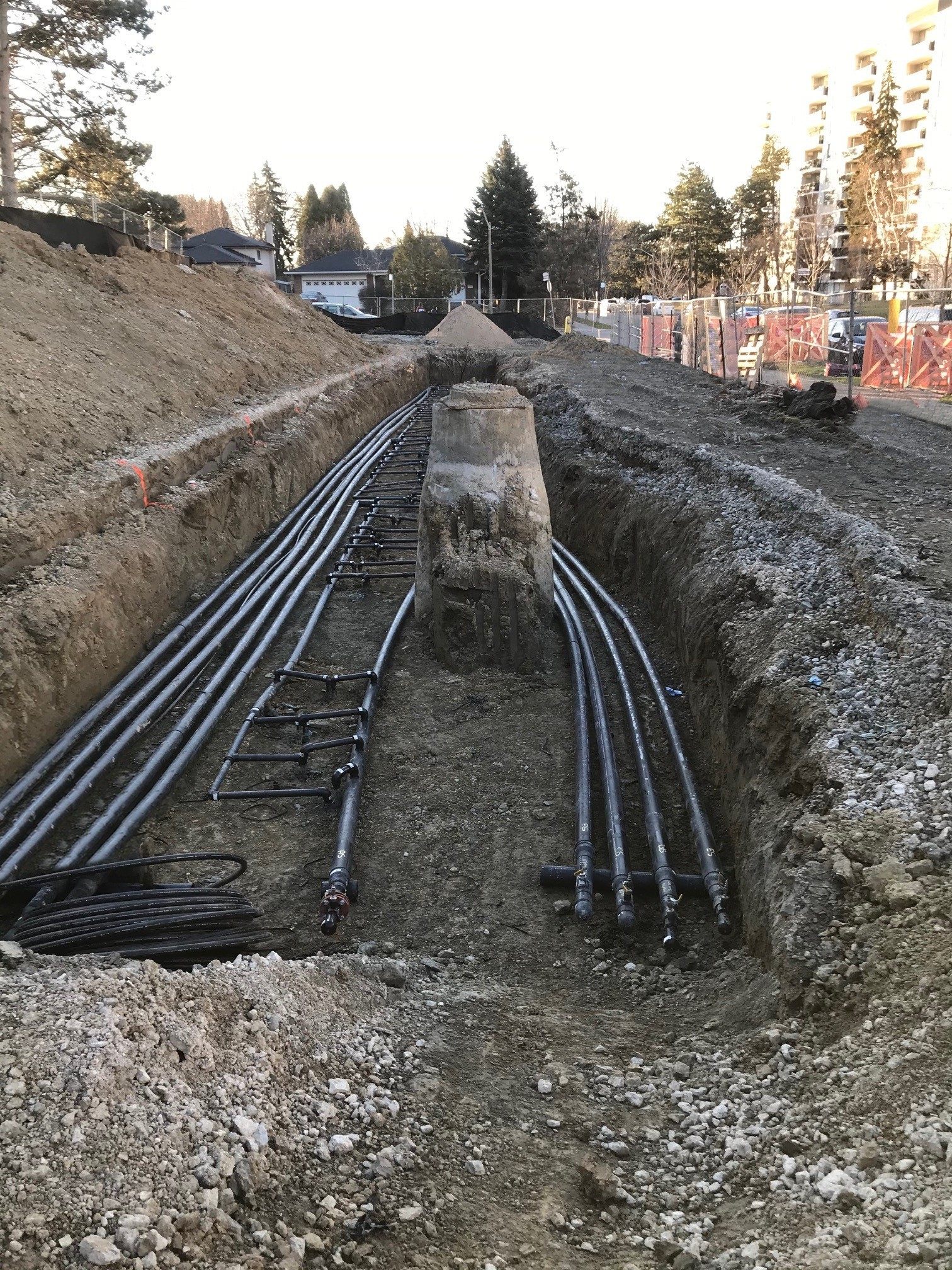
Both of these materials are rated for operation at 180 F, which can be important if thermal solar energy will be collected and stored in the ground. PEX is also known for having a high level of chemical resistance, which is sometimes necessary in brownfield locations.
This model specification also includes content for indoor piping for GSHP systems, which is typically located in vaults or building mechanical rooms. Polypropylene (PP-R and PP-RCT) piping is often used for manifolds and piping installed in vaults or mechanical rooms. Polypropylene pipe is fusible and usually includes layers of chopped glass fibers for reduced longitudinal thermal expansion/contraction. PP-RCT material has approximately 25% higher pressure rating than PP-R pipe for the same wall thickness.
These four piping materials are approved in codes such as CSA/ANSI/IGSHPA C448 Series 25, Design and installation of ground source heat pump systems for commercial and residential buildings; IAPMO’s Uniform Mechanical Code and Uniform Solar, Hydronics and Geothermal Code; and ICC’s International Mechanical Code.
Installation and testing protocols
In addition to specifications for outdoor and indoor piping, installation and pressure-testing recommendations are also provided, as well as industry definitions for the many aspects of a GSHP system. Although a model specification is not a substitute for a full installation protocol per codes, MS-7 includes critical installation requirements, including:
• Pipe inspection before installation;
• Avoiding kinks by following proper bend radii;
• Preventing damage during insertion into boreholes;
• Managing internal and external pressures to not exceed the pressure capabilities of pipe;
• Selecting appropriate backfill material.
How to use PPI MS-7
This document is like a piping menu, and the specifier should select which piping material is required for a given project and then copy and paste the appropriate language into his or her own specifications, saving time and ensuring accuracy. For example, if it is preferred that only HDPE piping be used, then the specifier can copy content only from that section.
MS-7 lists the required material designation codes and applicable standards for piping. For fittings, it references the latest ASTM procedures, which cover proper assembly and fusion methods.
Top five reasons to use PPI MS-7
1. Piping materials have improved, and using the correct specification language ensures that only the best materials will be permitted for projects.
2. The latest model codes from CSA, IAPMO and ICC require compliance with additional standards for piping, such as NSF 358, Polyethylene Pipe and Fittings for Water-Based Ground-Source “Geothermal” Heat Pump Systems, and NSF/ANSI/CAN 61, Drinking Water System Components - Health Effects, which are included in PPI MS-7.
3. There are new standards for fittings and installation methods, which are captured in MS-7.
4. It is critically important to specify the installation of ground heat exchanger piping to ensure that it is not damaged or kinked during installation and will fulfill the long-term expectations of customers.
5. Pressure-testing of ground loop piping should always be required to ensure that pipe is not damaged and fittings and joints have been properly assembled. A detailed pressure-test method is included in MS-7.
Ground-source heat pump systems are one of the most sustainable applications of plastic piping systems, but pipe must be selected and installed correctly for maximum performance and longevity. The team of experts from PPI that developed MS-7 consulted with the latest model codes and standards from ASTM, CSA, IAPMO, ICC, IGSHPA, and NSF when developing the content. PPI plans to keep MS-7 as a living specification, updating it regularly to reflect new materials, fusion technologies and best practices.
PPI MS-7 is available at no charge from the PPI Building & Construction Division at www.plasticpipe.org/buildingconstruction. Specifiers using MS-7 are encouraged to provide feedback to help shape future revisions.