The architecture, engineering and construction industry is in an era of debate between natural gas versus electrified building systems. There are multiple factors that might inform these decisions, such as availability of natural gas, stakeholder requirements, utility costs and considerations for greenhouse gas emissions.
All-electric systems also offer the possibility of heat recovery to lower overall energy consumption, depending on the configuration and approach. As with all projects, early coordination and communication are paramount to successful system implementations.
Gas vs. electric
Historically, natural gas-fueled plumbing systems have been preferred due to high energy density, ease of delivery and comparatively low cost per energy unit due to abundant supply. However, in recent years, heightened awareness of greenhouse gas emissions due to both combustion of natural gas and direct-to-atmosphere leaks from aging distribution systems has led to increased consideration of electricity-sourced heat as an alternative.
Electrically powered heating equipment has a compelling case, given that buildings are already provided with electrical systems for non-combustion use, such as lighting, receptacles, cooling and more. Unfortunately, electric resistance heating dramatically increases electrical loads. It also can pose challenges for both new construction, based on the extent of heating, and for existing buildings, given the limited capacity of electrical distribution.
While natural gas has a high energy density, combustion of gas to produce heat is subject to several energy efficiency losses among the burner, combustion air, flue gases and altitude factors.
For example, in ski resort towns in western Colorado at altitudes of 11,000 feet above sea level, the combustion efficiency can drop as much as 30% based solely on altitude, compared to the stated appliance efficiency under nominal conditions. On the other hand, electric resistance is inherently 100% efficient in producing heat as no external sources or exhaust are required, despite the increased cost per energy unit.
Electrical design teams have discussed these realities for mission-critical facilities, weighing between natural gas and diesel generators. The latter are often favored due to the on-site nature of fuel storage in the belly tank below the diesel generator.
Achieving the same level of reliability and redundancy for natural gas requires dual-fuel boilers and secondary fuel sources (such as propane or fuel oil) in addition to the electrical redundancies noted previously. Natural gas interruptions have become more common due to extreme weather events, such as hurricanes and wildfires.
A specific example of an unforeseen interruption is the December 2021 Marshall Fire that occurred northwest of Denver. While natural gas and electric interruptions in the immediate area of the wildfire were expected, the fire caused the shutdown of a nearby natural gas compression plant that serves the main pipeline supplying natural gas to the high Rockies west of Denver. This then led to an extended natural gas outage in cold, high-altitude areas with limited alternatives in the middle of winter.
With early coordination, electric heating equipment can be factored into on-site generator loads to eliminate the reliance on natural gas during potential service interruptions.
Like gas-fired water heaters, electric-resistance water heaters are available in traditional tank, point-of-use and tankless styles. These electric-resistance systems, however, do not support potential heat recovery. Cooling-only systems for HVAC, for example, reject waste heat to the air independent of electric-resistance heaters.
The application of heat pumps for HVAC and water heating, when properly configured, can leverage cooling waste heat to significantly reduce the energy required for water heating by three times or more, while also improving HVAC cooling efficiency.
Heat pumps
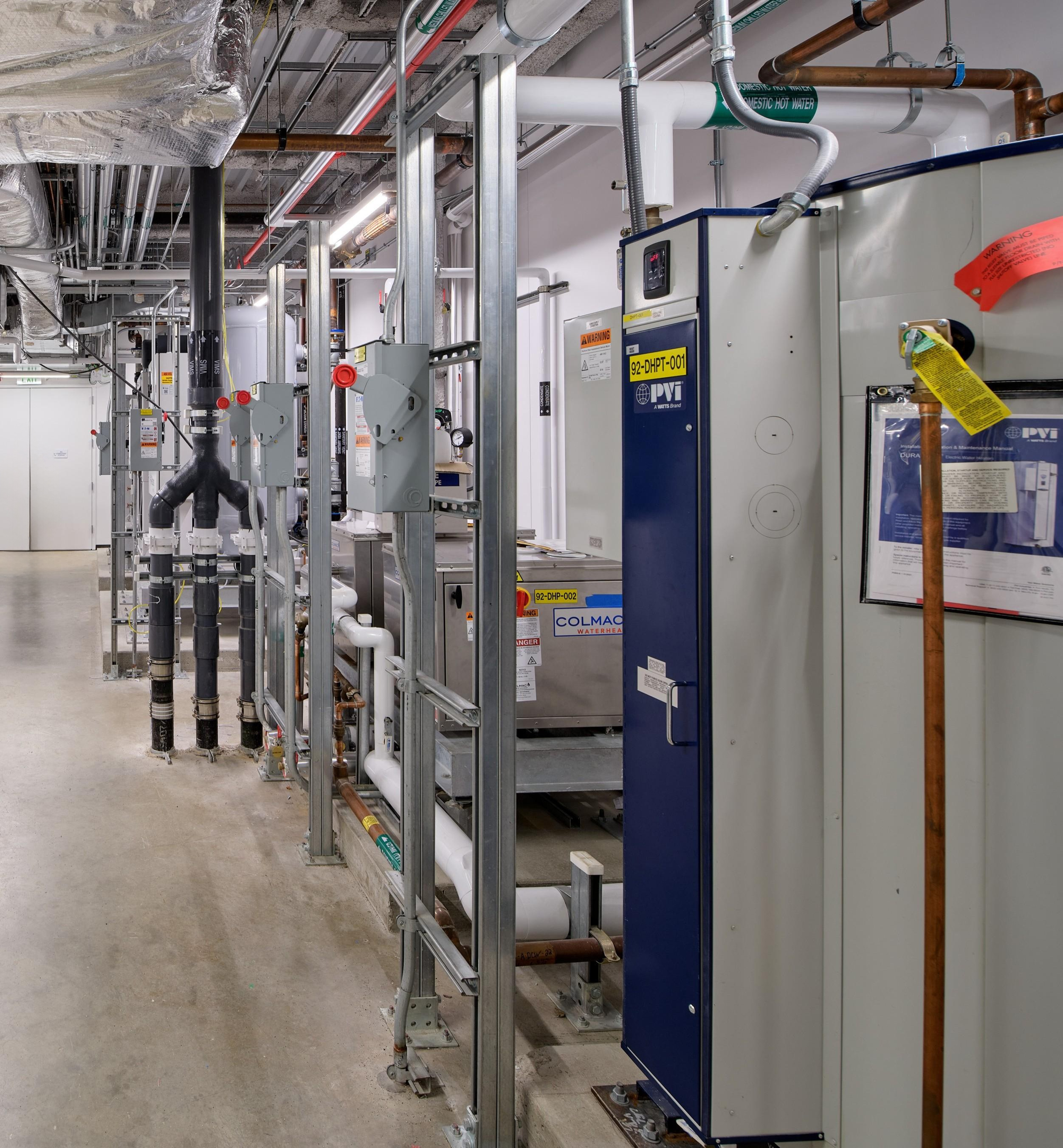
Traditional electric-resistance domestic water heaters use a storage tank-type or an instantaneous tankless-type water heater. Storage tank-type heaters have smaller electrical loads, building up heat over time that is stored in the form of hot water in the tanks to cover an instantaneous higher demand.
The advantage of tankless water heaters is that they don’t include storage (more energy efficient); however, they have a much higher instantaneous electrical demand. Often, existing electrical systems do not have the available power to support these large electrical connections.
By contrast, heat pump-type water heaters move heat from a heat source to a heat sink rather than generating heat from electric resistance. When a heat pump heats water, it can provide beneficial cooling to other systems. An air-source domestic water heat pump rejects cooling to the environment, which is still more efficient than producing heat via electric resistance. A water-source domestic water heat pump, however, cools a secondary water source that can be used to provide beneficial cooling to other systems.
The decision on what system is best for a given application depends in large part on the availability of other potentially complementary systems and their relative sizes.
For example, the Department of Energy’s Lawrence Berkeley National Laboratory Biological & Environmental Program Integration Center uses campus chilled water, combined with water-source heat pumps (WSHPs), for the domestic and laboratory hot water systems, supporting the project’s sustainability goals. During the process of heating domestic and laboratory hot water, the system precools the chilled water and returns it to the campus plant. This approach reduces both plumbing heating energy and mechanical cooling energy.
For other buildings with more basic mechanical systems, such as refrigerant-based air-cooled rooftop or variable refrigerant flow systems, there are no complementary systems for WSHPs. Without a complementary waste heat source, domestic water heating will be limited to electric-resistance or air-source heat pumps (ASHPs) with auxiliary heaters (depending on project location).
That same building with a process cooling water system or WSHPs, however, can be matched up with water-source domestic hot water heat pumps.
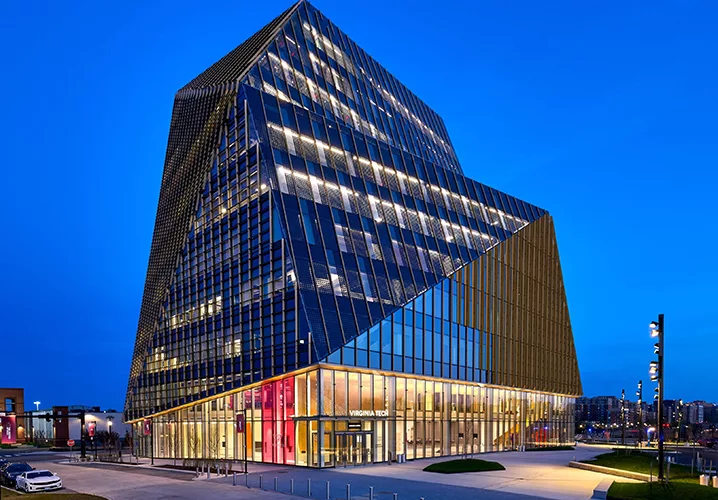
Electrification at Virginia Tech’s Academic Building 1
Virginia Tech’s Innovation Campus Academic Building One (VT ICAB-1) is designed to meet Alexandria, Virginia’s district-wide environmental sustainability goals and Virginia Tech’s guiding principles for its 21st-century campus. These building systems emphasize low-carbon electrified design, with no on-site natural gas emissions, by leveraging other types of building systems to increase overall sustainability.
A key design feature is the gem-like building’s architectural facets, which were optimized for daylighting, glare and building-integrated photovoltaic (PV) output.
Advanced metering allows for monitoring and recording of energy use for the various load types throughout the building to track consumption and inform the effectiveness of sustainability strategies in reducing energy usage. The sophisticated electrical power monitoring and control system provides enhanced load management capabilities for system flexibility and energy savings, and limits electrical energy use when power is disrupted. The goal of the building envelope is to maximize the PV output consistent with the on-site renewable energy generation goals.
The building features a rooftop terrace and garden with PV shading, balancing outdoor amenity space with rooftop equipment yards for ASHPs.
In addition to ASHPs, the mechanical systems also include WSHPs. During the coldest times of the year when ASHPs have the lowest efficiency, the mechanical systems operate the ASHP in series with the WSHP to overcome efficiency losses and maintain overall heating capacity. Having WSHP available also opens the door to increased efficiency in the future.
In this case, the design team planned for future integration of a sewage waste energy exchange (SWEE) system as a source/sink to the WSHP. A SWEE system takes the residual heat from the sanitary waste stream (consistently around 70 F) and converts it to a source/sink option for the WSHP system.
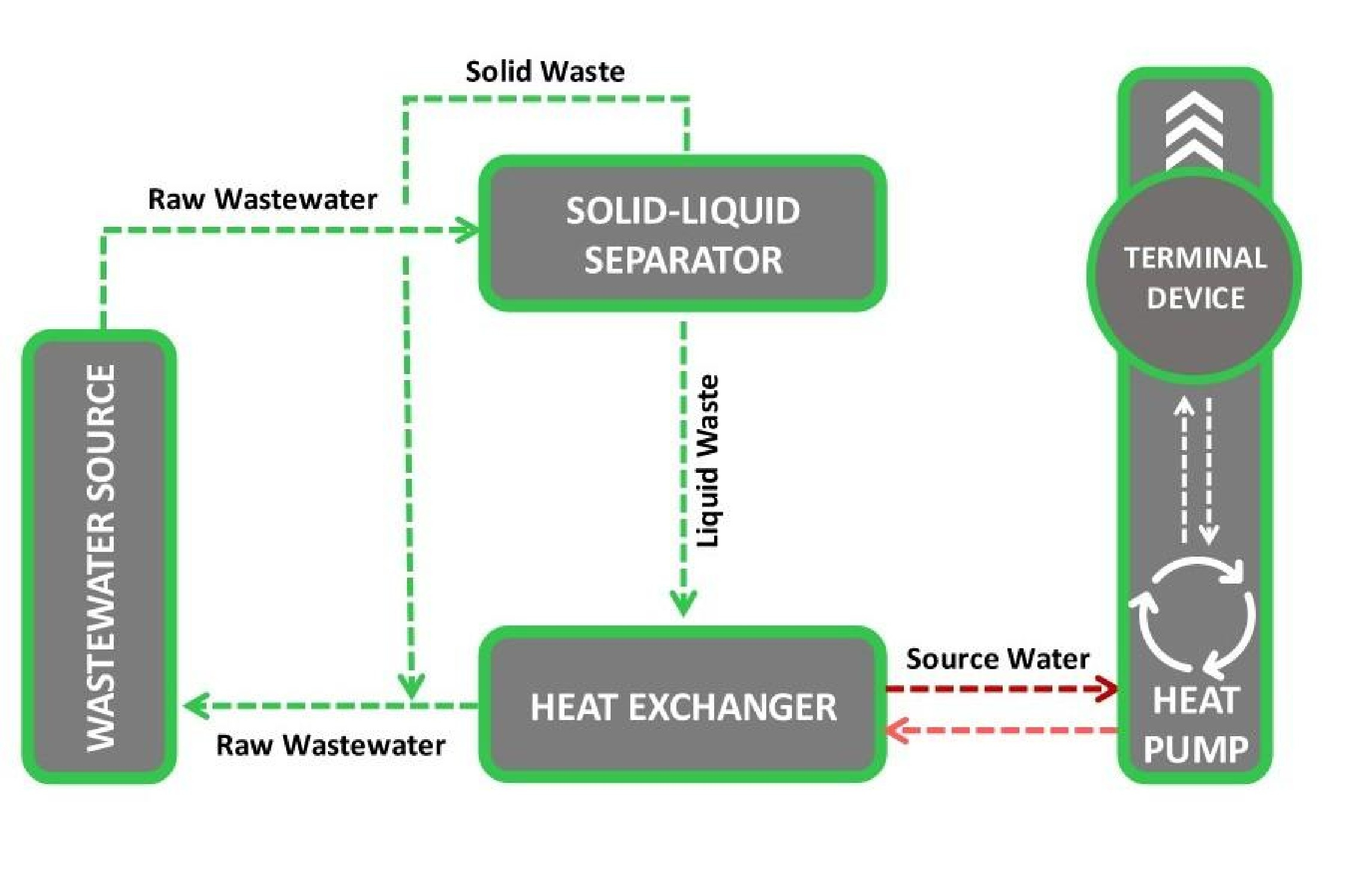
As other buildings on the site are constructed and the load on the sanitary waste stream increases and becomes more consistent, the VT ICAB-1 building’s mechanical systems become more efficient. Providing more detail on the system, the raw wastewater passes through a separator, removing solid waste and sending it back to the sewer.
The liquid waste then passes through a specialized water-to-water heat exchanger, transferring thermal energy to or from a separate clean fluid stream. The now hotter (or colder) sanitary waste continues down to the sewer and is replaced by incoming 70 F sewer flows to repeat the process.
The architectural and engineering design industry continues its trend away from natural gas systems toward electrified building system solutions. At the same time, improvements in technology allow for increased energy efficiencies that come from the sharing and recovery of energy. This combination is redefining how modern buildings operate within their environment to limit waste and balance resources within the building.
Lhymwell Manalo is a plumbing designer at SmithGroup’s Phoenix office. He is a member of ASPE and has more than 9 years of experience designing plumbing systems for a variety of building types.
Anthony Winning is a registered electrical engineer at SmithGroup’s Denver office. He is affiliated with numerous industry organizations, including IFMP and ASHE, and is an advocate for integrated systems engineering. Over his 12-year career, he has supported projects ranging from residential to healthcare and other mission-critical facilities.



