Last month, we discussed the importance of performing emergency flushing and disinfection when Legionella bacteria are suspected or confirmed in a building’s water system.
Since last month’s column, there have been several reports of Legionnaires’ disease outbreaks around the country. Notable cases were in Michigan, Ohio, the U.S. Virgin Islands and New York City. A significant outbreak was reported in NYC’s Harlem neighborhood, and another outbreak in the Bronx. As of this writing, the outbreak in the Harlem area has reported approximately 114 people who have been diagnosed with Legionnaires’ disease and seven deaths. There were also two reported cases in the Bronx neighborhood.
In larger cities with a high population density and large buildings with complex water systems, aerosolized water can easily infect humans. If a building system is not monitored and maintained to control Legionella growth conditions, the potential for contamination of many people is possible (see Table 1). Legionella bacteria can be transmitted to humans through aerosolized water mist from contaminated cooling towers, showers, sinks, decorative fountains and hot tubs, as well as other sources of bacterial growth.
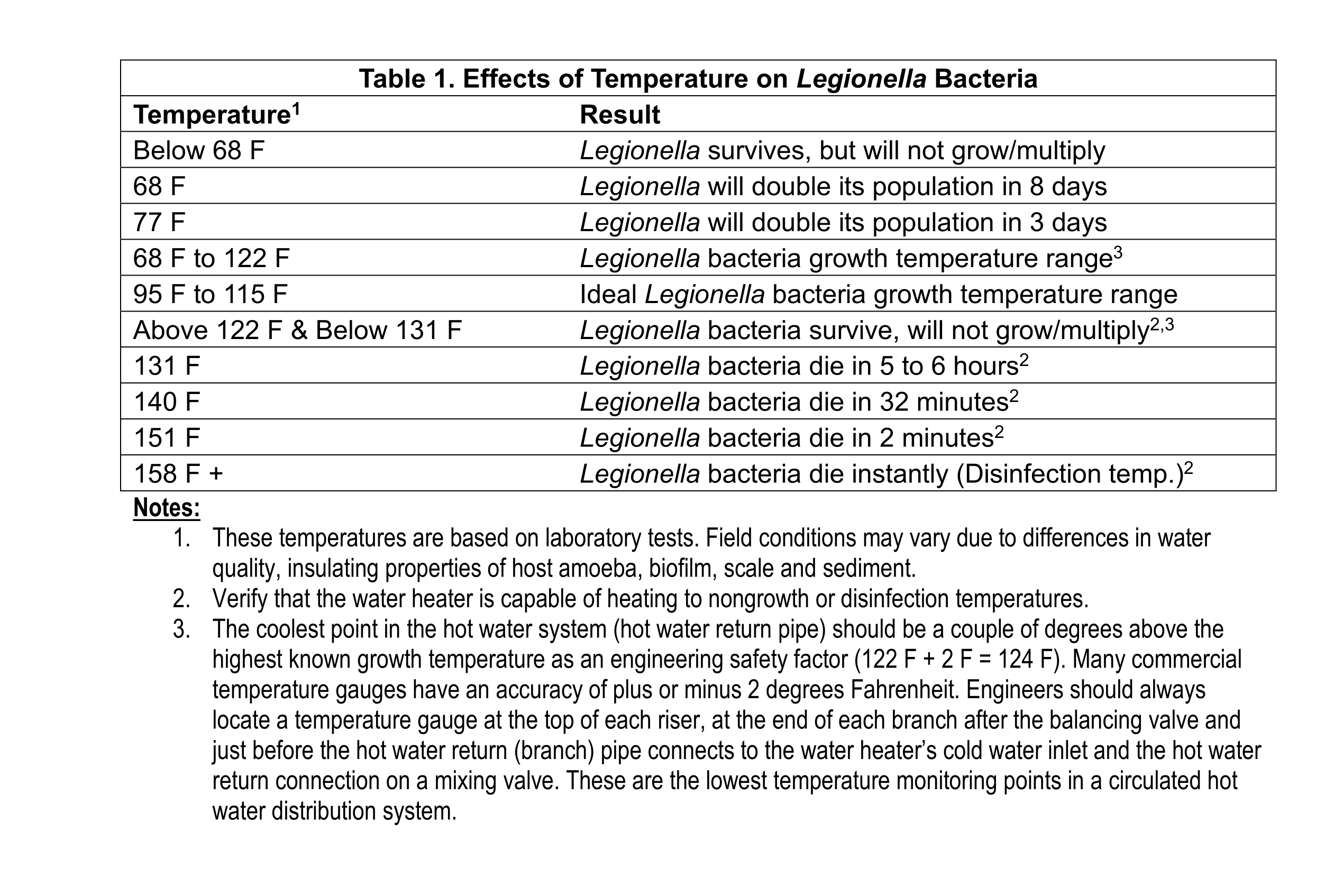
Each year, as water temperatures rise in the summer months, bacteria can grow rapidly. Chlorine in the water utility pipe can dissipate to levels that are ineffective at controlling bacterial growth.
When a positive test for bacteria or a possible case of Legionnaires’ disease is associated with a building, the owner or water management team should implement an emergency flushing and disinfection protocol. The protocol should include notifying health officials if they are not already involved. The owner should hire a qualified Legionella remediation contractor to assess the building water systems and help develop a remediation plan as part of a water management plan or an emergency response plan (ERP).
The ERP should include a risk assessment and documentation of the building water systems. The ERP should also identify where to take Legionella samples and water treatment chemical residual tests before any flushing and disinfection takes place, as a baseline. Then it should cover taking samples and tests from the same locations after flushing and disinfection for comparison or validation.
A variety of resources are available to assist owners, operators or water management team members in developing water management plans to help control the risk of bacterial growth in their building’s water system. These include ASHRAE 188: Legionellosis: Risk Management for Building Water Systems and ASHRAE Guideline 12: Managing the Risk of Legionellosis Associated with Building Water Systems.
The Centers for Disease Control and Prevention (CDC) has several resources covering Legionella and water sampling and developing water management plans. One good source is the CDC toolkit, “Controlling Legionella in Common Sources of Exposure.”
When a building has no water management plan and no emergency remediation plan for what to do after notification of a positive test for Legionella in the building or a case of Legionnaires’ disease from a building tenant or visitor, an owner can suddenly become overwhelmed.
The following is a checklist owners, operators or water management teams can use to develop a customized emergency flushing and disinfecting protocol or as part of a water management plan to quickly respond to Legionella bacteria in their building water systems.
Flushing of a building water system is a necessary part of the disinfection process. It must be performed before and after disinfection chemicals are added as part of the disinfection process. Flushing may also be performed without the addition of chemical disinfectants if postflushing Legionella sampling and testing is done to validate the system is free of bacteria after flushing.
To properly perform an emergency flush and disinfection of a building water system requires documenting the process. The owner should seek professional help as well as advice from the local health department for an emergency remediation procedure. Some state or local jurisdictions offer sample emergency response plans to follow.
Remediation action items prior to flushing and disinfection operations
The steps to consider for emergency remediation of a contaminated building water system should include some or all of the following, depending on the building and the occupants:
1. Notify local health department officials and ask for their assistance with the process.
2. Consider hiring a professional consultant specializing in emergency remediation to take water samples and develop protocols for flushing and disinfecting Legionella bacteria from building water systems. The consultant should perform the preflushing, disinfection and postflushing as part of the overall emergency response plan.
Contact a laboratory approved for testing Legionella samples; the CDC has a list of approved labs. The lab can overnight the sterile bottles and swabs to you or your consultant. Early in the process, it’s important to notify the lab as soon as possible that you will be taking samples and overnighting them to the lab so staff is available to receive and perform culture testing the following day.
3. Check with the authorities having jurisdiction for any requirements.
4. Determine if the Legionella contamination is a risk to building occupants and if evacuation of occupants during the flushing and disinfection operation is necessary.
5. Determine the possible health risks for all building occupants. This includes using high-temperature water that can cause scalding or the release of aerosols that may contain Legionella bacteria, among other risks. If occupants can be exposed, do not perform the procedure in an occupied building. If occupants are at serious risk, consider evacuating the building.
6. Consider temporarily using bottled water if the facility is not evacuated.
7. Consider water filters that will filter Legionella. (This is an expensive, temporary solution.)
8. If emergency flushing and disinfection are to be done in an occupied building, see if there is an ideal time to perform the remediation.
9. Develop an informatory letter notifying and warning of the possible bacteria in the building water system. The letter should give directions to occupants about not using water from the building’s plumbing systems. The letter should explain the steps to be implemented for disinfection by the water management team and remediation professionals. Consider follow-up progress letters or meetings with residents to keep them informed.
10. Determine any water-use restrictions/signage warnings to post during the emergency flushing and disinfection procedures, such as signs posted that say “Out of Service” or “Warning — Do Not Use.” Follow lock-out, tag-out procedures as required by the OSHA.
11. Determine what building water systems need to be disinfected.
12. Determine how long the total remediation process will take, which includes:
Notifying and meeting with health officials.
Checking with the water utility to verify treatment chemicals in utility water.
Securing a remediation contractor.
Developing a plan for the overall emergency flushing and disinfection procedure.
Adding flushing hose valves in the water service piping if needed.
Before flushing take Legionella samples..
Before flushing take water treatment chemical residual samples.
Perform predisinfection flushing of all branches and mains (minimum of three times the system volume).
Setting up disinfection chemical tanks, pumps and injection equipment near the building water service entrance.
Establishing disinfection flow rate and concentration to fill the system with disinfection chemical levels in accordance with Table 2.
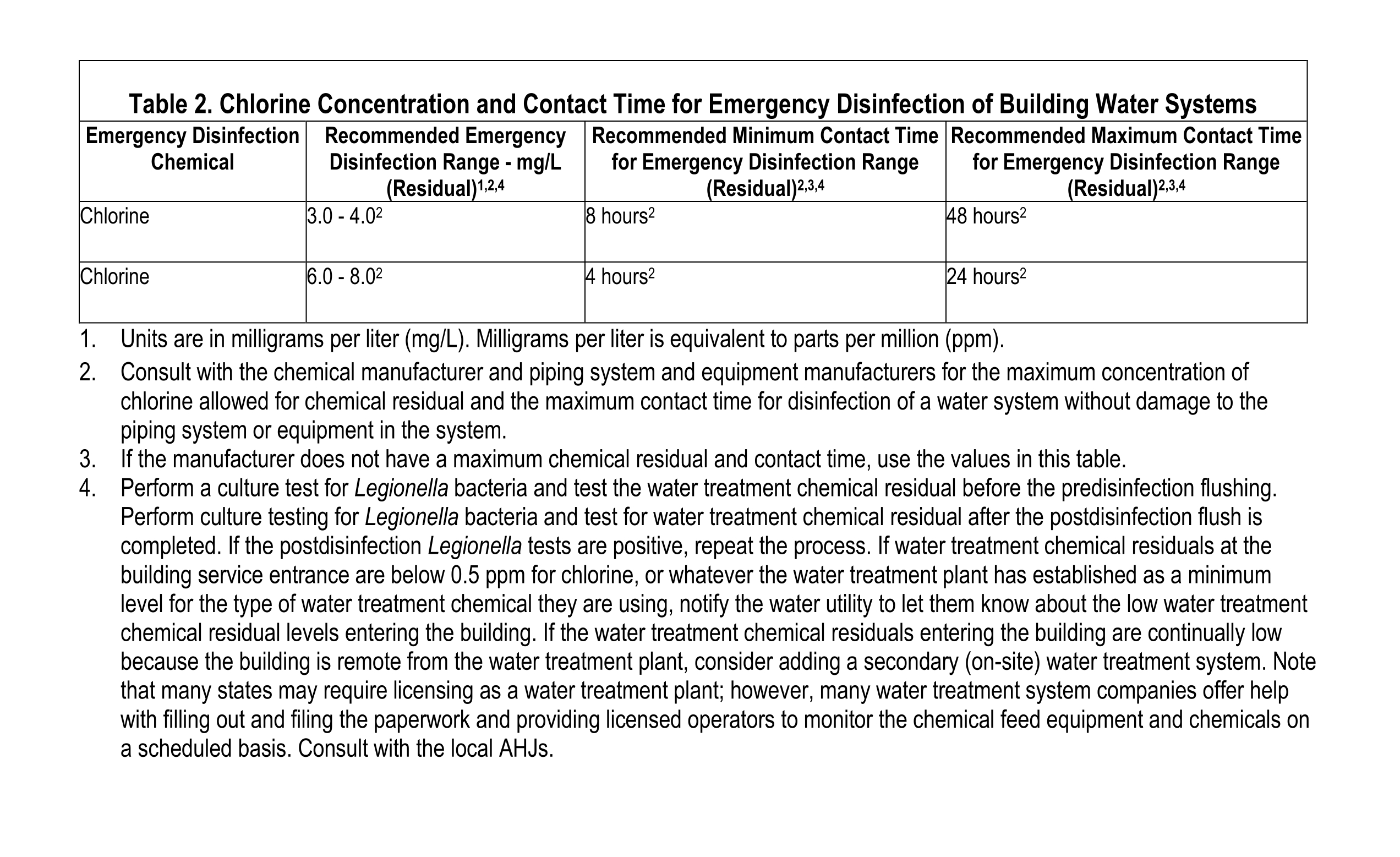
Establish minimum disinfection contact time when the target disinfection chemical concentration reaches each fixture.
Postdisinfection flushing (after contact time has been met at all fixtures/branches).
Postflushing Legionella sampling at the same fixtures (for comparison with predisinfection samples).
Postflushing chemical residual testing at the same fixtures (for comparison with predisinfection chemical residual testing).
Cleaning time/disassembly of disinfection tanks, pumps and equipment.
Including overtime or shift scheduling if this is a continuous operation that may take days or weeks to occur in larger buildings.
13. Confirm water utility treatment chemical(s).
Note that in some cases, the source water may contain high levels of Legionella. The problem may be in the municipal water mains, where fire flows or water main breaks may disrupt biofilm in the municipal water system pipe, allowing high levels of bacteria to enter a building. In other cases, the source of high numbers of Legionella bacteria is that conditions in the building are ideal for bacterial growth, allowing the bacteria to grow rapidly.
These are the steps that must be taken prior to disinfection. Next month, we will continue with the steps to take during the predisinfection flush, disinfection and postdisinfection flush operation.





