
Acoustics refers to the qualities of a space or building relative to sound transmission. Performing arts theaters are designed to limit external noise transmission and to enhance the transmission of sound from the stage to the audience.
As it relates to buildings and building systems, the term acoustics most often refers to noise control. Noise sources can be external or internal, such as isolating freeway noise in an adjacent building or limiting noise from the gym in an office sharing a common wall. The control of noise in buildings can be either active or passive.
Passive noise control comes through the design and selection of building elements. Using dual-pane windows, for example, not only improves the thermal envelope but also helps reduce noise intrusion from the outside. Adding soft surfaces (such as carpet and acoustic ceiling tiles) within a space helps to dampen internal noise generation from people and equipment.
Avoiding transfer openings between spaces or providing offsets with dampening materials helps mitigate sound transmission. Direct sound transmission is difficult to control, but the use of barriers and offsets forces sounds to reflect off surfaces and lowers their intensity. Combining this approach with soft surfaces further enhances this effect.
Arizona Public Media’s new home
Acoustic noise can be a nuisance and can be found in residential houses and commercial buildings. Some spaces, such as conference rooms, auditoriums, performance halls and recording studios, require a higher level of acoustic control compared to other areas.
For some programs and spaces, such as Arizona Public Media (AZPM), the public broadcasting service of the University of Arizona in Tucson, having proper acoustics is critical. A new 61,500-square-foot building will house a mix of collaborative, administrative, production and editing spaces outfitted with the latest technology to facilitate the next generation of media.
The studios will host audiences for program production, community forums, program screenings, lectures, special events and community gatherings. A large community conference space seating 40 to 50 people will provide an environment for the collaborative exchange of ideas and be an asset to the community.
Radio, podcast, talk show, performance and flash studios, along with their associated control, editing and postproduction spaces, are outfitted with state-of-the-art broadcast systems to create high-quality media. These spaces are designed to be acoustically isolated but with proximity to the staff work areas to aid in efficient operations.
These spaces also provide real-world learning experiences for students, featuring the most up-to-date equipment, to help prepare them to become the next generation of media leaders.
Isolating noise at the source
When acoustics is referenced in the context of building mechanical and plumbing systems design, it is often implied that the mechanical and plumbing systems are generating objectionable noise. White noise often refers to higher-frequency HVAC air noise typically originating in air outlets. If the white noise is consistent at a lower level, it can boost privacy by masking the conversations of others.
Intermittent white noise, however, becomes more of an annoyance. The application of soft surfaces is a good way to isolate mid-to-upper frequency noise, which has shorter wavelengths. Lower frequency noise is harder to control, as the longer wavelengths may require local isolation at the source or other more robust means to limit transmission. Vibration is also a concern as it relates to noise and can be a mechanism to propagate noise from one area to another.
Assuming mechanical or plumbing equipment is the source of the noise in question, then the best way to isolate it is at the source. The closer that source is to the sound-sensitive space, the harder it will be to isolate.
A plumbing equipment room with an air-compressor adjacent to an open office is problematic. Even with a solid acoustic wall in between, noise can easily propagate through a door or vibration can travel through the wall assembly. If this same plumbing equipment room, however, were located at the loading dock, away from the open office, little if any noise treatment may be required.
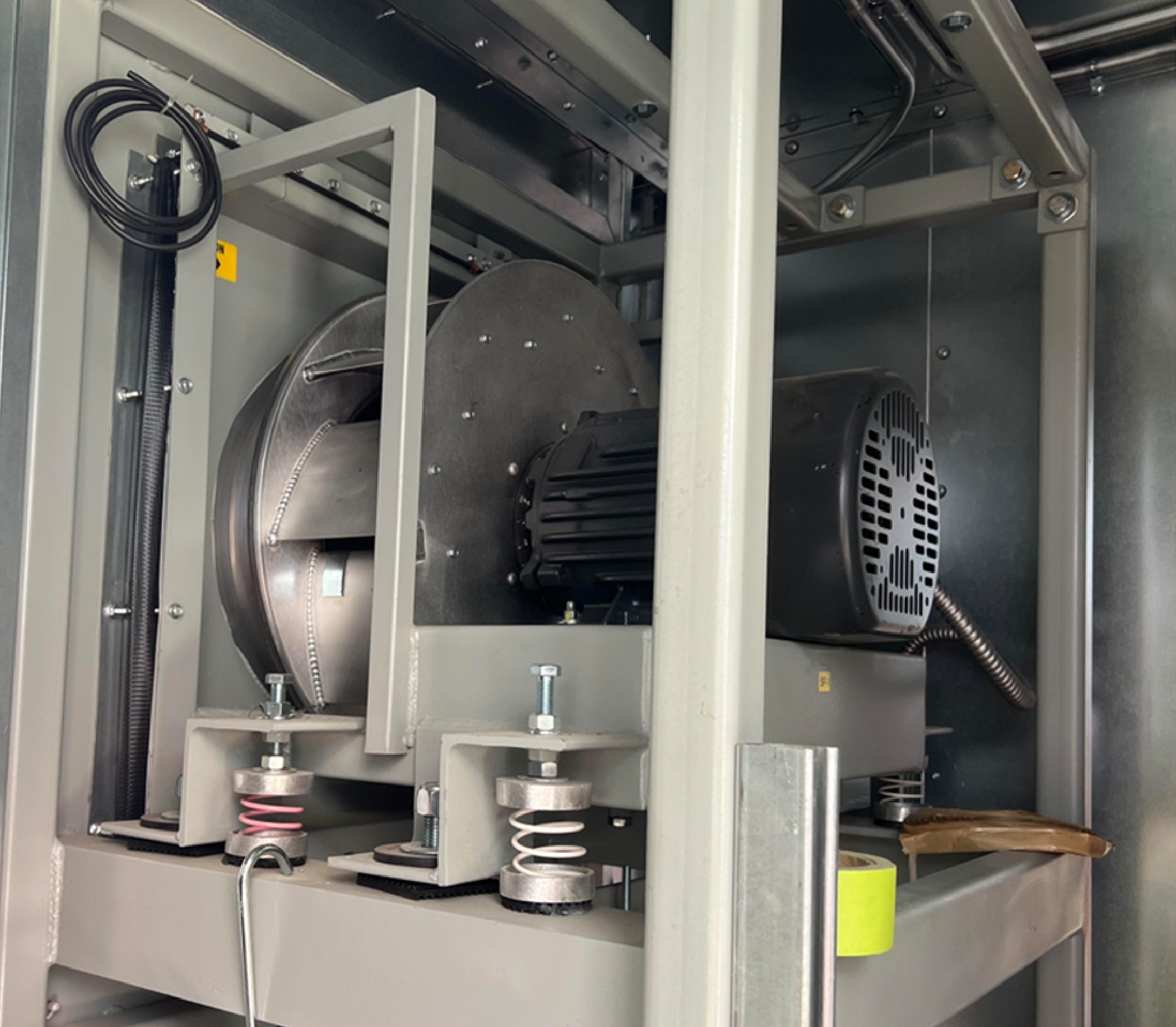
Vibrations can be transmitted through systems and infrastructure. A mechanical unit on the roof directly above a sensitive space, even if not directly serving that space, can transmit vibrations through the building structure, which can be felt below and become potential noise sources in that area. By adding vibration isolation to the equipment (such as fans and compressors), the transmitted vibration can be drastically reduced. Placing the same equipment on an elevated, isolated steel structure decouples the vibration from the space and removes direct adjacency to vibration.
Ductwork and plumbing piping
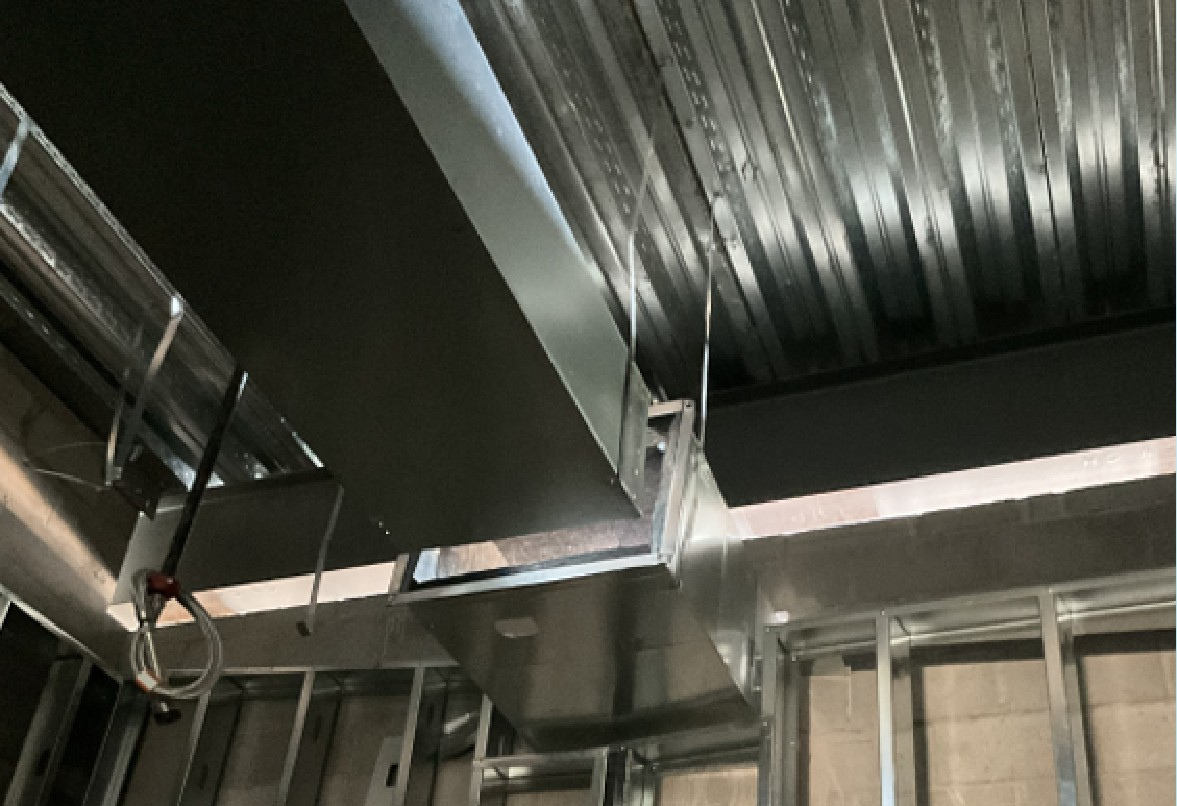
Mechanical noise can also propagate into sensitive spaces through ductwork and devices. A local mechanical cooling unit or airflow control device can generate noise. Locating these devices above a ceiling, or even better, outside of the space in question, can greatly improve performance. Selecting higher-performing air outlets at lower velocities also reduces mechanical noise.
If, after these approaches, the noise levels are still excessive, acoustic silencers may be added to provide the necessary isolation. Noise transmission has two components. The first may be direct and come through the infrastructure, ducts, etc., while another component breaks out through the system distribution, ductwork walls, etc. Aligning duct silencers with acoustic barriers can help control both aspects of noise transmission.
Plumbing systems can also contribute to noise generation. The most common acoustics issues in plumbing systems are caused by water hammering in the pipe and flow noise. Proper pipe sizing is critical, as an undersized pipe increases the velocity of the fluids, which adds flow noise. Less efficient duct or pipe fittings can also generate non-ideal flow conditions or turbulence, which can translate into increased noise.
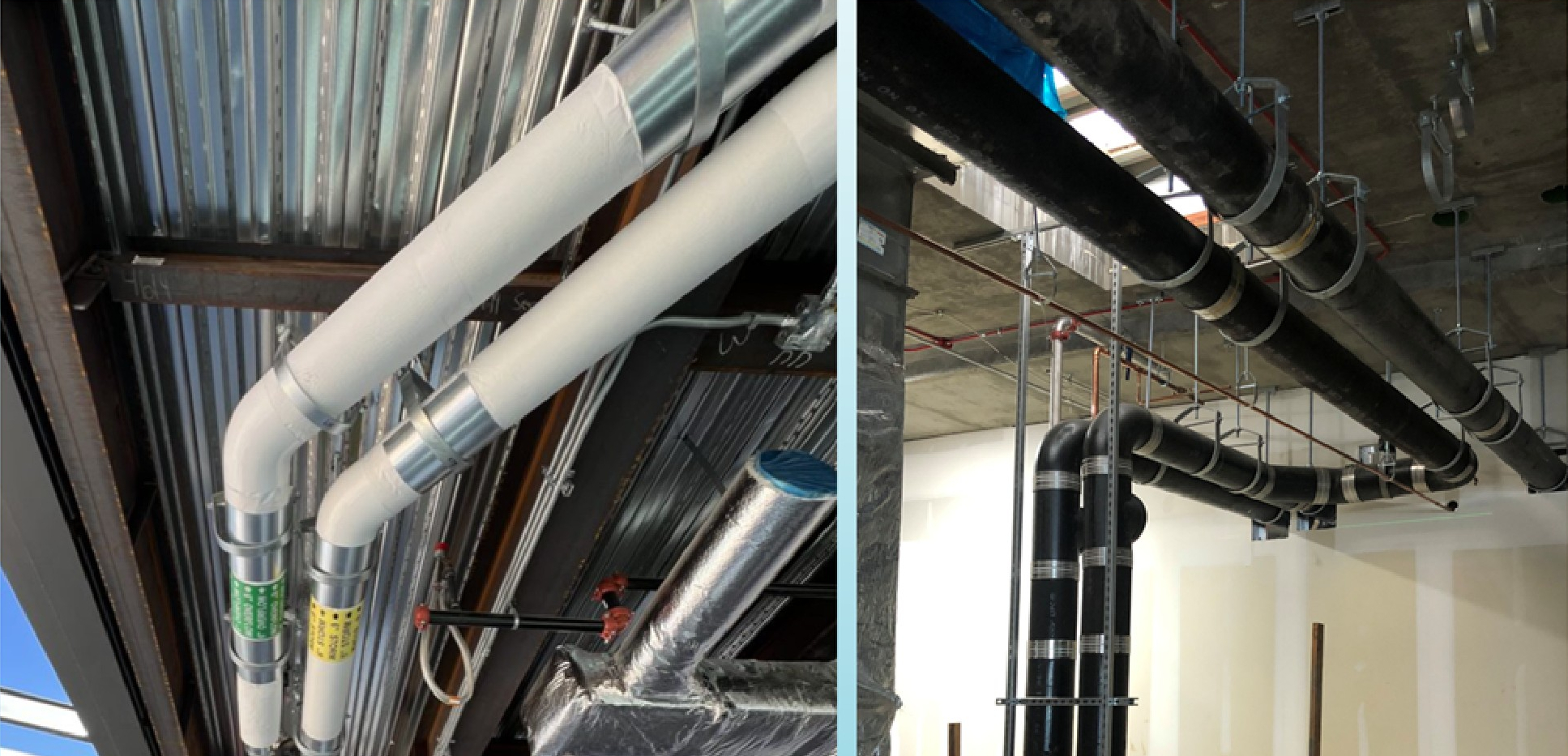
Pipe material can also impact the noise transmitted into rooms. Cast-iron pipe used in the storm drain system, with its thicker walls and increased mass, is less noisy compared to using lightweight PVC. However, if lightweight PVC is used or already installed, adding insulation to the pipe can help reduce the noise.
Strategic planning of the pipe routing is also important. When routing plumbing systems, it is essential that designers understand all the program spaces, adjacencies and functions of each room within the building. For critical noise-sensitive areas, mechanical and plumbing infrastructure should be avoided where not serving that space.
Beyond providing vibration isolation for mechanical and plumbing equipment, system designers also need to consider the infrastructure that extends from them. Flexible connections provide isolation of infrastructure (ductwork, piping, etc.) from the equipment, but this isolation should also extend to the use of spring hangers or neoprene isolators to further decouple system vibration from the structure.
These isolated hangers could extend up to 50 feet away from the equipment, depending on the sensitivity of the surrounding spaces.
Distance and isolation are the most effective means of providing mechanical and plumbing system isolation. Locating equipment in areas not sensitive to noise greatly simplifies the requirements for noise control, and speaks to the importance of collaboration with architectural partners early on to designate appropriate locations for equipment.
Similarly, by keeping system mains away from noise-sensitive spaces, designers greatly reduce the acoustic systems and equipment needed to properly isolate.
As engineers, we need to be vocal about expected equipment noise and vibration, as well as actively listen to identify noise and vibration-sensitive spaces within the building. When the design team understands both of these aspects, it can optimize placement and minimize the costs needed to provide proper acoustic isolation.
Lowell Manalo is the plumbing discipline leader for the western region at SmithGroup. He is a member of ASPE and has more than 20 years of experience designing plumbing systems for a variety of building types.
Robert Thompson, PE, is a mechanical engineer and principal at SmithGroup. His focus is on science, technology and forensics with an emphasis on sustainability and energy efficiency.




