It’s 4 p.m. on a sunny Friday afternoon, and you’re itching to get out of the office. Yet, in the back of your mind, the impending weekend shutdown of one of your biggest customers weighs on you. Suddenly, your email chimes with a message from the customer, addressed to you and the installing mechanical contractor: “Boiler Keeps Going Down — Need Help ASAP.”
Six months ago, you helped design a high-efficiency boiler system to meet your customer’s space heating and water heating needs. However, after visiting the site, the installing contractor found a heat exchanger leak, isolated the boiler and sent the heat exchanger to the sales rep for warranty review. More concerning is that the contractor also noticed that the temperature deltas of the other boilers were weak.
Luckily, the shutdown can continue, but the owner won’t get all the hot water he needs and, obviously, something detrimental is happening in this system. After a few anxious weeks, the heat exchanger pictures and report came back from the sales rep. You can’t believe the pictures, and worse, the claim is denied. The heat exchanger looks like it came out of the Titanic wreck.
It starts in the piping
More than ever, initial system cleaning and water quality are tantamount for heating system functionality, dependability and longevity. Unfortunately, today’s heating systems have a lot going against them to accomplish those goals.
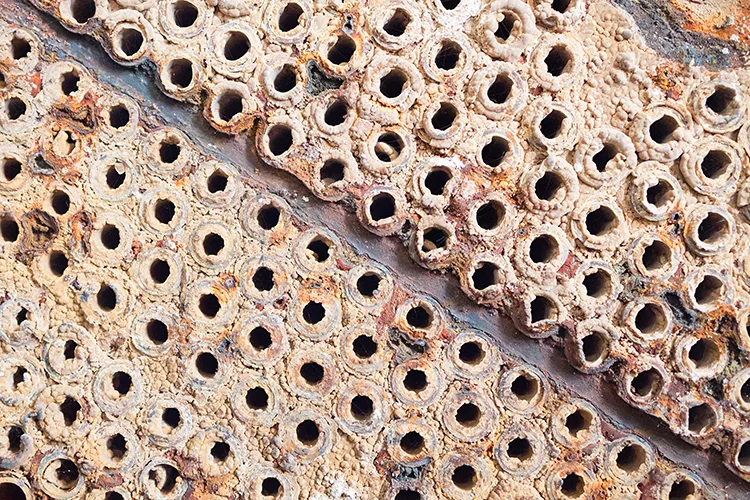
Contractors do everything they can to gain a competitive edge while bidding and, unless specified, they will bid the less costly import pipe and fittings. As someone who has worked both in HVAC wholesale and as a contractor, I can confidently say 9.5 out of 10 times, the import versions will have more rust, scale, slag and general internal debris than domestic ones. The pipe and fittings possibly originated from a dirty foundry and likely spent a few weeks or months on a saltwater boat ride (see Figure 1).
Next time you’re on a large jobsite, look inside some of the larger carbon steel pipes. During installation, additional weld slag, flux, Teflon tape/dope and deburring debris will make their way into piping as well.
As soon as water begins to flow, these nasty little items get hung up in heat exchanger passageways, balancing valves, pumps and air vents. It’s extremely important for all types of piping systems to clean this material out before the system starts up.
Hard as a rock
Now comes the problem you encounter after the installation is complete: hard tap water, which affects about 85% of Americans. Hardness is the sum of the calcium and magnesium concentrations, both expressed as calcium carbonate grains per gallon.
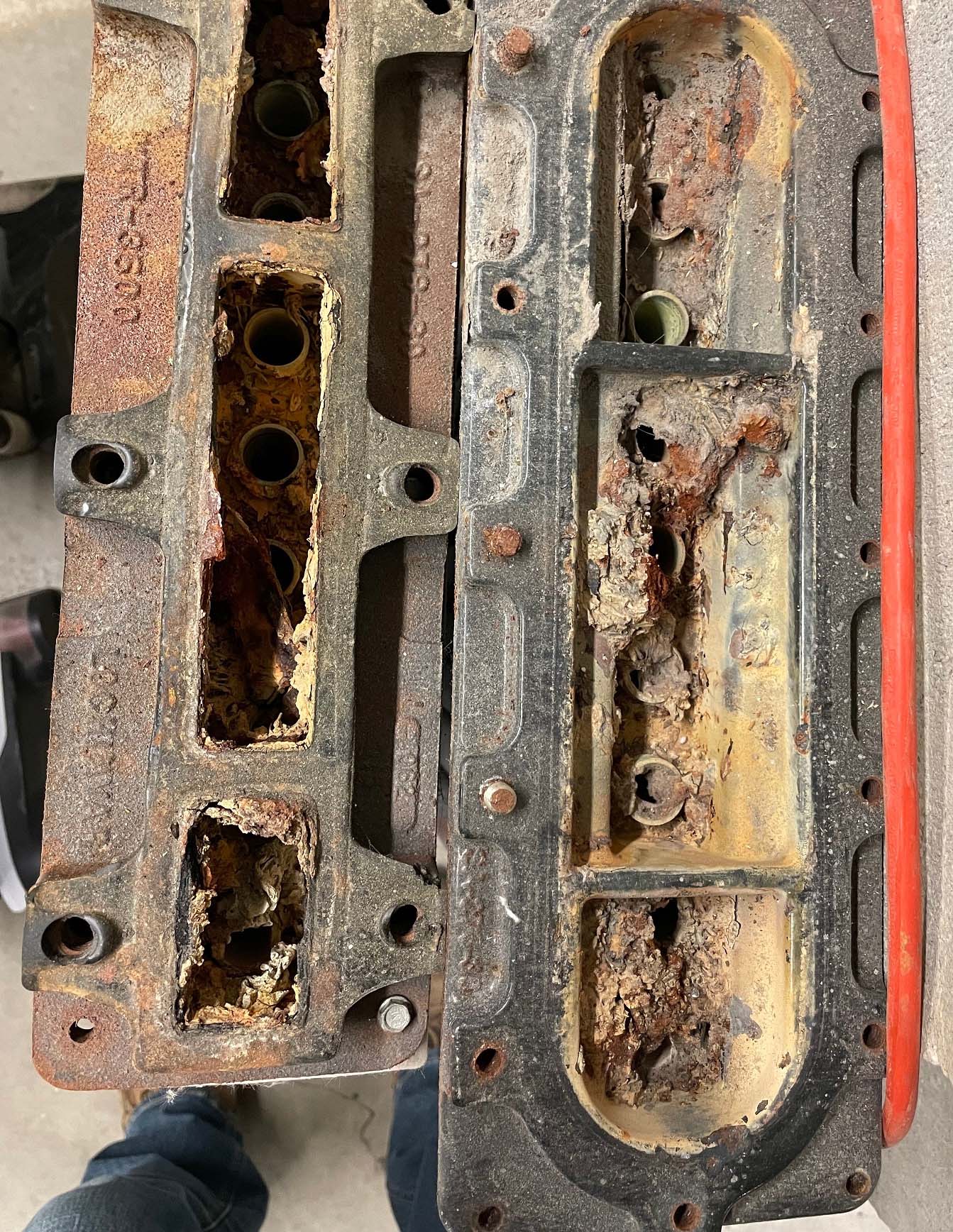
To maximize efficiency, heat exchanger waterways have become smaller, and the burners have been positioned closer to the heat exchanger surface. As these surfaces rapidly heat up, the calcium and magnesium come out of solution and build up on them. Every second the burner is operating, more and more of these minerals accumulate and create buildup inside the waterways (see Figure 2). Water volume, flow rate and heat exchange rates diminish until failure shows its ugly head.
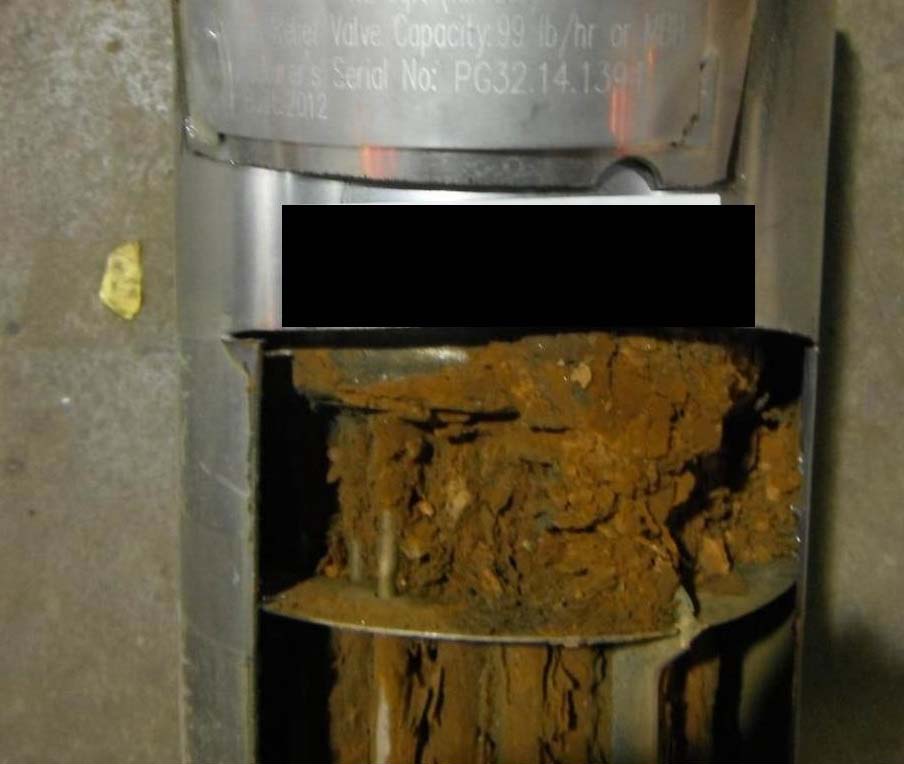
If the water quality is poor, this may only take months. This is especially true for open-loop systems, such as large condensing water heaters. In these units, a continuous flow of new water is always entering the heat exchanger, potentially packed with calcium and magnesium.
Plan for success
Preparation is key to addressing the potential water quality issue facing today’s heating systems. If the system is being filled with a glycol solution, ensure that it is diluted using demineralized water.
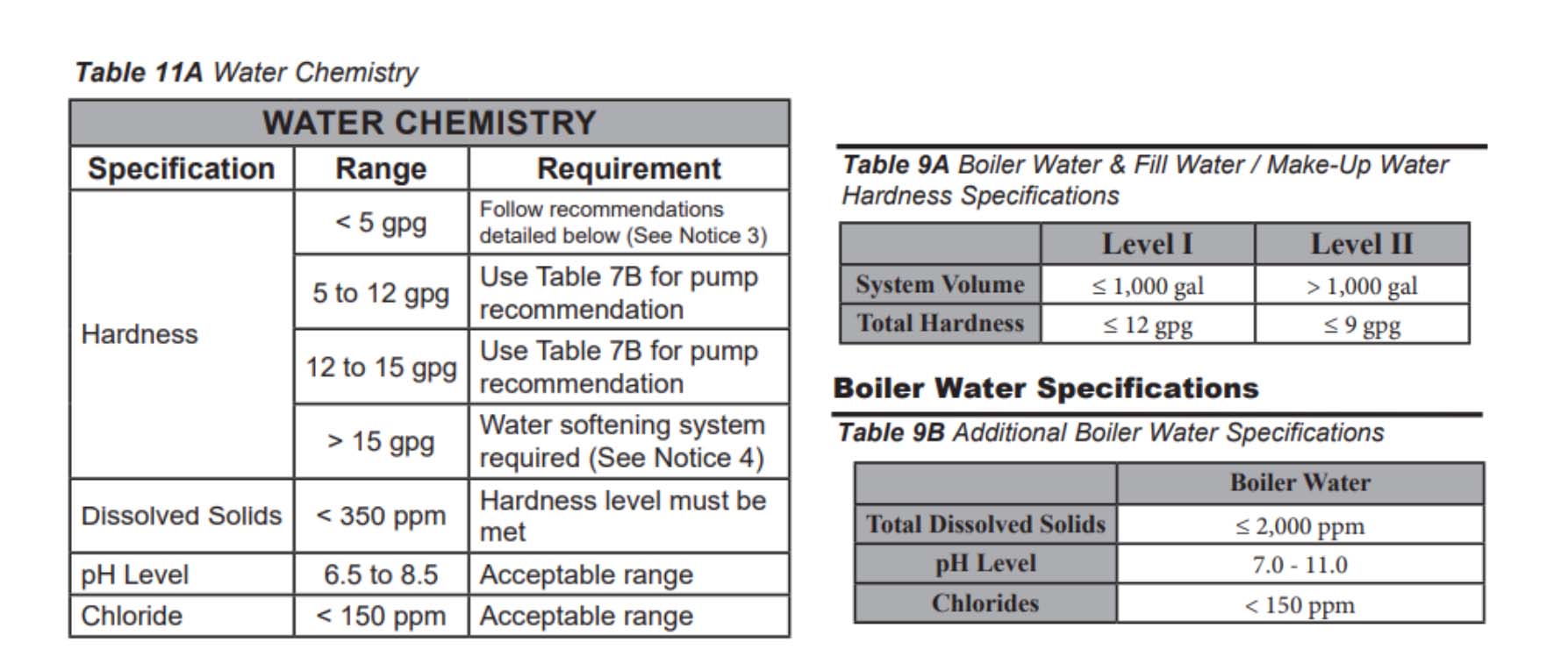
Whether you’re an engineer, contractor, owner or commissioning agent, always know the water quality you’re working with and what your system requires. The installation manuals for the heaters, heat exchangers and storage tank will be your guide (see Figure 3).
Total dissolved solids, chlorides (byproducts of chlorination), pH and hardness are important, whether the unit is a water heater or boiler. If you’re the engineer or commissioning agent, base the commissioning specifications on these values. If you’re the owner, ask the contractor to provide this information. If you’re the contractor, provide this information to save everyone headaches later.
A water quality test with these levels can be easily and inexpensively obtained prior to filling the system. Local labs, water softener companies, local plumbing wholesalers or even mail-in tests can provide great data on what to plan for.
Next, make sure the system is thoroughly cleaned out. Think of this heating system like your car’s cooling system. If grit and sand fell into the coolant while you were replacing it, you wouldn’t expect it to work very well, would you?
When planning for cleaning, the “how” and “with what” are important. I’ve seen many mechanical specifications calling for highly caustic system pre-cleaners, and no one is thrilled about using them. The odor they create is breathtaking; even diluted, the cleaner can turn your skin and eyes into soap if it touches either one of them (it’s called saponification).
It’s also difficult to pump into and drain from a system safely, hard to ship or transport, and typically not compatible with septic systems or wastewater treatment plants.
Engineers, please stop copying and pasting these hazardous caustic chemicals into project specs until you read the safety data sheet and instruction manual. No plumber or pipefitter wants to deal with them, and so, too often, it doesn’t get done. More chemicals are coming to market that use weaker acids to do the same thing, and they are also biodegradable.
You can also clean the system through physical action. In a typical cleaning scenario, systems are filled with hoses and a small transfer pump. While flowing water is good, turbulent water is even more effective.
Over the last few years, power-flushing carts have made their way onto the scene. Using hot water and high flow rates, the turbulent motion of the water helps push any debris to screens and works like scrubbing the pipe walls. If the system includes a pot feeder basket strainer or pleated filter, be sure to have one in place to catch the debris as it flows through.
After cleaning, drain the system down completely. To help remove the water, it may be helpful to fill the system with compressed air from one location and blow down drains under pressure at low points as it is quite common to see slugs of remaining cleaning water in low, trapped areas of piping.
Replace any pleated filters, dispose of any removable start-up screens (pump suction diffusers) and clean any wye strainers, dirt separators or magnetic particle separators. Now, the piping system is ready to go!
Your boiler likes clean water, too
Now comes the important part: ensuring that the lifeblood of the system put into action is clean and treated.
For water heating systems that do not meet the recommended parameters listed in the installation manual, consult with your local water treatment specialists. These contractors can help keep your water within the recommended parameters using filters, water softeners, water conditioners or multi-pronged, full-skid systems.
On the boiler side, things are a little more complicated, but if done correctly, it will last a long time. The main goal, no matter what the volume of the system, is putting in as close to a demineralized water state as possible. Not purified, distilled or ultra-pure, but demineralized.
A word of caution here: Both distilled and deionized water are considered corrosive to many metals, so ensure they are not accidentally used. For residential and commercial systems, there are some great options for using on-site water.
HVAC treatment manufacturers are now offering cartridge or cart-based demineralizers that connect to the on-site water supply with hoses. The one you pick will depend on the system volume.
Both options include digital or visual indicators to signal when they’re depleted. For large-volume systems, it’s more cost-effective to buy demineralized water in bulk from local chemical or water treatment companies.
Final water treatment is by far the easiest part. Many larger companies already contract water quality specialists to treat steam boilers and cooling plants. If your client does this, it would be prudent to bring these water quality specialists on board with the new system and let them handle the chemical treatment.
With water quality specifications in hand, they can tackle this thoroughly. Typically, this route includes a maintenance plan with bulk chemical purchasing and using a control panel with dosing pump.
If your client doesn’t contract for water quality, there are great solutions available from manufacturers that provide cleaners.
Whether using a water quality specialist or dose-it-yourself options, the goal remains the same: to protect the system with pH buffering and cathodic, anodic and organic corrosion protection.
With a little bit of planning and hard work, high-efficiency boiler and water heater systems can provide years of dependable service. Starting the system’s life with clean piping and water will go a long way.
If you have questions, any boiler or water heater representative would much rather speak with you now than when dealing with a malfunctioning heat exchanger.
Andy Williams is a piping system designer and project engineer at Aldag Honold Mechanical in Sheboygan, Wisconsin. He completed his bachelor’s degree in environmental science at UW-Green Bay and is registered in Wisconsin as a Designer of Engineering Systems. His specialties are in-floor heating, boiler system design and renewable energy systems.