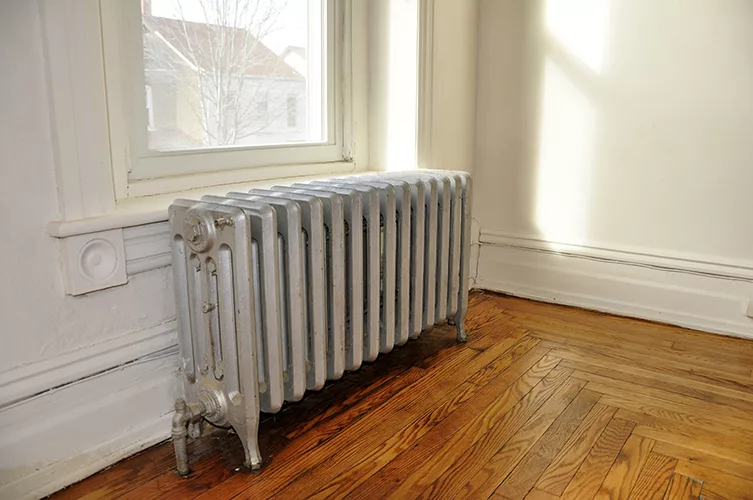
I have often been called to solve steam pipe banging problems in New York City buildings. For example, in one 82-unit complex on East 29th St. in Manhattan, the steam pipe banging problem could not be solved by implementing changes to the steam system, which would be the normal way of solving the situation.
The apartment complex was built in 1910; the total area of the two separate but adjacent buildings was more than 25,000 square feet, subjecting the structure to New York City’s Local Law 97, which requires dramatic reductions in energy by the year 2050.
System deficiencies
Yogi Berra once said, “We made too many wrong mistakes.”
Many system deficiencies were found in the steam system. These include:
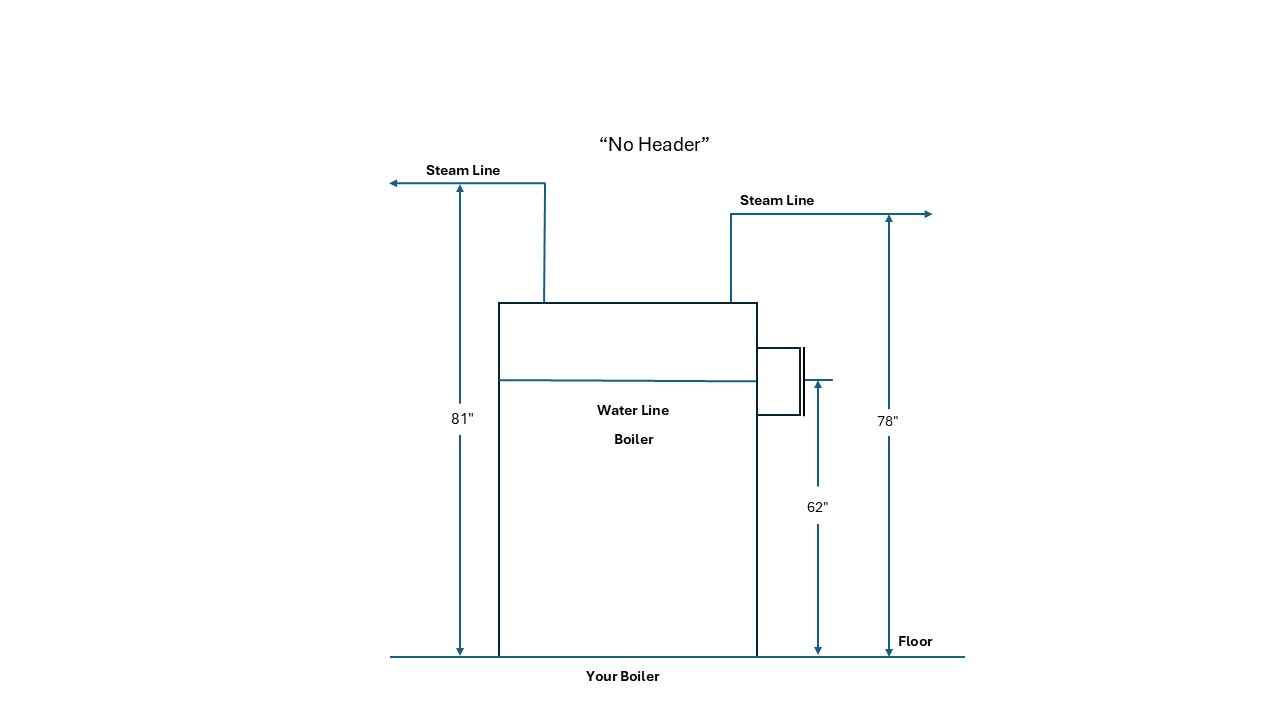
• There was no header above the boiler and no way to separate the condensate from the steam generated at the boiler.
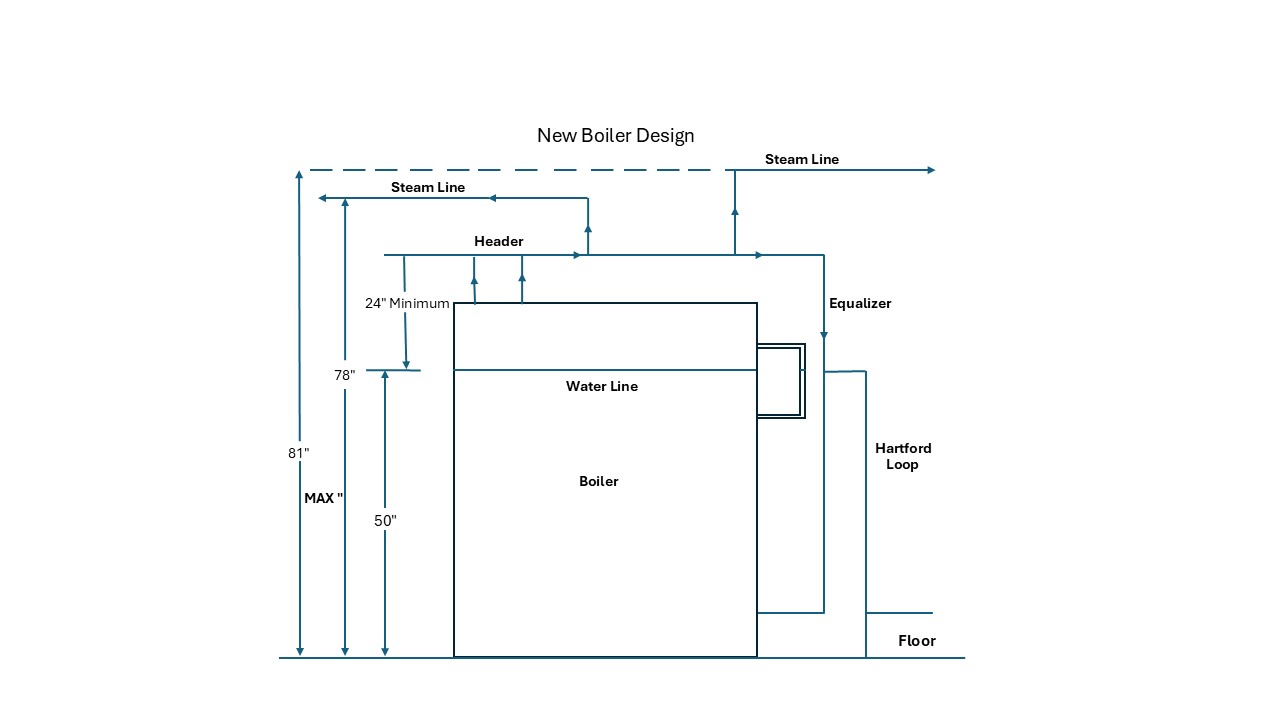
• No equalizer pipe was associated with the header.
• No Hartford loop was associated with the equalizer pipe.
• The steam lines came directly out of the boiler. They were supposed to be taken off the main horizontal steam header, which did not exist.
• Each of the two main steam lines, 4 inches in diameter, had a steam capacity of 589,680 BTU/hour or a total of 1,179,360 BTU/hour. The boiler produced 2,339,000 BTU of steam per hour. The boiler was oversized by a factor of 2.
• As a result of boiler oversizing, the steam velocity was excessive, blasting condensate down steam lines like a cannon, causing the steam pipe banging.
• The boiler water line was 62 inches above the floor (see Figure 1). The bottom of the two steam lines were 78 inches and 81 inches above the floor. Only 16 inches or 19 inches existed from the water line at the sight glass to the bottom of the steam lines. However, for proper separation of steam and condensate, it is supposed to be a minimum of 28 inches.
• If the steam pressure is too high, condensate backs up in the return lines. You put in condensate return pumps to solve problems, but you only put bandages on the system.
• Most one-pipe steam systems operate at pressures beyond what is necessary to heat a building. A one-pipe system usually only needs 0.75 pounds/square inch to operate.
• The boiler water line was too high; it should be 28 inches below the lowest main steam line. At best, it should be a maximum of 50 inches above the floor.
• The four main steam air vents on the main steam mains were probably defective.
• The steam and condensate pipe insulation is missing.
• Condensate lines are buried under the concrete.
• The fluctuating water line indicates violent water boiling, sending condensate into steam lines.
Recommendations
Greta Thunberg has said: “Change is coming whether you like it or not.”
Here are the six changes needed in this 82-unit building to address the pipe-banging problem and improve overall efficiency (see Figure 2):
1. Add insulation to the exterior building walls; the apartments feel cold in the winter because the walls are cold. A 5-degree difference exists between the interior surface of the exterior and interior walls in this building. All 82 apartments must be insulated from the interior by blowing insulation between the studs in the exterior walls.
This work can be done with several apartments at one time, what an insulation company can do in one day. It is easier when apartments are vacant. This work should be done before the heating season. Assuming a cost of $1,500 per apartment, the total cost is $123,000.
2. Replace the oversized boiler; a smaller boiler is needed with a water line less than 50 inches off the floor. It should be noted that more radiators may be removed after insulating the walls. I know of an apartment building in Brooklyn where all the radiators were taken out, and the building is being heated solely by riser pipes. Cost: $150,000 to $200,000, first-order estimate.
3. The sizing of the new boiler is related to the connected radiation load. The radiation survey of four apartments, when scaled up to the entire building, noted an attached radiation load of approximately 1,151,170 BTU/hour.
This present connected load is very close to the carrying capacity of the two main steam lines of 1,179,360 BTU/hour. No changes will be necessary to the main steam lines in the basement ceiling other than to connect to the new boiler. If the attached radiation load can be brought down to somewhere between 400,000 and 600,000 BTU/hour, the velocity of the steam in the mains can be reduced by 50% and steam pipe banging will never happen.
4. The building needs an entirely new condensate return system. I would recommend copper lines, as they never rust out.
5. Install a separate domestic hot water system. A variable-speed pump set up with a temperature difference of 30 degrees between supply and return temperatures will reduce steady-state heat losses (these pipes heat the building in the summer) and reduce electrical usage.
6. Two booster pumps pressurize the domestic hot water system. Consider putting in variable-speed pumps to reduce the water pressure to the lowest psi to pressurize the system.
Separate domestic hot water system
Before replacing the boiler, it is recommended that a separate domestic hot water system be installed to separate it from the space-heating main boiler. Separating the two systems allows one to install a much smaller boiler to heat the building.
For an apartment building with 82 units, you will need 800,000 BTU/hour of hot water to satisfy the demand when numerous tenants use hot water.
I would recommend two 400,000 BTU/hour Navien gas-fired condensing hot water boilers. The boilers are 95% efficient; two units are recommended for redundancy.
The location will have to be determined in the basement as well as the exhaust flue to the outside. Also, a location must be determined to drain the condensate produced from burning natural gas.
First-order cost estimate: $50,000 to $75,000; the filing fees with the NYC Department of Buildings and the NYC Department of Environmental Protection are not included.
When you encounter a heating issue in a building, one should take a holistic approach to the problem and come up with a solution that will not only solve the problem at hand but also cut energy costs in the long run. In these cases, it is worth the effort to retain an engineer who can perform the necessary engineering analysis and design work.
Daniel Karpen is a registered New York State Professional Engineer with more than 20 years of experience in energy and engineering consulting. His strong background in physical sciences and technology, combined with his knowledge of government procedures, provides a foundation for getting practical results quickly. Much of his work has been in developing energy conservation management plans in both the private and public sectors. For more information, visit www.danielkarpen.com.