Grab some popcorn! Let me preface what I’m about to write by saying that I understand we, as a nation, need to be on an even playing field with our global trading partners — or at least more even than it’s been over the past decade. I also admire the current administration’s desire to rectify the fiscal irresponsibility, corruption and egregious spending that’s pushed our national debt to $36.21 trillion. With all that said, I really question the methods currently being used to balance the budget.
Politically, I lean to the right, but voting straight party lines is one of many factors that’ve put us in this pickle. Hardline MAGA supporters will insist that the tariffs are 100% necessary. Admittedly, I’m no economist, but what I do know is that the tariffs make my job a lot harder. Tariff-induced price increases wouldn’t be so hard to account for if they were consistent.
To illustrate my point, on May 12, 2025, the United States and China published a joint statement announcing an agreement to temporarily reduce tariffs on each other’s products for 90 days. We are lowering tariffs on Chinese goods from 145% to 30%, while China will reduce its tariffs on American imports from 125% to 10%.
The political right sees this as a President Trump victory, while the left is convinced he backed down after realizing that the tariff battle was a losing war.
Regardless, the agreement de-escalates the trade war for now, but it only raises more questions. What happens in three months when this quasi-truce ends? Will it be honored by both parties? How do manufacturers, distributors and contractors account for this?
Pricing is up in the air
A pause does little to help manufacturers make long-term decisions. In fact, it only raises anxiety and increases the number of unknowns while quoting projects. That, specifically, is the biggest challenge for our industry.
I need to know the price of the products I’m selling. So does the manufacturer. Same for the supply house. Everyone is grasping at straws right now, and they’re employing different methods to stay out of the red.
Some manufacturers are taking the wait-and-see approach. Others have published notifications stating that they’ll simply pass the cost increases through. Still others have simply raised prices across the board. Which method they use is likely dictated by how much Chinese material is used to create the product they sell and how long the timeline is from raw material to shipping product.
One brand we install makes brass hydronic system components. It raised its prices across the board by 25%. That’s a big jump, but it is, at the very least, a constant figure that I can use to price a job.
The pumps we install have U.S.-made motors and injection-molded housings, but seals and other components are Chinese-made. Some fittings, pipe and other consumables are entirely Chinese. Many products that are 100% domestically produced are going up in price simply because foreign costs are increasing, which supports higher pricing.
As I’m sure you know, it’s not as simple as telling your estimator to raise prices (sans labor) by a certain multiplier.
This conundrum is exacerbated by the fact that my company insists on being 100% transparent with our customer base. It’s exceedingly difficult to provide accurate, fair pricing in a quote when the material expenses are subject to change by the week. Our suppliers, who used to honor a price quote for 30 days, will now only hold a price for either five or 10 days.
As a result, we’re now only honoring a quote for 10 days. We used to honor them for 30 days. We’ve also added language to our quotes explaining the need to pass through material price increases. We prefer this method over a blanket price increase.
This adds a layer of complexity to the customer’s budgeting and decision-making process, but it’s a burden we all share. Most customers understand and acknowledge this as a necessity.
Pay attention to fluctuating tariff news
The best advice I can provide is to double down on communicating clearly with your customer. Unless they live under a massive rock, they’ll have at least a vague idea of what’s going on and why your prices are subject to change rapidly. Be transparent and honest. It’s almost inevitable that, at this point, the conversation with the customer turns political. Be careful here. I don’t need to tell you that political conversations can be a minefield.
Second, check product pricing compulsively. We used to check supplier pricing once each month. Our office staff are now doing it weekly. Then, prices are checked again right before a quote goes out the door.
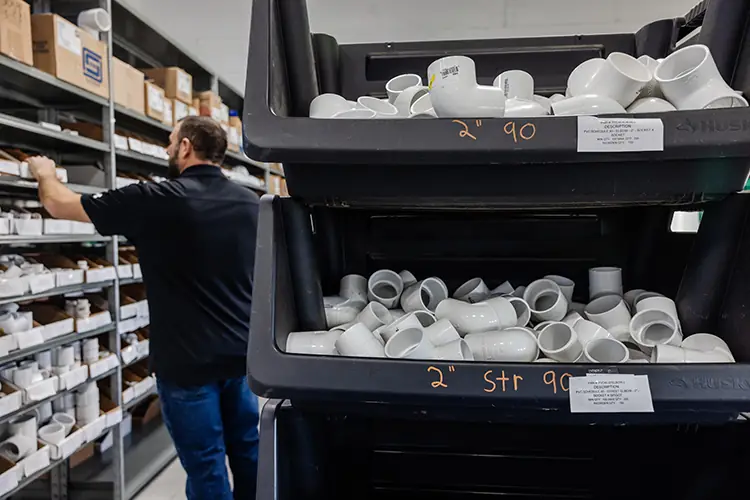
Finally, holding a deep inventory of consumable products may help flywheel you through rapid price changes. Eliminating 100 fittings and five pumps from the cost fluctuation challenges can go a long way. If you have inventory space you’re not using and cash to invest, filling those shelves with commonly used products during this 90-day tariff hiatus might be a good idea.
Then again, depending on what you’re buying, the recent trade agreement might not have any impact at the sales counter.
Stay abreast of tariff news. By the time you read this, everything could have changed a few times.