Now that we’re well into 2025, employers, large and small, are adopting return-to-office policies, calling remote workers back into the fold. Meanwhile, public and private spending on medical facilities is increasing. Investments focus on modernizing hospitals, outpatient centers and related infrastructure. And at the same time, real estate and construction costs are at an all-time high.
As a result, there’s never been a greater incentive to retrofit and upgrade existing space within the commercial real estate market. But with that opportunity comes the challenges of working within the constraints of an existing building envelope – or even an existing system.
This was the reality faced by Warren Systems, Inc., an HVAC contractor in Lapeer, Michigan, last year when they were chosen to replace a cooling system at an office and senior care facility owned by Lapeer County Medical Care, also in Lapeer.
Two large, 75-year-old air handlers supplied air conditioning to part of the 202-bed skilled nursing care facility, each containing a 35-year-old DX (direct exchange) cooling coil and a hydronic coil for space heating.
The boiler system was still serviceable, but the cooling system had aged out, and facility managers were looking for the most cost-effective form of replacement.
Lapeer Medical wanted to replace the cooling system in half the building immediately while also seeking a plan to retrofit the other half in the near future. Warren Systems, specializing in commercial HVAC work, have served Michigan and surrounding states for 20 years and were able to offer several options.
Fitting the budget
“Originally, we were asked to bid the project as a conventional VRF system, with separate indoor units for each room,” says Ben Warren, general manager, Warren Systems, Inc. “However, this didn’t fit the budget or the space constraints of the old building, so we took a closer look at the existing air handlers to determine if they could be paired with custom-made coils and a VRF DX Kit.”
Ben and his brother Landon, the company’s service manager, discussed the project with Scott Breimayer and Skylar Kaczanowski, technical service advisors at Johnstone Supply’s West Michigan location.
Warren Systems had retrofitted existing air handlers with custom VRF coils in the past, but not with Fujitsu’s AIRSTAGE equipment, which Johnstone Supply carries. That said, they had used AIRSTAGE VRF equipment enough in the past to be confident in the equipment and the support they received from Johnstone.
“Warren Systems does great work and does not often require assistance from us,” Kaczanowski adds. “You give them instructions, show them once and they take it from there.”
But given the custom nature of this project, all involved wanted a sounding board.
“We brought Wayne DeCosa, Fujitsu applications engineering manager, into the conversation,” Kaczanowski adds. “We had a few questions about function settings and unit operations, and he can always answer questions quickly.”
The proposed retrofit was not only feasible, but it also reduced the upfront cost by 30 to 50 percent compared to a conventional VRF installation. Removing indoor heads from the equation eliminated the need to install hundreds of feet of copper line set, so the DX approach also eliminated all mechanical work within the occupied space.
Careful design
“We had an air balance test conducted on all 10 zones and checked the capacity of the existing coil,” Ben says. “Using those specs in Fujitsu’s Design Simulator gave us the proper VRF equipment. After that, we had a custom, four-circuit interlaced coil built for the project by Coil Replacement Co.”
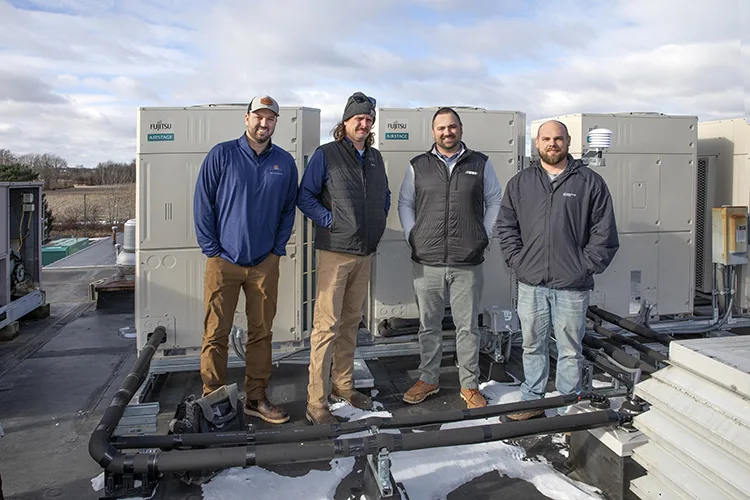
Four, 10-ton AIRSTAGE VU-V condensers were specified for the 40-ton mix coil. This provided redundancy without the need for dampers.
By using Fujitsu’s DX Kit, coils can range from 1.5 tons to 14 tons per unit. Installations can be modular, with multiple large coils, which Warren Systems needed at Lapeer Medical.
“We found that the existing blowers – both the supply and return fans – in the big air handler were in good shape, but they needed new drives to accommodate the four DX Kit circuits,” Ben adds. “We installed VFDs on each fan to modulate with the VRF system.”
This approach didn’t require an upgraded control system. Before the retrofit, the system simply called for stage one or stage two cooling to the condenser. The only change needed to the controls was how the system is operated.
“Because the VU-V system is set up for demand, we had to add an operational setpoint on the Fujitsu side,” Kaczanowski explains. “This tells the VRF condensers how hard to run. The control system still uses a discharge setpoint temperature, only now a 0-10v signal is used. I completed this in a single day working with a controls company.”
Install and support
Installation work took the Warren Systems team two weeks in the spring of 2024. The four VU-V condensers are installed on the roof of the building. Hail guards were added to the condensers to protect against Michigan’s harsh weather.
The new custom coil was installed within the large air handler, downstream of the existing hydronic coil. While the AIRSTAGE system is not sized for the full heating load of the building, it can be used in place of the boiler system depending on outdoor ambient temperature, or as a source of emergency heat if the boiler system fails.
After commissioning the system with Kaczanowski, Landon confirmed that the new coil provides discharge air temperatures ranging from 50 to 58 degrees.
“I used to work for a VRF manufacturer,” Landon adds. “Most contractors want to install what they know instead of taking a chance with something new. My advice is to get on the phone with people who can support you. They may have a better, easier, more profitable solution, and most importantly – one that will result in a happier customer. If you can’t get that level of support externally, look elsewhere or bring that expertise in-house.”
Ben adds: “We’ve done a lot of VRF projects in the past and have learned some hard lessons due to lack of support from the distribution channel. Fujitsu partners with the right people. Johnstone provided outstanding support throughout this entire process. That’s why we work with them.”
Further improvements
“The existing system was pretty crude, which comes as no surprise considering its age,” Ben says. “The hot deck/cold deck system worked in such a way that the hot water coil was constantly circulating, even when cooling was called for. We installed a shutoff valve that communicates with the heating circulator so that the loop goes cold in cooling mode.”
As with any medical facility, there’s an extreme demand for fresh air and filtration, and that load is constantly changing. The fresh air intake and exhaust louvers are downstream of the return air plenum. Warren Systems installed enthalpy sensors, allowing the air handler and VRF system to accommodate the increased load of the makeup air.
“There’s a minimum fresh air setting, as you’d expect, but we can also draw 100 percent filtered outdoor air to economize,” Ben explains. “From what we’ve been told, Lapeer Medical’s energy savings is astronomical. It’s hard to quantify because the building is very large with only one meter, the second air handler hasn’t been retrofitted, and data from a full year hasn’t been collected and scrutinized yet. However, the customer has been thrilled with the energy reduction and improvements in comfort.”
Next steps
The new cooling system at Lapeer Medical operated flawlessly last summer, but there’s work yet to be done. Warren Systems is currently designing a similar, though smaller, system for the remaining portion of the building. The plan is to retrofit the second air handler later this spring.
Once that’s complete, Warren Systems will remotely monitor the VRF systems via Fujitsu’s AIRSTAGE Cloud, a cloud-based BMS that includes monitoring, management, and maintenance of all Fujitsu products and select third-party equipment.
“This project demonstrates the flexibility that can be achieved when you couple an excellent rep with an excellent contractor,” DeCosa says. l
Dan Vastyan owns Delta C, LLC, a small communications firm focused on the plumbing, HVAC and energy industries. He can be reached at [email protected].



